
An Empirical Survey of Cultural Coexistence, Conflict, and Partition (1925–Present) Do cultures mix — or do they coexist, fracture, and separate under pressure?
By Gerald Bratley MCIEx
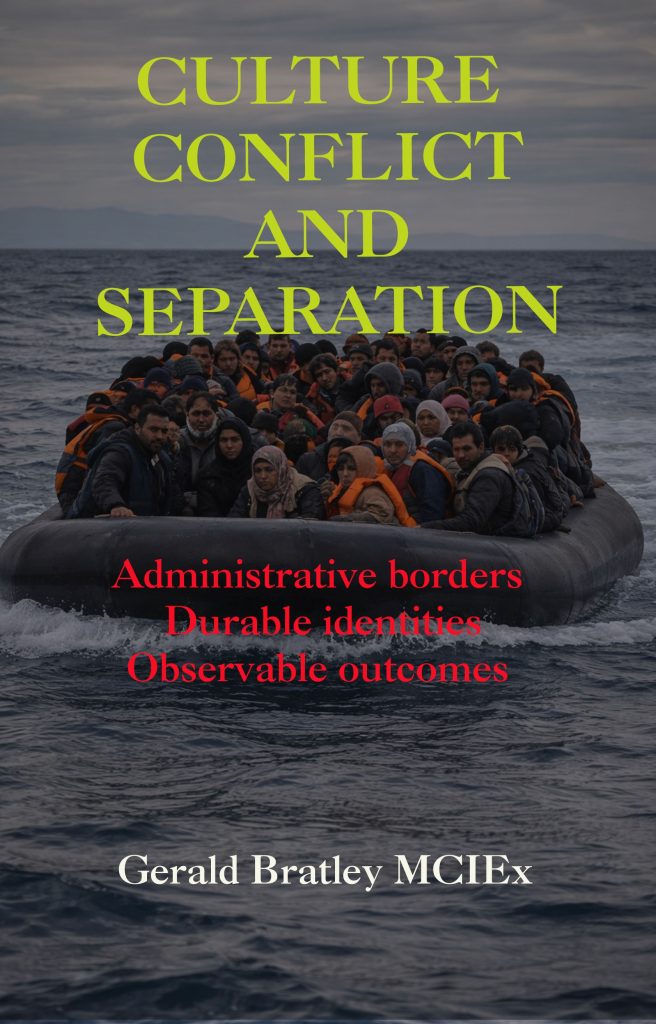
Do distinct cultures integrate into a shared identity—or do they coexist, fracture and eventually separate under pressure?
During the past century, borders have repeatedly been drawn, dismantled and redrawn, often through administrative decisions made far from the people most affected. Culturally distinct communities have been placed within shared states, divided between new states or expected to build unity through political structures created with limited consultation.
Culture, Conflict and Separation is a comparative, evidence-based examination of what followed.
The book distinguishes between three possible outcomes:
- integration into a stable shared civic identity
- coexistence between communities that remain culturally distinct
- separation through partition, secession, conflict or enduring division
It surveys conflicts and partitions from 1925 to the present, distinguishing strategic and ideological wars from those in which ethnic, religious, linguistic or cultural identity became the principal force behind mobilisation, civilian targeting and political legitimacy.
Detailed case studies include Czechoslovakia, Yugoslavia, India, Pakistan and Bangladesh, Lebanon, Syria, Ireland, Sudan, Malaysia and Singapore, Eritrea, and the Arab–Israeli and Israeli–Palestinian conflicts.
The book then examines post-war migration and asylum in the United Kingdom, considering:
- the legal distinctions between refugees, asylum seekers and economic migrants
- routes of arrival and administrative systems
- settlement and accommodation patterns
- government expenditure and official data
- the difference between coexistence and integration
- the persistence of cultural identity under shared government
At the centre of the book is the concept of the integration gap: the distance between unity declared through constitutions, borders and political speeches, and unity actually built through trusted institutions, shared identity, representation and credible dispute resolution.
This is not a theory of human nature, a political manifesto or an argument for predetermined solutions. It brings together historical records, government data and comparative evidence, allowing recurring patterns to emerge.
History records what happened. Interpretation is left to the reader.
Available on Amazon in paperback and Kindle formats.
- Explore all books by Gerald Bratley
- Read more about the Author
- Explore articles in the same category: History, Culture and Conflict
- Kindle ASIN : B0GBKGX454
- Publisher : Independently published
- Publication date : 1 Jan. 2026
- Language : English
- Print length : 192 pages
- Paperback ISBN-13 : 979-8279186242
- Item weight : 231 g
- Dimensions : 13.97 x 1.22 x 21.59 cm