
By Gerald Bratley MCIEx
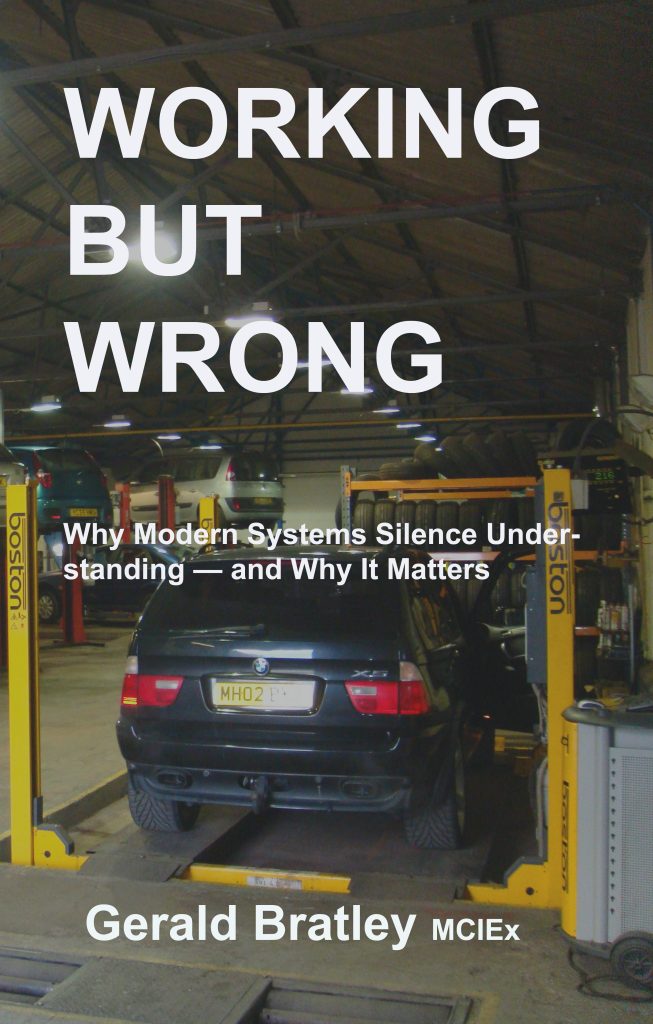
Modern systems rarely appear to fail. They measure, report, warn, reset and reassure—yet they can still be dangerously wrong.
Working but Wrong examines a quiet but far-reaching change across engineering, transport, manufacturing, public services and everyday technology: the replacement of understanding with procedure, and professional judgement with compliance.
Using vehicles and transport systems as a central thread, Gerald Bratley traces the movement from repair as skilled problem-solving to component replacement guided by software-controlled diagnostics. He explores apprenticeships, modular design, warning systems, sensors, software gatekeeping and the gradual loss of local repair knowledge.
The book asks:
- Why do warning systems sometimes train people to ignore them?
- When did software become the final authority?
- Why did repair disappear while replacement became normal?
- How did declining skills weaken communities and resilience?
- Who questions a system when everyone has followed the correct procedure?
Drawing on nearly six decades in British industry, international trade and government service, the author connects technical systems with human behaviour, commercial incentives and public policy.
This is not an argument against technology or a nostalgic demand to return to the past.
It is a clear and unsettling examination of what happens when a system works perfectly—but no longer allows the people inside it to think.
Available on Amazon in paperback and Kindle formats
- Explore all books by Gerald Bratley
- Read more about the Author
- Explore articles in the same category: Engineering and Technology
- Kindle ASIN : B0GM4TKFCX
- Publisher : Independently published
- Publication date : 6 Feb. 2026
- Language : English
- Print length : 126 pages
- Paperback ISBN-13 : 979-8247188599
- Item weight : 218 g
- Dimensions : 13.97 x 0.81 x 21.59 cm