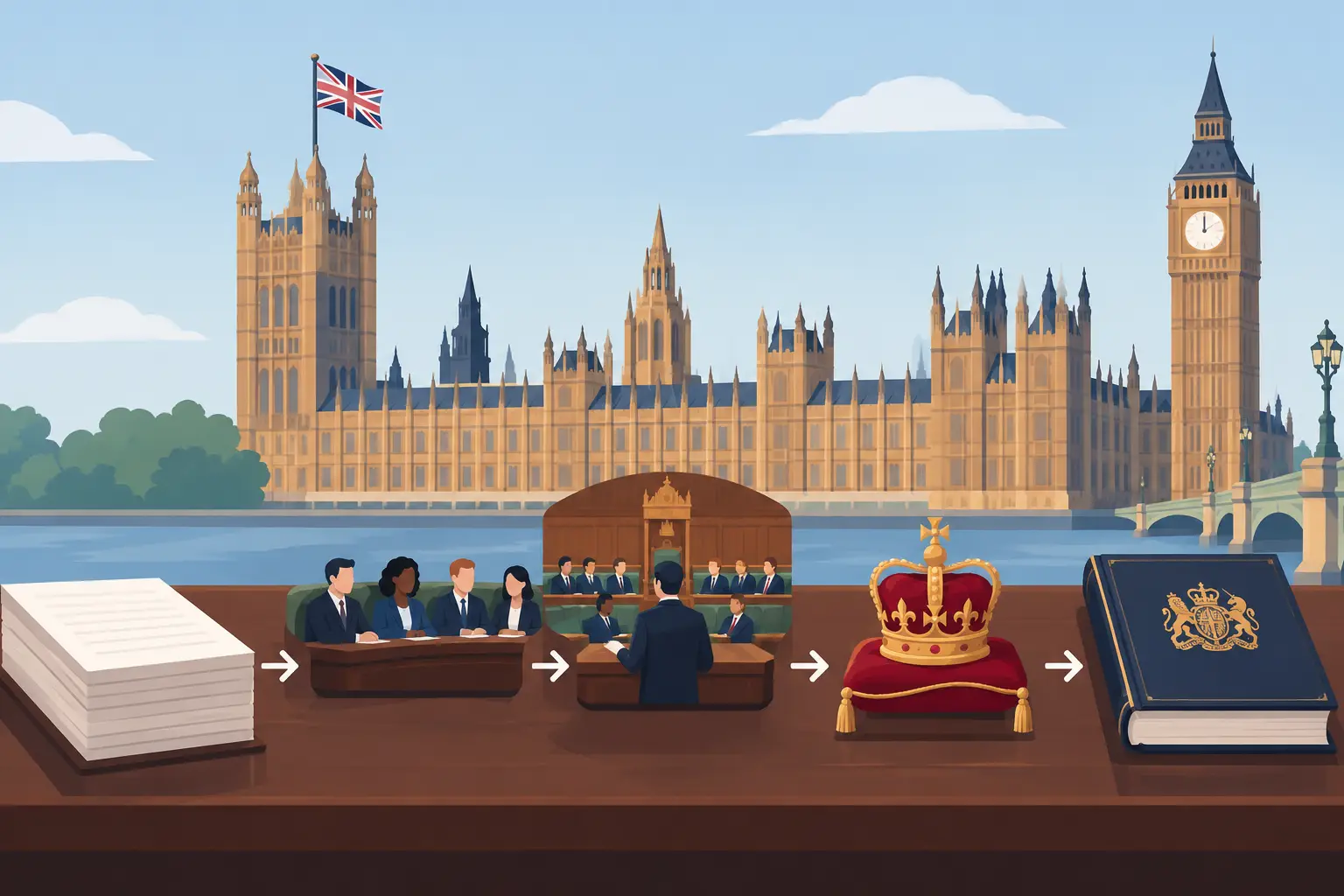

A British general election can remove a government in a single night, yet much of the machinery that shapes public life does not change at all. Civil servants remain at their desks, judges continue to interpret the law, the House of Lords revises Bills, and the Crown performs its constitutional role. To understand how British democracy really functions, one must look beyond the ballot box and examine the relationships between institutions, power and public consent.
British Politics and Democracy
Articles examining British democracy, political representation, Parliament, party discipline, institutional power and the relationship between voters and government.
8 Books About the British Political System
Westminster can look reassuringly familiar: a Prime Minister at the dispatch box, a Budget in a red case, a general election fought constituency by constituency. Yet readers seeking books about the British political system soon find that the familiar surface conceals a complicated settlement of statute, convention, patronage, history and power.
How Inherited Privilege Works in Britain
A child does not need to inherit a country estate or a title to begin life with an advantage. A mortgage deposit, a place at a sought-after school, confidence with authority, or an uncle who knows somebody can matter just as much. That is the practical starting point for understanding how inherited privilege works in Britain. It is usually less a matter of a secret cabal than a chain of ordinary advantages, each one making the next easier to obtain.
British Democracy Explained Simply
Ask a group of sensible adults how Britain is governed and you will often hear a muddle of terms – Parliament, government, Crown, Westminster, MPs, peers, ministers. The confusion is understandable. British democracy explained simply means stripping away ceremony and habit and looking at who actually holds power, how they get it, and how they can lose it.
The House of Managed Democracy – A Review received today (11/06/2026)
This review of The House of Managed Democracy considers Gerald Bratley’s examination of the gap between how British democracy is described and how it is experienced by voters. That was the first thing that grabbed me about the book. On the surface, The House of Managed Democracy is a structured, research-driven examination of the United … Read more
EU Membership: A View from a Working Lifetime
The relationship between UK EU membership and international trade is best understood against the changes experienced by British exporters over several decades. My working life spans the period before Britain joined the European Economic Community, through our years of membership, and into the present day. In the 1960s Britain still lived largely in the world … Read more