
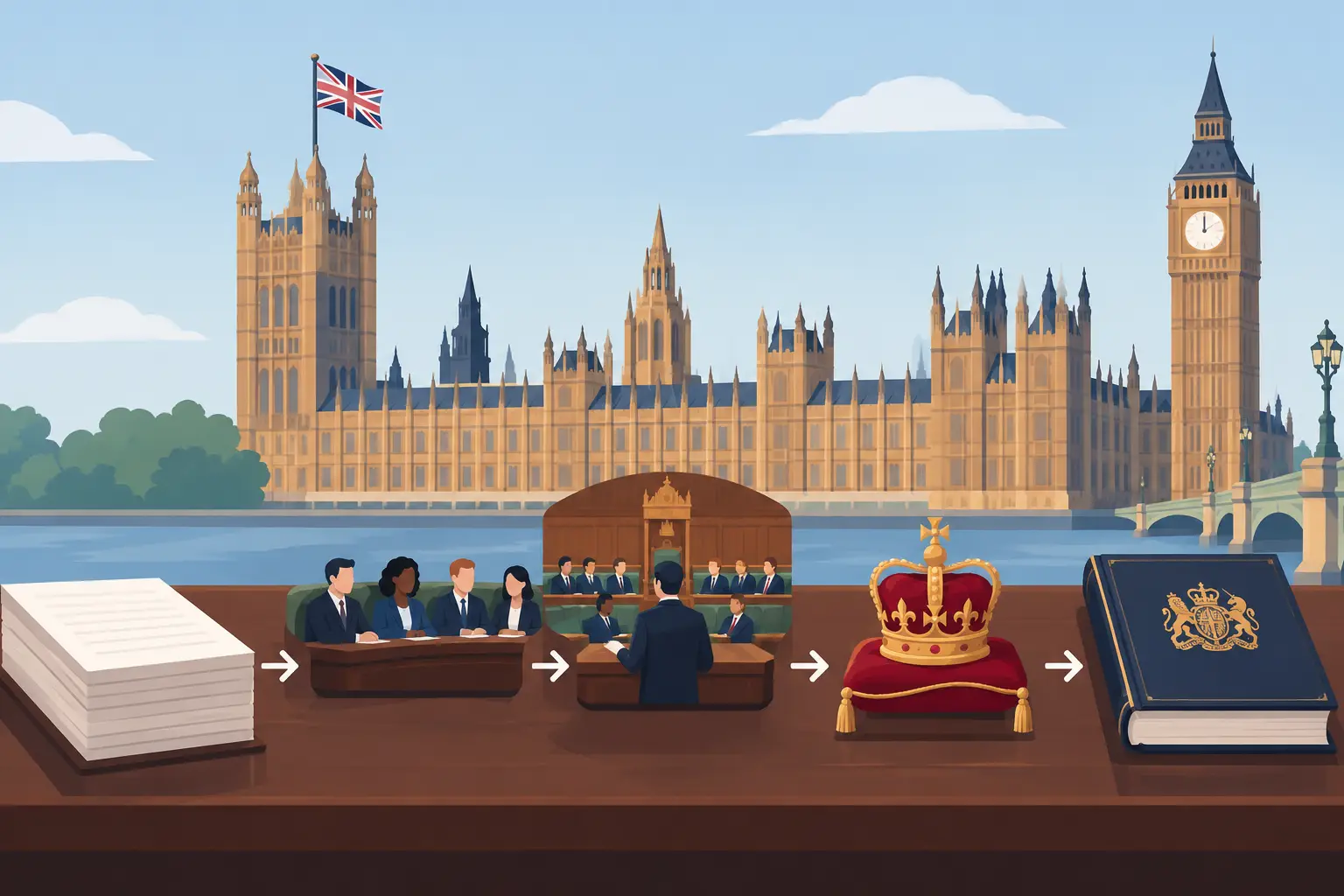
A Bill may look like a dry bundle of clauses, schedules and amendments, but it can alter the terms on which a business trades, a council spends, a police officer acts or a family receives support. Understanding how British bills become law is therefore more than a schoolroom lesson in procedure. It is a way of seeing where political promises meet legal reality – and where they are often delayed, diluted or defeated.
The process is deliberately slower than a government announcement suggests. A minister can announce an intention in the morning; turning it into enforceable law may take months, sometimes years. Along the way, parliamentary scrutiny, drafting problems, party arithmetic, pressure from outside Parliament and negotiation between the Commons and Lords all have their effect.
From political intention to a Bill
Most Acts begin with a policy decision by government. A manifesto commitment, a public scandal, a court judgment, a change in technology or an international obligation may provide the trigger. Yet an intention is not legislation. Before a Bill is introduced, civil servants develop the policy, consider its cost and practical consequences, and consult interested parties to varying degrees.
The Parliamentary Counsel then has the specialised task of converting policy into legal language. This is a discipline in its own right. Just as international trade depends on people who understand documentation, transport, insurance and payment terms, legislation depends on distinct expertise: policy officials, departmental lawyers, parliamentary drafters, ministers and administrators who must eventually make the measure work. A badly defined power or an overlooked exception can create years of dispute.
The government normally publishes an explanatory document alongside a Bill. This is useful, but it is not the law. The legal effect lies in the text Parliament passes, read alongside existing Acts, regulations and court decisions. That distinction matters whenever ministers present a Bill in broad and reassuring language.
Not every Bill is a government Bill. Private Members’ Bills are introduced by backbench MPs or peers. They can draw attention to an issue and occasionally become law, especially with government support, but they face severe pressure on parliamentary time. Private Bills concern particular bodies or local interests, while hybrid Bills combine public policy with effects on particular individuals or organisations. The great bulk of major legislation, however, is government business.
How British bills become law: the parliamentary stages
A Bill may start in either House, although major and politically contentious measures usually begin in the House of Commons. Bills dealing mainly with taxation or public spending must begin there because the elected House controls supply.
First Reading: formal introduction
First Reading is largely procedural. The title of the Bill is read out and it is ordered to be printed. There is no debate on its detailed merits. Its practical significance is that Parliament and the public can see the proposed text.
Second Reading: the argument over principle
Second Reading is the first substantial test. MPs or peers debate the Bill’s central purpose: whether the proposed approach is desirable at all. In the Commons, a government with a working majority will normally carry this stage. That does not mean the debate is pointless. Ministers must put their case on record, opposition parties identify weaknesses, and concerned members can expose consequences not apparent in a press release.
A defeat at Second Reading is serious because it rejects the Bill in principle. Governments usually avoid bringing forward legislation unless they believe they can command the necessary votes.
Committee Stage: where the clauses are tested
Committee Stage is often where the real work begins. In the Commons, most Bills go to a Public Bill Committee, whose membership broadly reflects the balance of parties in the House. Some Bills are considered by a Committee of the Whole House, particularly where constitutional issues or major tax provisions are involved.
The committee works through the Bill clause by clause. Members may propose amendments, question ministers and press for explanations of how powers will be used. The government normally has the votes, but amendments can still matter. They may correct drafting errors, narrow a power, provide safeguards or force the minister to give a clear statement that later influences interpretation.
The Lords performs a particularly valuable function here. It has no democratic mandate equal to the Commons, but it contains former ministers, lawyers, scientists, civil servants, business figures and others with experience of the fields affected by legislation. That expertise does not make peers infallible, nor does it remove the case for reform of the House. It does mean that a Bill can receive scrutiny less tightly controlled by the government payroll.
Report Stage and Third Reading
At Report Stage, the whole House considers further amendments. This gives members who were not on the committee an opportunity to participate. In the Commons, the selection of amendments and the timetable can limit discussion sharply, especially where the government uses programme motions.
Third Reading is the final stage in that House. In the Commons it is usually brief, with debate focused on what has changed. In the Lords it can be more substantive. A vote in favour sends the Bill to the other House.
The second House and parliamentary ping-pong
The Bill then goes through the same broad stages in the other House. It may pass unchanged, but that is far from guaranteed. The Lords may amend a Commons Bill; the Commons may amend a Lords Bill. If the two Houses disagree, the Bill moves back and forth in what is commonly called parliamentary ping-pong.
This is not merely ceremonial obstruction. It is often the point at which an imprecise provision, an excessive delegated power or an unintended commercial consequence is properly confronted. Ministers may accept an amendment because it improves the Bill, offer a compromise, or use their Commons majority to reject it.
The Commons has the final democratic authority in most cases. Under the Parliament Acts, the Lords can delay certain public Bills but cannot normally block them indefinitely. Its power is weaker still over money Bills, which it may delay for only a month. These limits reflect the principle that an elected chamber should ultimately prevail, while preserving a revising chamber capable of requiring a second look.
Consent, delegated powers and the parts people miss
The familiar diagram of readings and votes can conceal important constitutional questions. If legislation affects devolved matters in Scotland, Wales or Northern Ireland, the UK Government may seek legislative consent from the relevant devolved legislature. Under the Sewel convention, Westminster will not normally legislate on devolved matters without that consent. The word ‘normally’ carries considerable weight. It is a political convention, not an absolute legal veto.
Many Acts also grant ministers powers to make detailed regulations later. These are known as delegated or secondary legislation. Such powers are often necessary: Parliament cannot sensibly place every technical rule, fee level or implementation date in primary legislation. But broad powers can allow significant policy to be made later with far less scrutiny than the original Bill received. Readers should therefore look not only at what an Act says, but at what it authorises ministers to decide afterwards.
Financial implications are another practical constraint. A Bill that requires new spending needs Treasury support and, where relevant, a financial resolution. Governments may favour an attractive policy in principle but decide that its cost, administrative burden or impact on employers makes it untenable.
Royal Assent and the start of legal force
Once both Houses agree on identical wording, the Bill is ready for Royal Assent. The monarch gives assent on the advice of ministers. In modern constitutional practice this is a formality, but it remains the final step by which a Bill becomes an Act of Parliament.
Becoming an Act does not always mean immediate change. Some provisions come into force on Royal Assent; others begin on a date specified in the Act or through a commencement order made later by a minister. Businesses, public bodies and citizens may then face a further period of guidance, regulations, training and adjustment before the law operates as intended.
That final gap between statute and practice deserves respect. Parliament can pass a rule, but it cannot by itself ensure that a local authority has the staff to administer it, that a small firm understands it, or that a court interprets it as ministers expected. The most useful habit for any citizen is to follow a Bill beyond the headline, through its amendments and into implementation. That is where the true character of a law is usually revealed.