
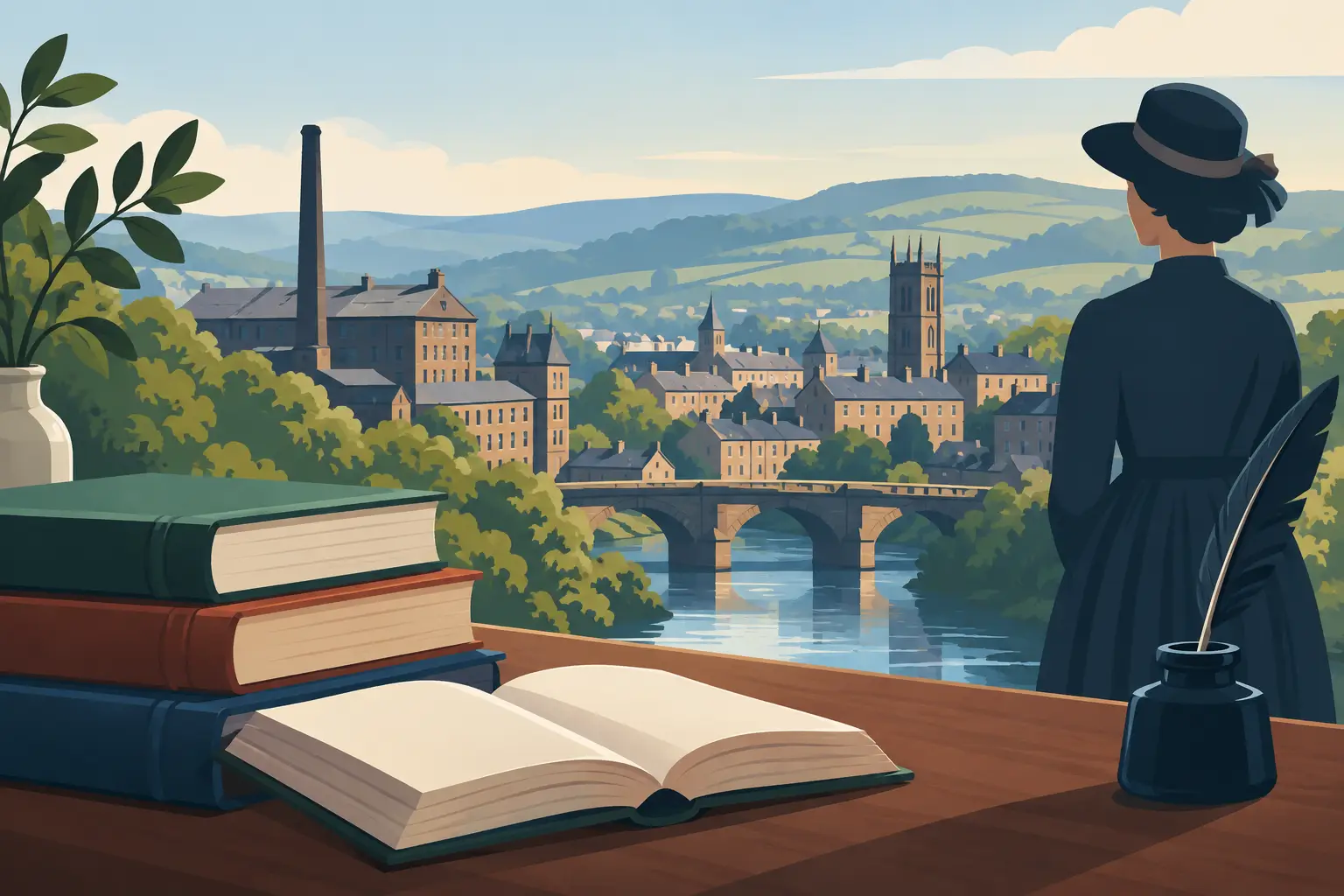
A chimney stack, a chapel door and a steep cobbled street can say more about a society than a page of official statistics. West Yorkshire historical fiction has particular power because the county’s past was neither genteel nor uniform. It was made in mills and workshops, on farms and in crowded terraces, in Nonconformist chapels and boardrooms, by families whose prospects could change abruptly with a trade cycle, a war or an injury at work.
For readers who want more than a costume drama set against northern scenery, the best fiction from this landscape offers a way of seeing how industrial Britain actually operated. It can show the pressure beneath prosperity: the discipline of the factory bell, the dependence of a town on one industry, and the sharp distinctions of class that were often visible in the street where a person lived.
What West Yorkshire Historical Fiction Can Do
The region is often reduced to a shorthand of mills, moors and blunt speech. All are real elements of place, but none is sufficient on its own. West Yorkshire contained prosperous textile centres, coal communities, agricultural districts, commercial towns and rapidly expanding suburbs. Leeds, Bradford, Halifax, Huddersfield, Wakefield and the smaller places between them did not share one identical history.
That variety gives a novelist material of unusual depth. A merchant involved in the wool trade, a mill worker tending machinery, a minister concerned with temperance, or a young woman leaving domestic service all occupied the same broad region but faced different constraints. Historical fiction can put those lives in proximity and reveal the arrangements of power which official histories sometimes flatten.
It can also correct a common mistake: the assumption that industrial communities were passive victims of change. West Yorkshire people formed mutual societies, unions, chapels, political associations and businesses. They migrated, saved, borrowed, argued and voted. Their lives were constrained, often harshly, but they were not without agency. A convincing novel recognises both facts.
Industry Was a Social System, Not Just a Backdrop
The nineteenth and early twentieth centuries are natural settings for the region, but an old mill should not be treated as decorative scenery. It was a working system involving capital, raw materials, machinery, skills, transport, markets and labour. The owner was exposed to fluctuations in demand and credit; the employee to wages, hours, safety and the availability of work. The relationship was unequal, yet it was also shaped by practical dependence on both sides.
This matters because a novelist who understands the processes can make a scene credible without turning it into a lecture. A delayed consignment, an order cancelled by an overseas buyer, a loom left idle, or a disagreement over piece rates can drive plot and reveal character. Trade and manufacture entered the home through rent, food, clothing, schooling and the prospects of children.
The same principle applies beyond textiles. Coal, engineering, transport and retail altered local life in different ways. Railways connected communities to national markets but also changed where people worked and whom they met. The arrival of a new employer could bring opportunity; its failure could damage an entire district. Historical fiction earns its authority when these consequences are felt at household level.
The danger of inherited stereotypes
There is a temptation to arrange the past into familiar moral categories: the cruel industrialist, the noble worker, the stern chapel-goer, the rebellious daughter. Such figures may have their place, but they become unconvincing when they are only labels. Industrialists could be exploitative and philanthropic, sometimes in the same week. Working people could show solidarity while also policing each other’s conduct. Religious conviction could provide comfort, education and community, while imposing severe expectations.
The point is not to excuse inequalities. It is to understand how people justified the world they inhabited, and what practical choices were open to them. Judgement without context is easy. Historical fiction is more valuable when it makes the reader confront context before reaching judgement.
Place Must Affect the Story
West Yorkshire’s geography is not an interchangeable northern backdrop. Valleys channelled roads, railways, mills and housing. Hills could separate communities which were close on a map but difficult to reach in bad weather. Stone construction, smoke, watercourses and changing light gave towns a physical character that influenced daily movement and social contact.
A character walking from a terrace to a mill, chapel or market should encounter a plausible route, gradient and distance. This need not become a gazetteer. One well-observed detail – wet flags on a yard line, grit brought into a house on boots, the smell at a canal basin, a view obscured by smoke – can establish more than a page of general description.
Place also means local institutions. The mechanics’ institute, the co-operative, the public house, the school board, the chapel committee and the town council were places where reputations were made and damaged. They connected private life with public authority. For an audience accustomed to seeing politics as something conducted at Westminster, this is a useful reminder that power has always operated locally as well.
Language Needs Restraint and Respect
Dialect presents one of the harder choices. West Yorkshire speech is part of the region’s identity, but heavy phonetic spelling can slow reading and turn characters into spectacles. It also assumes that dialect is merely an accent, rather than a vocabulary, rhythm and social signal which changed between districts and generations.
Usually, a light touch is stronger. A few well-chosen local words, a distinct turn of phrase and dialogue shaped by the speaker’s education, occupation and confidence can convey voice without demanding that the reader translate every line. The same character may speak differently at work, at home and before an official. That is not inconsistency; it is social knowledge.
Research should therefore extend beyond dictionaries of dialect. Newspapers, letters, memoirs, local advertisements, inquest reports and minutes of voluntary organisations can show what people worried about and how they expressed themselves. They also expose the gaps in the record. Those gaps are where imaginative fiction has work to do, provided imagination does not contradict what is known merely for convenience.
Whose History Is Being Told?
A strong historical novel asks whose account has survived and whose has been lost. Employers, clergy, magistrates and journalists left substantial records. Women working within households, children, migrants, casual labourers and people living in poverty often appear only when institutions noticed them: at a school, a court, a workhouse or an inquest.
That uneven archive is not a reason to invent freely without discipline. It is a reason to read evidence carefully. A novelist may not know exactly what one mill hand thought on a particular morning, but wage records, housing reports, family budgets, oral history and the known rhythm of work can establish the boundaries of plausibility. Within those boundaries, fiction can restore individual feeling to lives recorded only in fragments.
Migration deserves special attention. West Yorkshire’s industrial growth drew people from nearby counties, from Ireland and from further afield. Later generations added other communities whose labour, enterprise and family life became part of the region. A historical setting should not be imagined as socially fixed simply because the story takes place before the present day. Change has long been one of the county’s permanent conditions.
Accuracy Is More Than Getting Dates Right
Readers forgive a minor error less readily when it suggests that the author has borrowed the past rather than studied it. Accuracy includes the cost of food, the time taken to travel, the limits of medical treatment, the legal position of women, the reach of the post and the ordinary inconvenience of obtaining information. It includes knowing that people did not possess modern assumptions about privacy, work, marriage or the state.
Yet factual accuracy alone does not create historical fiction. A catalogue of correct details can be as lifeless as a museum label. The writer’s task is to select the details that put pressure on the characters and expose the values of the period. It depends, too, on the intended novel. A family saga may need a broad social canvas; a mystery set in one town may need precise knowledge of police practice, property and local routes.
For readers, the reward is not simply nostalgia. The past of West Yorkshire explains much about the present: patterns of settlement, pride in skilled work, suspicion of distant authority, civic ambition and the persistent memory of industries that once ordered whole communities. These are not relics. They continue to influence how places see themselves.
Read the finest novels of the region with an eye for the systems behind the story, but leave room for the people within them. A factory, chapel or terrace becomes historically meaningful when it changes what a person can hope for, fear or refuse.