
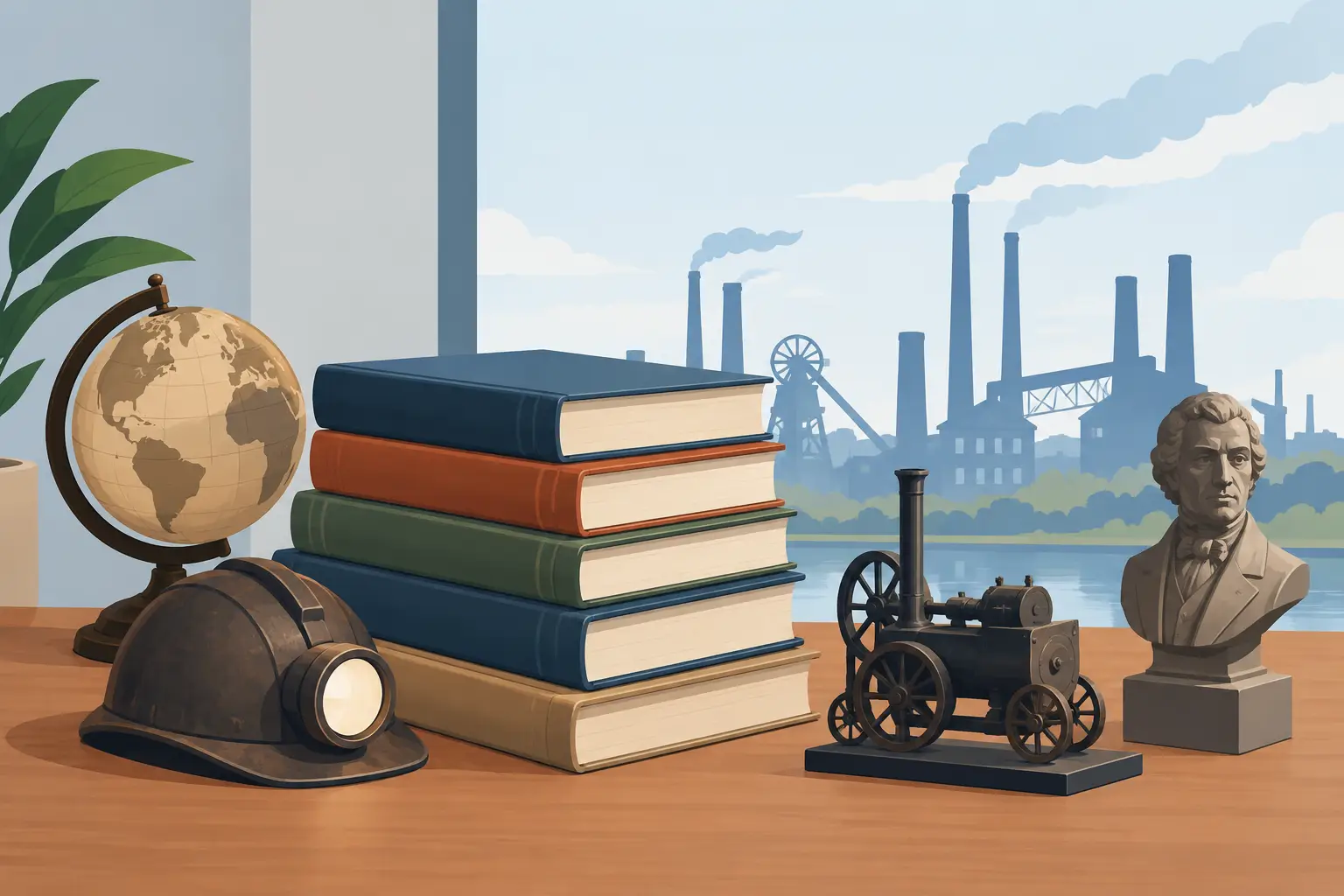
A coal fire, a railway timetable, a factory hooter and a row of outside lavatories tell us rather more about industrial change than a diagram of a spinning jenny. The best books on industrial history show how machinery, energy, capital and trade altered ordinary routines as well as national wealth. They also make clear that industrialisation was neither a single event nor an uncomplicated story of progress.
For British readers, the subject can feel familiar enough to be taken for granted. Yet the industrial past explains much that still shapes the country: regional inequality, attitudes to work, the standing of engineering, the legacy of empire and the stubborn importance of transport and energy. A good reading list must therefore include the factory, but not stop at its gates.
What makes an industrial history worth reading?
The strongest accounts combine economic explanation with human evidence. It is not enough to say that coal was abundant or wages were high. The reader should understand why those conditions mattered, who benefited, who bore the costs, and how developments in Britain connected with markets and labour far beyond these islands.
There is no entirely neutral account of this period. Some historians stress invention and enterprise; others emphasise exploitation, class formation or imperial power. That is not a defect. It is a reason to read more than one book, particularly where an author’s assumptions are plainly stated and the evidence can be weighed.
10 best books on industrial history
1. The Industrial Revolution by T. S. Ashton
Ashton’s short book remains one of the clearest starting points. First published in 1948, it presents industrialisation as a long process rather than a sudden miracle, drawing attention to technical improvement, enterprise and the interaction of industries. It is concise enough to give a newcomer a framework before the detail becomes overwhelming.
Its age is both a strength and a limitation. Ashton’s account is less alert than later work to empire, gender and the harshest experiences of labour. Read it for a lucid traditional interpretation, not as the final word.
2. The British Industrial Revolution in Global Perspective by Robert C. Allen
Allen asks a question that gets to the heart of the matter: why did industrialisation begin in Britain? His answer gives serious weight to relatively high wages, cheap energy and the incentives these created for labour-saving invention. This is economic history with a practical grasp of costs, markets and investment.
Readers interested in engineering and business will find it particularly rewarding. The argument is demanding in places, but it explains why an invention only becomes historically significant when it can be made, financed and used profitably.
3. The Making of the English Working Class by E. P. Thompson
Thompson’s great work is not a general survey of industrial production. It is an account of how working people experienced and responded to immense social change between the late eighteenth century and the 1830s. He restores political purpose, custom, religion and resistance to people too often reduced to statistics.
The prose is energetic and the author has a strong point of view. That is precisely why it remains valuable. It forces the reader to see that a new industrial economy did not merely create jobs; it disrupted communities and changed the terms on which people lived.
4. A Short History of the British Industrial Revolution by Emma Griffin
Griffin offers an accessible corrective to both complacent celebration and automatic pessimism. Using workers’ autobiographies alongside wider evidence, she examines employment, family life, consumption and the uneven nature of hardship. Her central achievement is to make room for individual experience without pretending that one experience speaks for all.
This is an excellent choice for readers returning to the subject after many years. It is compact, readable and sufficiently questioning to encourage further study.
5. Energy and the English Industrial Revolution by E. A. Wrigley
No history of industry can make much sense without energy. Wrigley explains how England moved away from an economy constrained by land, timber and muscle power towards one driven by coal. That shift released productive capacity on a scale that previous societies could not sustain.
The book is especially relevant when energy policy is again central to public debate. It does not offer easy modern parallels, but it shows why fuel sources, transport and technical capability must be understood together. Industrial change was never simply about clever machines.
6. The Shock of the Old by David Edgerton
Edgerton’s title captures his important challenge: historians and politicians often pay too much attention to novel inventions and too little to the technologies that were actually used. Britain’s twentieth-century industrial story involved maintenance, adaptation, imports, state purchasing and long-lived machinery, not just celebrated breakthroughs.
This is one of the best books for readers who dislike fashionable claims that every era has invented an unprecedented technological revolution. Edgerton is argumentative, but productively so. He makes the reader ask who used a technology, in what quantity, and for what purpose.
7. Empire of Cotton by Sven Beckert
Cotton linked Lancashire mills to enslaved labour, imperial power, finance, shipping and consumers across the world. Beckert’s wide-ranging history demonstrates that the industrial revolution cannot be understood as a wholly domestic British achievement. It was bound up with coercion and global commercial organisation.
The scale can be daunting, but that is part of the book’s value. It replaces the narrow picture of the mill town as a self-contained industrial landscape with the reality of an international system of raw materials, credit and labour.
8. The Great Divergence by Kenneth Pomeranz
Why did north-west Europe industrialise before China, despite the sophistication and prosperity of several Asian regions? Pomeranz treats the question seriously rather than assuming European superiority. He compares regions with care and gives colonial resources and access to coal their proper place in the explanation.
This is not light reading, but it is indispensable for anyone who wants to move beyond a Britain-centred account. It also serves as a useful warning against neat national stories. Economic development depends on geography, trade, institutions and contingency.
9. Industry and Empire by Eric Hobsbawm
Hobsbawm provides a broad interpretation of Britain’s industrial expansion and its imperial setting. He writes with conviction about capitalism, class and power, and readers will not mistake his political standpoint. Nevertheless, his ability to connect economic change with social and political institutions makes the book enduringly useful.
It works best alongside Allen or Griffin, whose approaches are different. Where Hobsbawm provides a commanding big picture, the other books help test its claims against economic evidence and personal testimony.
10. The Industrial Revolutionaries by Gavin Weightman
Weightman is the most approachable author on this list for a general reader. Through the lives of inventors, builders and entrepreneurs, he brings canals, steam engines, ironmaking and railways into view without losing sight of commercial reality. It is a vivid introduction to the people who turned ideas into working systems.
The biographical approach has limits: industrial history is not made by notable men alone. Even so, this book conveys an essential truth. Innovation depended on patient experiment, practical skill, finance, suppliers, workers and customers. An isolated invention changed little.
Read across arguments, not down a single line
A sensible route is to begin with Ashton or Griffin, then move to Allen and Wrigley for the economic and energy foundations. Thompson adds the human and political consequences, while Beckert and Pomeranz widen the field beyond Britain. Edgerton is especially useful once the reader reaches the twentieth century and wants to question the usual story of technological progress.
The period also repays attention to local memory. In Britain of the early 1950s, coal fires, steam railways, heavy industry and new consumer goods still existed side by side. The country was changing, but older habits, working arrangements and physical surroundings had not disappeared. That is often the lesson lost in simplified histories: industrial change arrives unevenly, and the past remains present for far longer than official narratives suggest.
Read these books with a notebook beside you. Record not only dates and inventions, but the assumptions each author makes about work, wealth, power and improvement. The most useful industrial history is the one that sharpens how you look at the factory, the railway, the port and the society they made.
4 thoughts on “10 Best Books on Industrial History to Read”
Comments are closed.