
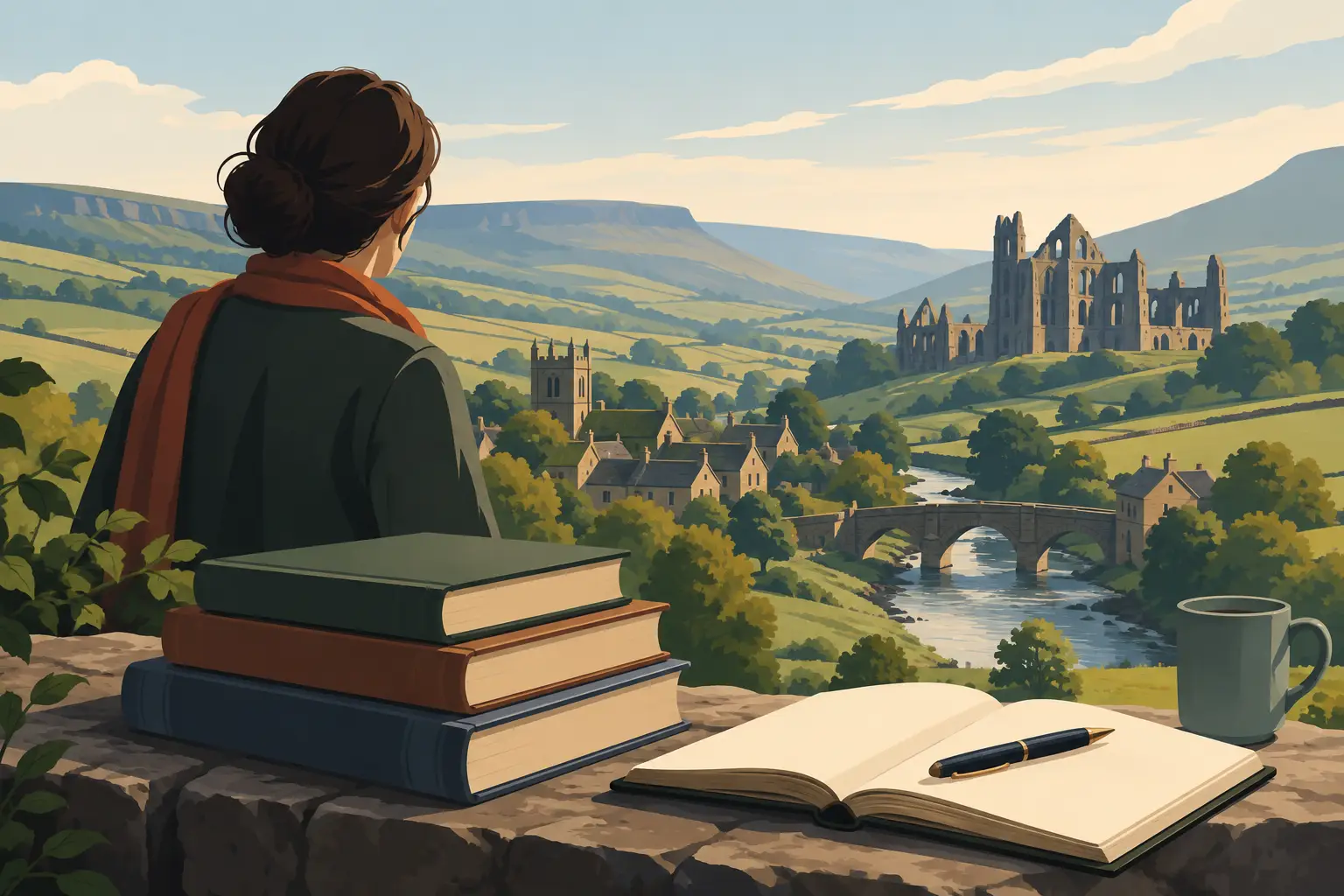
A Yorkshire mill was never merely a building, nor a pit simply a place of work. Each shaped the hours people kept, the air they breathed, the families they raised and the power they possessed or lacked. That is why Yorkshire historical fiction can be far more than costume drama set among stone walls and moorland: at its best, it is a means of understanding how large forces entered ordinary lives.
For readers interested in history, the attraction lies partly in recognition. The county’s past contains the raw material of Britain’s transformation from a largely rural society into an industrial and imperial power. Wool, coal, railways, civic ambition, religious nonconformity, labour organisation and sharp divisions of wealth all left their mark. But fiction has a particular task. It can show not only what happened, but what change felt like when its consequences were uncertain.
Why Yorkshire historical fiction carries unusual force
Yorkshire is often treated as a single, dependable image: hard weather, blunt speech, sturdy independence and industrial grit. There is some truth in each element, but the simplification is misleading. The West Riding textile towns, the coalfield communities, the port of Hull, the agricultural East Riding, the cathedral city of York and the Dales did not share one experience of history.
A credible novel understands this variety. A cloth merchant in Leeds, a miner’s wife near Barnsley, a farmer in the Wolds and a servant in a York household may inhabit the same county while living in different worlds. Their work, food, prospects, education and relationship with authority are not interchangeable. Geography matters because it determines the available employment, the nature of transport and even the social reach of a family.
This is where the strongest writing resists nostalgia. A soot-darkened townscape may look striking on the page, but industrial employment was not an atmospheric detail. It involved danger, noise, injury, illness and dependence upon employers who often controlled more than wages. Equally, industrial Yorkshire was not only deprivation. It created skilled workers, commercial fortunes, self-confident municipalities, mutual societies and a strong sense that people could organise to improve their own conditions.
The history beneath the story
Good historical fiction does not read like a textbook with invented dialogue placed between the facts. Yet it must rest on sound knowledge. The writer needs to know how people travelled, how they addressed one another, what a household could afford and where social boundaries lay. A labourer could not casually enter a drawing room, and a young woman’s movement through public space was subject to constraints that modern readers may underestimate.
The details that matter are often modest. Was meat an occasional purchase or a daily expectation? Did news arrive through a newspaper, chapel gossip, a letter or the public house? Could a family read? How long did it take to travel from a village to a market town before the railway altered distance? Such questions prevent the past becoming a modern drama in old clothes.
There is, however, a balance to be struck. Research can become display. Pages crowded with dialect, machinery specifications or historical incident may reassure the author but weary the reader. The purpose of factual accuracy is to make characters’ choices intelligible. A strike, an enclosure, a death in the pit or the arrival of a railway should matter because it changes what someone may lose or gain.
Class must be lived, not announced
Class is central to much Yorkshire history, but it is too often handled as a set of labels. The distinction between owner and worker was real, as were the tensions between skilled and unskilled labour, town and country, established families and new money. Still, no community divides neatly into heroes and villains.
A mill owner might be severe in wage negotiations yet genuinely believe he had responsibilities towards his workforce. A worker might resent an employer while aspiring to a small business of his own. A chapel-going household could hold radical views on representation and deeply conservative views on family life. Such contradictions are not a defect in historical fiction. They are its substance.
The period chosen makes a difference. The late eighteenth and early nineteenth centuries offer upheaval: mechanisation, urban growth and anxious debates about order. Victorian settings allow the writer to examine confidence, reform and entrenched inequality side by side. The twentieth century brings war, declining heavy industry, the changing position of women and the difficult passage from collective employment towards a more fragmented economy. There is no inherently superior era. The question is whether the novel understands the pressures particular to its chosen moment.
Landscape is part of the argument
In Yorkshire historical fiction, landscape should not function as decorative scenery. The moor, dale, pit village, mill town and coast impose practical conditions. Weather can determine a journey’s safety, a harvest’s value or whether a household is cut off. A steep valley may concentrate industry and housing in uncomfortable proximity. A remote farm may make independence necessary while also limiting opportunity.
The landscape also shapes memory. Former mill chimneys, terraced streets and disused railway cuttings are reminders that economic systems leave physical traces long after the firms and occupations have gone. For older readers especially, this can give historical novels a particular resonance. Many families retain stories of relatives who worked in textiles, coal, engineering or domestic service. Fiction cannot replace family history, but it can provide a broader setting in which those fragments make sense.
That said, the county must not be romanticised as a place untouched by the wider world. Yorkshire’s industries depended on overseas markets, imported raw materials, finance, shipping and imperial connections. Woollen cloth sold abroad, coal powered national industry, and ports connected local enterprise with distant places. A novel concerned with Yorkshire can therefore illuminate Britain’s international position without abandoning its local focus.
What readers should look for
The most rewarding novels do not promise a comfortable return to the past. They show that the past was contested, and that people had incomplete knowledge of what would follow. A character living through factory expansion did not know the twentieth-century consequences of industrialisation. Someone leaving the countryside for a town could not see the future through a reader’s hindsight.
Look for writers who allow uncertainty to remain. Their characters should have motives beyond representing a social category, and their institutions should have weight without becoming lectures. Dialogue ought to sound plausible rather than being forced into exaggerated dialect. Yorkshire speech has many local forms and changes across the county; a sprinkling of apostrophes is no substitute for an ear for rhythm, social setting and restraint.
It is also worth asking whose perspective is absent. Historical records have often been created by employers, officials, clergy and those with property. Fiction can responsibly imagine the experience of those less fully recorded, but imagination must be disciplined by evidence. The answer is neither timid silence nor confident invention without limits. It is careful attention to what is known, what is likely and what can only be suggested.
The value of returning to the county’s past
Historical fiction set in Yorkshire remains valuable because it tests national stories against local reality. Britain is frequently described through abstractions – industrial revolution, class system, empire, reform, decline. In a well-made novel, those broad terms acquire faces, households, wages, ambitions and losses.
That has relevance beyond literary pleasure. Public debate often treats communities affected by economic change as if they were statistics or electoral shorthand. Yorkshire’s history demonstrates that industries are embedded in places, and that when they expand or disappear the effects extend far beyond the workplace. They alter confidence, family expectations, civic institutions and the meaning people attach to their home.
The finest Yorkshire historical fiction leaves the reader with no easy verdict on the past. It offers something more useful: a clearer sense that the landscapes and communities around us were made by decisions, conflicts and forms of labour which still deserve to be remembered.