
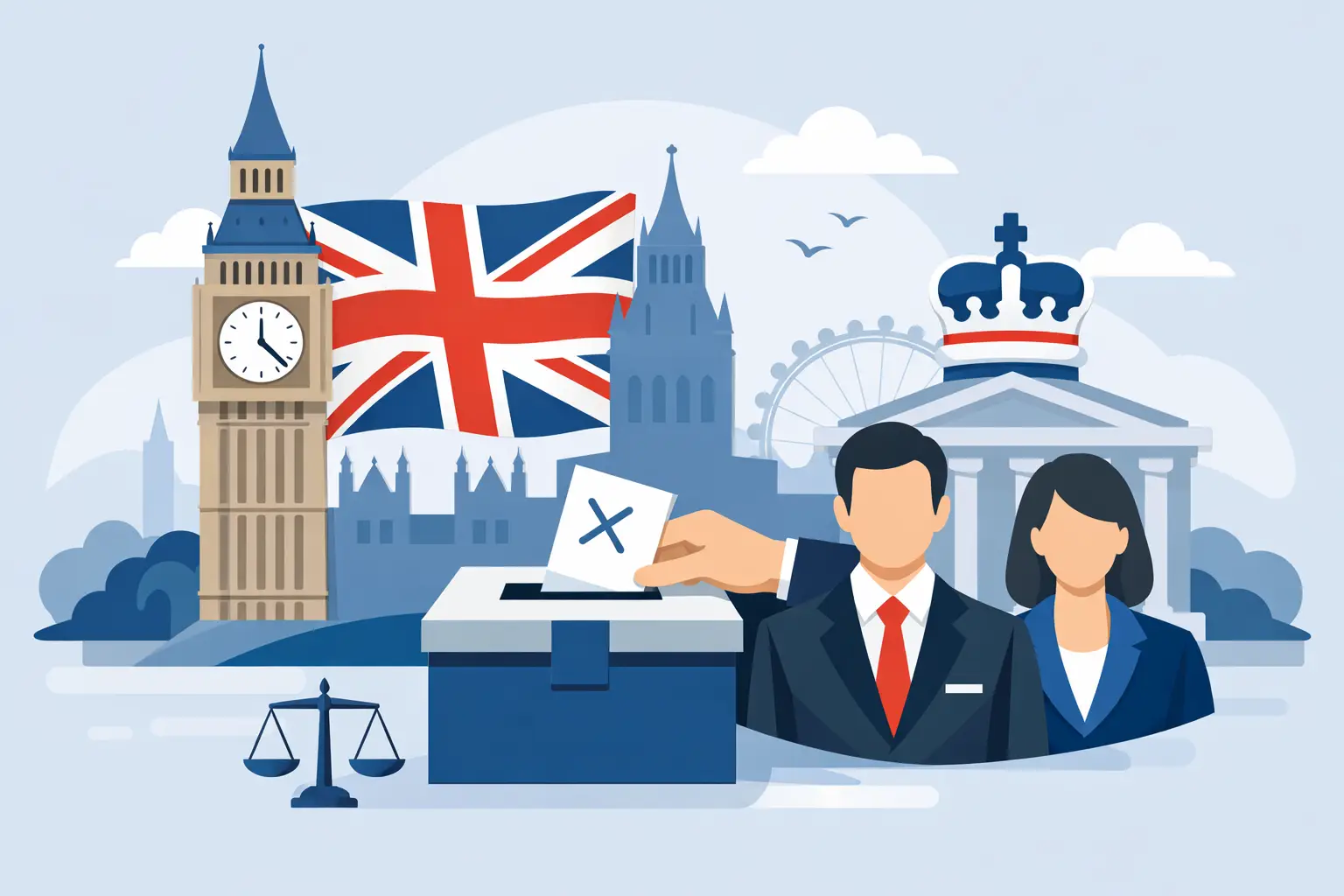
Ask a group of sensible adults how Britain is governed and you will often hear a muddle of terms – Parliament, government, Crown, Westminster, MPs, peers, ministers. The confusion is understandable. British democracy explained simply means stripping away ceremony and habit and looking at who actually holds power, how they get it, and how they can lose it.
At heart, Britain is a parliamentary democracy with a constitutional monarchy. That sounds grander than it is. In plain terms, the public elects Members of Parliament, the party that can command a majority in the House of Commons forms the government, and the monarch remains head of state but does not govern in any personal political sense.
British democracy explained simply: who does what?
The first thing to grasp is the difference between Parliament and government. Many people use the words as if they mean the same thing. They do not.
Parliament is the law-making body. It consists of the House of Commons, the House of Lords and the Crown. The House of Commons is the elected chamber and is the one that really matters in democratic terms, because it is where governments are made and unmade. The House of Lords is unelected and revising in function. It scrutinises, delays and amends, but in the end it does not normally defeat the democratic will of the Commons for long. The Crown is part of Parliament in legal form, because legislation receives Royal Assent, but this is a constitutional formality, not a personal royal choice.
The government, by contrast, is the executive. It is the Prime Minister and ministers who run departments, propose most laws, control much public spending and direct day-to-day policy. Government comes out of Parliament, but it is not identical to Parliament.
That distinction matters because a healthy democracy requires more than elections. It requires those in office to be answerable to elected representatives, and for those representatives to be answerable to the public.
How the public chooses a government
In a general election, voters in each constituency elect one MP to the House of Commons. Britain uses the first-past-the-post system. The candidate with the most votes wins, even if that total is well below 50 per cent.
This is one reason British democracy can appear simpler than it is. The result often produces a clear governing majority, which can be useful for decisiveness. A government can pass budgets, push through legislation and remain in office without constant coalition bargaining. But there is a trade-off. The number of seats a party wins may be quite out of proportion to its national share of the vote.
That is why a party can win a solid Commons majority without winning anything close to a majority of all votes cast. Supporters of the current system say it produces stable government. Critics say it can distort representation and leave many voters in safe seats feeling their vote changes little.
Both arguments have force. It depends whether one values governability above proportional fairness, or the other way round.
Why the Prime Minister is powerful
The Prime Minister is not directly elected by the public as a national leader in the presidential sense. He or she becomes Prime Minister by being the person most likely to command the confidence of the House of Commons, usually as leader of the largest party.
Once in office, the Prime Minister can be very powerful. That is partly because of party discipline. In Britain, MPs elected under a party label are usually expected to support their party in major votes. If the governing party has a decent majority and remains reasonably united, the Prime Minister can dominate the Commons.
So although Britain is often described as government by Parliament, there are periods when it can look more like government through Parliament. The executive can become very strong indeed.
The role of the monarch
This is where foreign observers, and not a few British citizens, often become uncertain. Britain is democratic, but it also has a monarchy. The key point is that the monarchy is constitutional, not governing.
The King reigns but does not rule. Ministers govern. Parliament legislates. Courts interpret the law. The monarch performs duties that are legally significant but politically constrained by convention. The sovereign appoints the Prime Minister, opens Parliament and gives Royal Assent to bills, but does so in line with established constitutional practice.
In practice, the monarch is expected to remain above party politics. That can help provide continuity in times of political turmoil. Yet it also reflects one of the peculiarities of the British system: some of its most important rules are not set out in a single written constitutional document, but in statutes, conventions, precedent and political habit.
That flexibility has often been praised as pragmatic. It can also be criticised as vague, especially when conventions are tested by ambitious politicians.
British democracy explained simply through Parliament
If one wants to see British democracy at work, the House of Commons is the place to look. MPs debate, scrutinise ministers, raise constituency concerns and vote on legislation. Questions to ministers, select committee hearings and major debates all form part of the machinery of accountability.
Select committees deserve more credit than they usually receive. They often conduct serious cross-party scrutiny and can expose administrative failure or weak policy. They do not govern, but they can improve governance.
The House of Lords is more awkward from a democratic standpoint. It contains life peers, bishops and a small number of hereditary peers. It is not elected, which sits uneasily with modern democratic principle. Yet it often contains expertise and experience that improves draft legislation. That is the case for it. The case against it is obvious enough – unelected legislators in a democracy are a contradiction, even if a limited one.
This is a recurring feature of the British constitution. It is not neat. It mixes democratic principle with inherited institutions and pragmatic compromise.
Where power is checked
No democracy is judged only by elections. The real question is whether power is limited, examined and, when necessary, corrected.
Britain has several checks. Parliament can challenge ministers. The courts can rule on whether government has acted lawfully. The press can expose misconduct. Elections can remove a government. Political parties themselves can depose a leader. Devolved governments in Scotland, Wales and Northern Ireland also disperse some power away from Westminster.
But these checks are uneven. A government with a large Commons majority can often control the legislative timetable and survive embarrassing setbacks. The courts do not decide whether policy is wise, only whether it is lawful. The press can inform, but it can also distort. Devolution has changed the picture, but England remains highly centralised compared with many other democracies.
So when people say Britain has strong democratic traditions, that is true. When others say power is still concentrated at the centre, that is also true.
What about the civil service?
An important part of the system is the permanent civil service. Ministers change. Officials remain. Their role is to advise, administer and carry out lawful policy, whatever party is in office.
This continuity can be a strength. It preserves institutional memory and steadiness. Yet it can also lead critics to complain of inertia, caution or excessive distance from ordinary voters. As with many British institutions, the reality is mixed rather than tidy.
Why British democracy can feel frustrating
Many voters feel they have little influence between elections. That feeling does not come from nowhere. Party control, safe seats, centralised decision-making and an electoral system that rewards concentrated support all contribute to frustration.
There is also a cultural point. British political life still carries traces of deference, class and establishment networks, even though those forces are weaker than they were. Formal privilege has been reduced, but informal privilege has not disappeared. Who gets heard, who advances, and who is taken seriously can still reflect background as much as ability.
That does not mean democracy is a sham. It means democracy exists within a social structure that is not always as open as democratic language suggests.
Why it still works better than some think
For all its faults, the British system has durable strengths. Governments can usually be formed without paralysis. Transfers of power are peaceful. Ministers can be removed. Laws are publicly debated. Independent courts matter. Citizens can criticise those in authority without fear of the state silencing them.
One should not romanticise these strengths. They require maintenance. Standards in public life can decline. Institutions can be bent. Conventions can be abused. But it would be equally mistaken to dismiss the whole system because it falls short of an ideal model found nowhere in practice.
British democracy is best understood not as a perfect design, but as an evolving settlement. It combines election, tradition, law, party management, public pressure and institutional restraint. Sometimes that produces stability. Sometimes it produces muddle. Often it produces both at once.
The simplest way to remember it is this: the public elects the Commons, the Commons sustains the government, the government runs the country, and the rest of the constitution exists to legitimise, limit or scrutinise that power. Once that is clear, the pageantry becomes easier to place in its proper proportion.
A useful habit for any citizen is not merely to ask who won the last election, but who can question power effectively after the cheering has stopped.
6 thoughts on “British Democracy Explained Simply”
Comments are closed.