
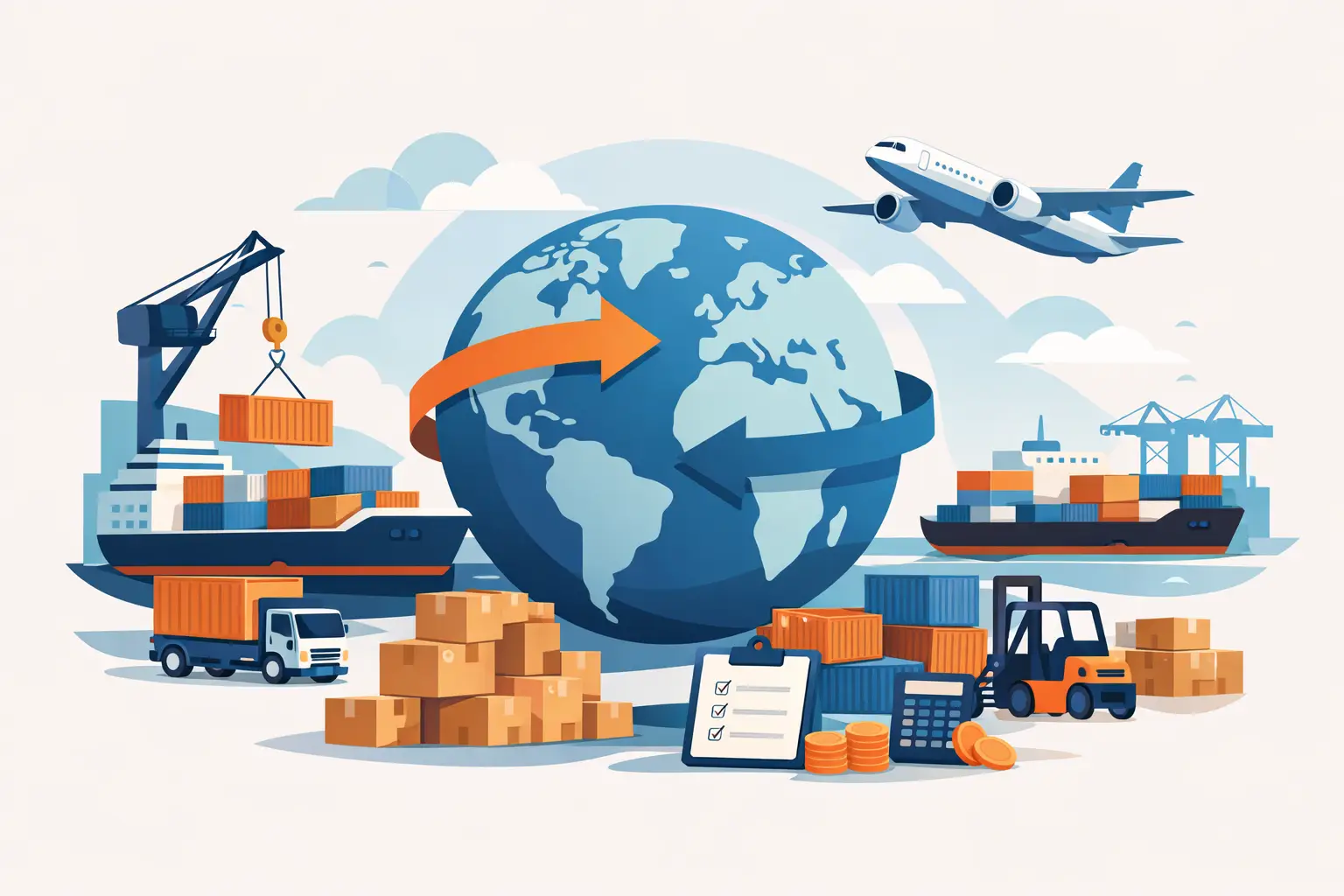
A firm can produce an excellent product, price it sensibly and still fail abroad because it misunderstands the plain realities of international trade export and import. That is one of the first lessons business teaches, and it has not changed with the arrival of email, container tracking and video calls. Goods still have to cross borders, buyers still have to be paid, and governments still take an interest in what enters and leaves their territory.
Too much writing on trade treats it either as an abstract economic virtue or as a bureaucratic nuisance. In practice it is neither. It is a disciplined commercial activity in which success depends on judgement, preparation and patience. Experience matters because the apparent simplicity of selling overseas can conceal a surprising number of expensive mistakes.
What international trade export and import really involves
At its simplest, export means selling goods or services from one country to another, while import means bringing them in. Yet anyone who has worked in the field knows that the sale itself is only the beginning. A proper export transaction may involve product adaptation, technical compliance, packing specifications, freight arrangements, insurance, customs classification, payment terms, documentation and after-sales support.
Importing has its own demands. The importer must judge supplier reliability, quality consistency, lead times, transport routes, landed cost, duties and local regulatory requirements. Many businesses discover too late that a low factory price is not the same thing as a good commercial proposition. Freight, delays, damaged goods, currency movements and compliance failures can erase the apparent saving very quickly.
This is why trade should never be romanticised. It offers real opportunity, but it also rewards sober minds. A company that does well in Manchester, Birmingham or Bristol does not automatically understand Melbourne, Chicago or Hamburg.
Why export and import are never just about price
Price matters, of course, but it is rarely decisive on its own. Overseas buyers want reliability, continuity and a supplier who understands their market. They need confidence that replacement parts will arrive, technical queries will be answered and promises will be kept. In many sectors, particularly engineering and industrial supply, a dependable second-best price can beat the cheapest quotation on the table.
The same principle applies to importing. The best overseas supplier is not always the one with the lowest unit cost. A supplier who communicates clearly, packages properly, respects specifications and ships on time will often save more money over a year than a cheaper source that causes repeated disruption.
There is also a wider point which is often missed in public debate. International trade is a relationship business wearing the clothes of commerce. Contracts matter, but trust matters too. Markets differ in tempo, negotiating style and expectations. Some want rapid decisions. Others expect discussion over time. Some are comfortable with direct disagreement. Others prefer a more formal approach. None of this is mysterious, but it cannot be ignored.
The practical foundations of international trade export and import
A successful trade business usually rests on a few unglamorous disciplines. The first is knowing exactly what is being sold or purchased. That means clear specifications, proper product descriptions and accurate tariff classification. If the goods are wrongly described, much else can go wrong afterwards.
The second is understanding delivery terms. Many trading losses arise because one side assumes responsibility ends at the factory gate while the other assumes the goods will arrive cleared and ready for use. Such misunderstandings are avoidable, but only if both parties state clearly who pays for freight, who arranges insurance and at what point risk passes from seller to buyer.
The third is payment. New exporters are often so pleased to secure an overseas order that they neglect the question of how and when they will be paid. Experienced traders are more cautious. Advance payment may be ideal, but not always achievable. Open account terms may help win business, but they shift risk towards the seller. Documentary credit can provide reassurance, though it brings cost and administrative discipline. There is no universal answer. It depends on the market, the buyer, the size of the order and the exporter’s appetite for risk.
Then there is documentation. Some people still speak of paperwork as though it were merely clerical. It is not. In trade, documents are part of the transaction itself. Commercial invoices, packing lists, certificates of origin, transport papers and customs entries all have legal and financial consequences. Errors can delay goods, trigger penalties or interfere with payment.
Logistics, delays and the cost of overconfidence
One of the enduring misconceptions about global commerce is that modern systems have made distance almost irrelevant. They have certainly reduced some difficulties, but distance still matters. Ports become congested. Weather interrupts schedules. Containers are rolled to later sailings. Road transport misses booked slots. Customs queries stop consignments. A small delay at one stage can ripple through an entire supply chain.
This is where overconfidence becomes expensive. Businesses that are new to export often promise delivery dates based on hope rather than evidence. Importers do much the same when they commit stock to customers before goods have actually cleared. Sensible traders allow margin for the unexpected because the unexpected appears with tedious regularity.
The lesson is straightforward. Build resilience into the transaction. Use realistic lead times. Confirm what the freight forwarder is actually handling. Check whether packing is suitable for the journey. Make sure somebody is responsible for customs formalities and that the information provided is complete. None of this is dramatic, but it is where competent firms distinguish themselves from careless ones.
Regulation, politics and why trade is never entirely free
People sometimes speak loosely of free trade as though borders have ceased to matter. They have not. Governments intervene for reasons of revenue, security, industrial strategy, consumer safety and diplomacy. Tariffs still exist. So do quotas, sanctions, licensing rules, product standards and local certification requirements.
For British firms, this is more than theory. Any company trading beyond its home market must deal with the practical consequences of different regulatory systems and political decisions. The United States, Australia and European markets each present opportunities, but each has its own legal and commercial habits. A product acceptable in one jurisdiction may require modification, relabelling or further approval in another.
This does not mean trade is impossibly difficult. It means serious exporters and importers treat regulation as part of market entry, not as an afterthought. Those who leave compliance until the goods are packed are inviting trouble.
What smaller firms often get wrong
Large companies can absorb a mistake more easily than smaller ones. A modest exporter may lose heavily from one unpaid shipment, one rejected consignment or one pricing error. Yet smaller firms also have advantages. They can adapt quickly, speak directly to customers and specialise in narrower markets where knowledge counts for more than scale.
Their common mistake is to approach export as a side activity rather than a managed business function. They assume domestic literature will do for overseas promotion. They quote without checking freight. They appoint an agent too quickly. Or they chase a distant market before proving themselves in one that is easier to reach and understand.
A more sensible approach is to start with disciplined selection. Which market has genuine demand, workable regulation and customers who can be reached and supported properly? Which distributor has real capability rather than a persuasive manner? Which orders are commercially sound after all costs are included? Growth abroad is valuable, but indiscriminate growth can be damaging.
Experience still counts
Digital tools have changed the speed of communication, and data is easier to obtain than it once was. Even so, trade remains a human activity shaped by judgement. A video meeting cannot tell you everything about a buyer’s seriousness. A polished website does not guarantee capacity. A spreadsheet cannot fully measure political instability, cultural misunderstanding or managerial weakness.
That is why first-hand observation still carries weight. People who have travelled, negotiated, visited factories, walked warehouses and seen how goods actually move tend to ask better questions. They are less impressed by theory unsupported by evidence. Gerald Bratley’s long involvement in export and international business reflects that older but still sound principle – that practical knowledge is earned on the ground.
There is no shame in finding international trade export and import demanding. It is demanding. But it is also one of the most revealing forms of business because it tests nearly everything at once – product quality, financial discipline, communication, patience and nerve. Done carelessly, it can drain time and money. Done well, it broadens judgement as much as revenue. The sensible course is not to be dazzled by overseas opportunity, nor frightened by it, but to treat it with the seriousness it deserves.
4 thoughts on “International Trade Export and Import Explained”
Comments are closed.