
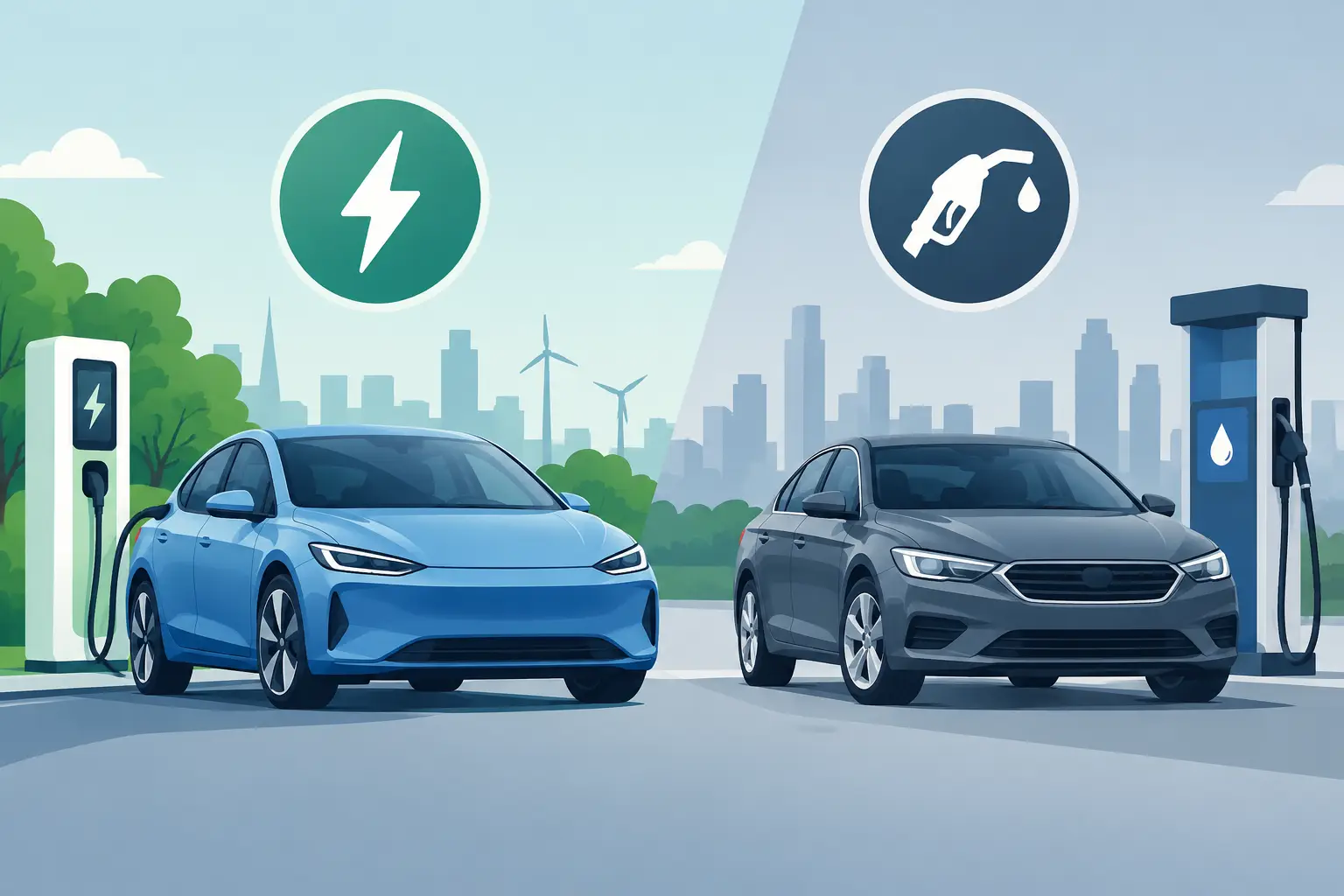
A car is not bought as an abstract environmental statement. It must start on a cold morning, carry people and luggage, reach its destination without drama and be affordable to run. That is why the discussion about electric cars versus petrol vehicles needs rather more honesty than the usual claims that one technology has already won.
Electric motoring is a substantial engineering advance, particularly for drivers who can charge at home and whose journeys are predictable. Petrol vehicles, however, remain practical, widely understood and supported by an infrastructure built over more than a century. The sensible choice depends on the driver, the journey and the conditions under which the vehicle is owned.
Electric cars versus petrol vehicles in daily use
For everyday driving, an electric car has a powerful advantage: it is quiet, responsive and easy to operate. Maximum torque is available from rest, making town driving and joining faster traffic notably effortless. There is no clutch, no conventional gearbox changing through its ratios and, in slow traffic, little of the vibration associated with an idling internal combustion engine.
Charging at home changes the experience further. A driver with off-street parking can return in the evening, connect the car and begin the following day with a useful range. There is no separate visit to a filling station, and electricity bought overnight may cost considerably less per mile than petrol. For many households, particularly those using a car for commuting, shopping and local journeys, this is the decisive practical benefit.
The limitation is obvious. Not every motorist has a drive, garage or allocated parking space. A large share of British households park on streets, in communal car parks or some distance from their home. For them, public charging is not an occasional back-up but an essential service. It must be reliable, sensibly located, clearly priced and available when required. Progress has been made, but provision remains uneven between regions, towns and individual sites.
Petrol retains the virtue of familiarity. A filling station is usually close by, refuelling takes minutes, and the range of even a modest petrol car is adequate for a long journey with little planning. That matters to people who travel extensively for work, visit family at short notice, tow trailers or simply dislike arranging a journey around charging stops.
Cost is more than the purchase price
The argument is often reduced to a comparison between the showroom prices of two cars. That is too narrow. Ownership has a purchase cost, finance cost, fuel or electricity cost, insurance, servicing, depreciation and, in some cases, the cost of installing a home charger.
Electric cars have fewer routine mechanical parts. There is no engine oil to replace, no exhaust system, spark plugs, clutch or conventional automatic gearbox. Brake wear can also be reduced because regenerative braking slows the car while returning some energy to the battery. These are genuine savings, though they should not be exaggerated. Tyres, suspension, air conditioning, body repairs and electronic faults have not vanished, and electric vehicles are often heavier than comparable petrol cars.
The purchase price remains difficult for many buyers. Although prices have fallen and the used market is widening, a new electric car commonly costs more than an equivalent petrol model. Finance arrangements can disguise this difference in a monthly payment, but they do not make it disappear. Residual values have also been uncertain in a market developing quickly, with manufacturers cutting prices and introducing improved models.
Electricity tariffs deserve careful examination. Home charging on a favourable overnight tariff can make running costs very attractive. Public rapid charging, especially at motorway locations, may be much more expensive. A driver without home charging should therefore not assume that electricity will always offer a substantial saving over petrol. The economics depend on where, when and how often the car is charged.
Range, time and the long journey
Published range figures are useful for comparison but not promises. Cold weather, speed, steep terrain, a full load and the use of heating all reduce range. This is not peculiar to electric cars – petrol consumption also worsens in adverse conditions – but the effect is more noticeable when a driver is managing a battery rather than a fuel tank.
On a typical British journey, modern electric cars now offer sufficient range for most needs. The problem arises less from the average day than from the exceptional one: a winter motorway journey, a holiday with a heavily laden car, a diversion, or an urgent trip where time is constrained. Petrol handles these circumstances with a margin that drivers have long taken for granted.
Rapid charging has improved the position greatly. A suitable vehicle can add a meaningful amount of range during a coffee stop, provided the charger works, is not occupied and delivers its advertised power. Those qualifications matter. Anyone who has worked with complex systems knows that performance is not determined by the best specification on paper but by the weakest operational link. A broken charger, a queue or a confusing payment arrangement turns a reasonable stop into an irritation.
This does not mean electric cars are unsuitable for long distances. Many owners make such journeys routinely and happily. It means that the journey requires a different discipline: checking the route, understanding the charging network and leaving a modest margin rather than arriving with the battery nearly empty.
The environmental question requires a full view
An electric car has no tailpipe emissions. In congested streets, that is a clear local advantage, reducing emissions of nitrogen oxides and other pollutants associated with petrol and diesel combustion. Electric cars are also quieter at low speed, which improves the character of residential streets.
But no vehicle is environmentally free. Building batteries requires energy, minerals, processing and transport through international supply chains. Mining conditions, water use and labour standards deserve scrutiny, not slogans. The same is true of oil extraction, refining, shipping and the global distribution of petrol. Comparing only what emerges from the exhaust pipe gives an incomplete account.
Over its working life, an electric car can offer lower carbon emissions, particularly as electricity generation becomes less dependent on fossil fuels. Britain’s grid has changed substantially over recent decades, making this advantage more credible than it would have been when coal played a larger part in generation. Yet the result varies with vehicle size, battery capacity, annual mileage and the source of the electricity used to charge it.
There is also an unfashionable but necessary point about size. A small, efficient petrol car may in some circumstances be a more responsible choice than a very large electric vehicle used sparingly. The best environmental policy is not simply to replace every vehicle with a heavier battery-powered equivalent. It is to encourage smaller, durable vehicles, better public transport where it is viable, and fewer avoidable journeys.
Industry, supply chains and national resilience
The transition from petrol engines to electric drivetrains is not solely a consumer matter. It affects manufacturing skills, component suppliers, electricity networks, mineral supply and the strategic position of countries that once relied on engine production and fuel taxation.
Britain has deep experience in automotive design, engineering and specialist manufacturing. It also faces a difficult adjustment. An internal combustion engine contains many precision components and supports an extensive supply chain. Electric vehicles have different requirements: batteries, power electronics, software, motors and charging equipment. Jobs will not necessarily disappear, but they will change, and the location of value within the supply chain may change with them.
Dependence on imported oil has long been understood as an economic and strategic concern. Dependence on imported battery materials and manufactured cells presents a different version of the same problem. Diversified supply, recycling capacity and realistic industrial policy matter more than grand announcements. International trade has always shown that a product is only as secure as the chain of suppliers, shipping routes, finance and technical knowledge behind it.
Which vehicle is the sensible choice?
An electric car is often the sensible choice for a household with home charging, regular mileage and a preference for lower day-to-day running costs. It is especially well suited to short and medium journeys, urban use and drivers willing to plan occasional longer trips.
A petrol vehicle may still suit the motorist without reliable charging, the driver making frequent long journeys through areas with limited infrastructure, or the buyer working to a strict initial budget. A well-maintained petrol car also need not be discarded prematurely merely to satisfy a fashionable timetable. Manufacturing a replacement vehicle carries a cost of its own.
The useful question is not which side wins an argument. It is whether the car fits the life it is expected to serve. Before buying, consider where it will be parked, how far it normally travels, how often it makes exceptional journeys and what the total cost will be over several years. A calm assessment of those ordinary facts will usually produce a better decision than either enthusiasm for novelty or attachment to the past.