
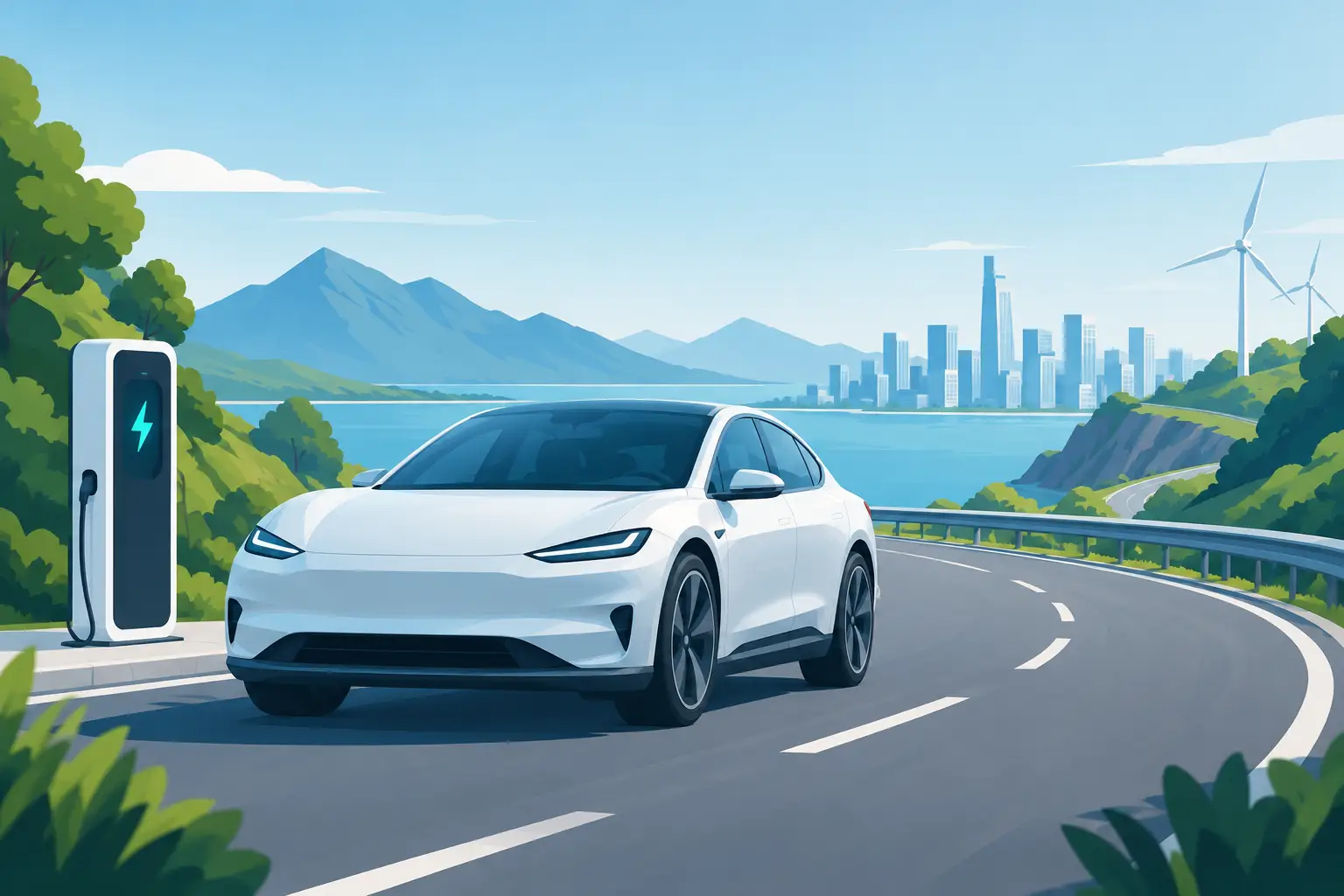
The most revealing electric vehicle trends are no longer found in motor-show announcements or government targets. They are found in the choices made by ordinary motorists, fleet managers, electricians, councils, insurers and manufacturers. The electric car has passed the point at which it could be treated simply as an interesting new product. It is becoming part of a much larger argument about industry, energy, trade and the practical limits of public policy.
For Britain, this matters particularly because the country is attempting a major transport transition while much of the manufacturing base, battery supply chain and raw-material processing lies overseas. There is genuine progress, but there is also a tendency among advocates and critics alike to make the matter simpler than it is.
Electric vehicle trends have entered a harder phase
The first phase of electric motoring was driven by enthusiasts, early adopters and company-car taxation. Buyers accepted compromises because they wanted new technology, lower running costs or an environmental alternative. A growing choice of models and improved batteries made that proposition increasingly persuasive.
The next phase is more demanding. It requires the motorist who cannot charge at home, the family buying used rather than new, the small business running a mixed fleet, and the rural driver who makes long journeys in winter to see a workable proposition. These are not marginal cases. They are the market.
This is why headline registration figures only tell part of the story. A manufacturer can meet a sales target through keenly priced lease deals, fleet discounts and heavy promotion, yet private buyers may remain cautious. That caution is not necessarily hostility to electric vehicles. Often it is a rational response to high purchase prices, uncertainty over residual values and concern about charging away from home.
The question has changed from, “Can an electric vehicle be made?” to, “Can it serve the varied circumstances of millions of people without depending on subsidy, inconvenience or optimism?” That is a proper test for any technology expected to replace an established system.
Price, depreciation and the used market
New electric cars have benefited from falling battery costs over the longer term, but the retail price remains a serious obstacle for many households. Premium models arrived first because they could accommodate expensive batteries. Smaller, cheaper electric cars are now appearing, but the market still has a considerable distance to travel before an equivalent new petrol, hybrid or electric model is an easy comparison for a typical buyer.
Depreciation complicates matters. Rapid price reductions on new vehicles may help fresh buyers, but they can unsettle existing owners and lenders. A used-car market needs confidence in battery condition, repair costs, charging capability and future demand. If buyers fear that a three-year-old electric car will be difficult to sell, they will quite reasonably expect a lower price.
This is not an argument against electric vehicles. It is an argument for treating the used market as central rather than incidental. Most motorists do not buy new cars. Reliable battery-health reporting, sensible finance, accessible repairs and a better-informed independent motor trade will do more to broaden adoption than another polished advertising campaign.
There is also an overlooked distributional issue. Home charging gives those with a driveway access to the lowest running costs. Those in terraced streets, flats or rented accommodation may depend on public chargers, where electricity can be substantially more expensive. A transition that rewards property ownership while penalising those without off-street parking will eventually lose public consent.
Charging is an infrastructure question, not merely a technical one
Much discussion of charging concentrates on the number of public charge points. Numbers matter, but availability, reliability, location and price matter just as much. A broken rapid charger at a motorway service area is not a minor inconvenience for a driver travelling with children, keeping an appointment or towing a trailer. It damages confidence far beyond that one journey.
The best charging experience is usually the one nobody notices: a vehicle charged overnight at home, ready in the morning. Yet public policy cannot assume that every household has a private drive, a garage or the ability to install equipment. Kerbside charging has a role, but it must not obstruct pavements or create hazards for wheelchair users, prams and older pedestrians.
Workplace charging can help, particularly where employees park for several hours. So can destination charging at supermarkets, hospitals, railway stations and hotels. These solutions have different economics from rapid charging, which requires costly grid connections and must earn its keep from drivers who want to leave quickly.
Electricity pricing is equally significant. It makes little sense for charging to be taxed more heavily at a public point than at home when public charging is the only option for many people. The issue is not simply convenience. It is fairness.
The grid can cope, but it must be managed
Claims that the national grid will collapse under electric cars are exaggerated. Electricity demand has long been managed through investment, pricing and planning. However, it would be equally complacent to assume that millions of vehicles can be added without local difficulties. A street of heat pumps, induction hobs, solar panels, batteries and electric cars places demands on local networks that were never designed for such a pattern of consumption.
Smart charging offers an obvious answer. Cars are parked for much of the day, and their charging can often be shifted away from the busiest periods. But such arrangements must be transparent. Motorists will accept automated control only if they retain the ability to override it when necessary and if the financial benefit is clear.
Battery supply chains are a strategic concern
An electric vehicle may be driven in Britain, but its battery materials may have travelled through several countries before reaching the assembly line. Lithium, nickel, cobalt, graphite and rare earth materials bring questions of mining standards, processing capacity, geopolitical risk and shipping. These are international trade questions as much as environmental ones.
China’s leading position in battery processing and electric vehicle manufacturing is a fact that cannot be wished away. Chinese producers have achieved scale, technical competence and, in many cases, prices that Western manufacturers struggle to match. Consumers may benefit from cheaper cars, but governments must also consider whether they are exchanging dependence on imported oil for dependence on imported industrial capacity.
Protectionism is not a simple answer. Tariffs can shelter domestic production temporarily, but they can also increase prices and invite retaliation. A more credible approach is to build capability where it is realistic: battery research, recycling, specialist components, power electronics, charging equipment and skilled maintenance. Britain cannot make every part of every vehicle, but it should avoid being merely a final market for other nations’ technology.
Battery recycling will become increasingly important as early generations of electric vehicles reach the end of their useful lives. It is not a short-term cure for material shortages, because the volume of recoverable batteries is still limited. Over time, however, recycling can reduce waste, recover valuable materials and create an industry of its own. It requires collection systems, safe handling, technical expertise and rules that do not make legitimate repair unnecessarily difficult.
The role of hybrids, vans and heavier vehicles
The public debate often presents a false choice between a battery-electric car and a conventional petrol or diesel vehicle. In practice, different uses call for different answers. A battery-electric car suits many households very well, especially where regular home charging is available. A plug-in hybrid can be useful for drivers whose journeys are genuinely mixed, although its environmental value depends entirely on whether it is charged regularly rather than treated as a heavy petrol car.
Commercial vehicles expose the limits of slogans. A city delivery van returning to a depot can be an excellent electric application. A long-distance lorry carrying maximum payload across the country presents a more difficult case because batteries add weight, charging takes time and depot infrastructure is costly. Hydrogen, overhead systems, improved rail freight and other approaches may retain a place in particular heavy-duty uses. Technology policy should not force every transport task into one solution merely because one solution is politically fashionable.
What should be watched next
The next few years will reveal whether electric motoring becomes routine for a majority rather than attractive to a well-served minority. The clearest signs will not be grand promises. They will be cheaper small cars, dependable public charging, credible battery warranties, better repair provision and a used market in which buyers feel they understand what they are purchasing.
Government has a role in setting direction and removing obvious barriers, but it cannot legislate confidence into existence. Manufacturers must make vehicles that people can afford and repair. Energy providers and charging operators must provide a service that works when needed. Local authorities must plan without treating the pavement as spare private land.
The mature view is neither to dismiss electric vehicles as an impractical indulgence nor to pretend that every objection is ignorance. Transport has always depended on systems: fuel supply, roads, workshops, finance, taxation and international commerce. Electric motoring will succeed where those systems are built with the same seriousness as the vehicle itself.