
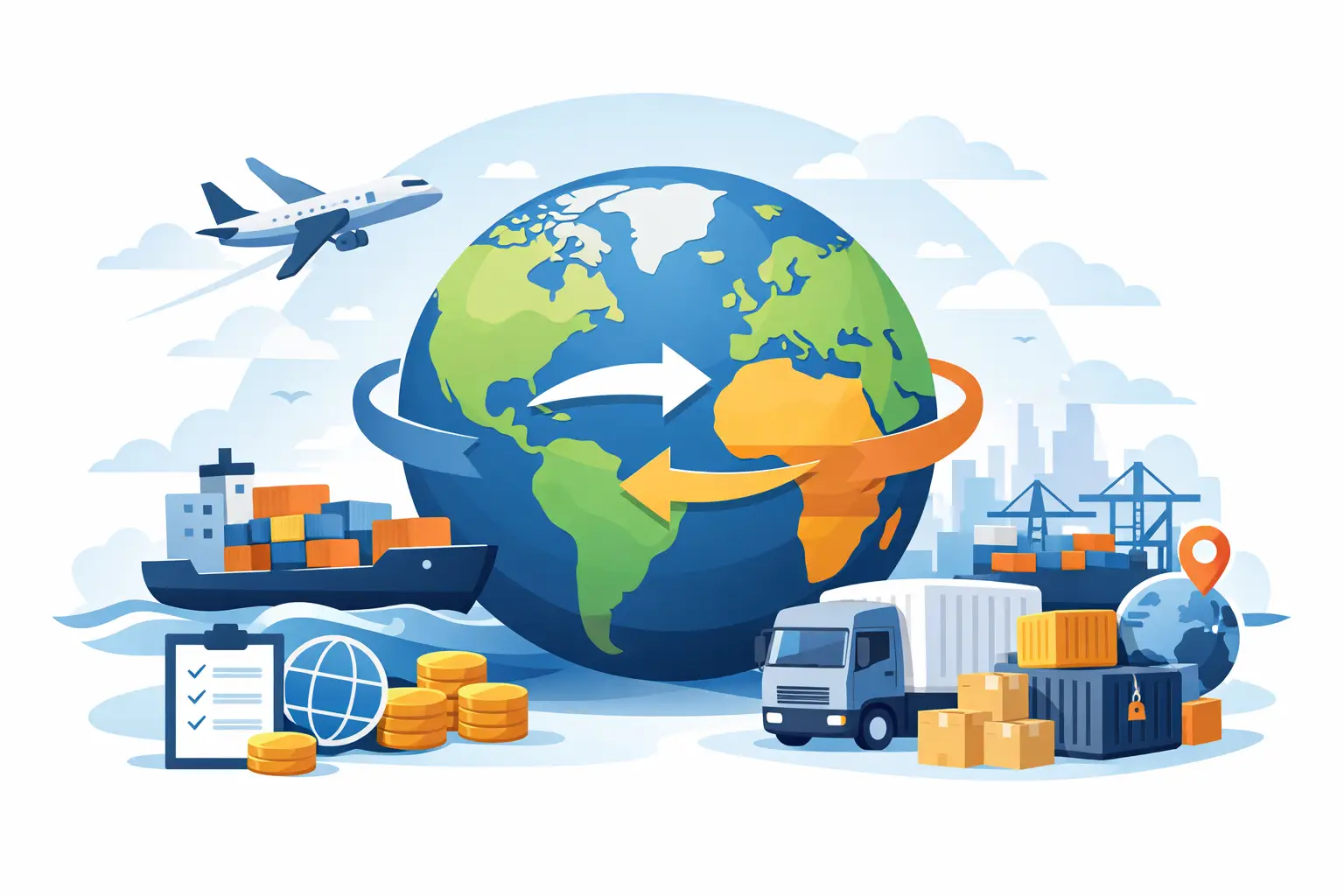
What is international trade? A clear, experience-led explanation of how countries buy and sell goods, services, capital and expertise worldwide.
A machine tool built in Germany, fitted with electronics from Japan, shipped through Rotterdam, insured in London and installed in a factory in Yorkshire tells you more about what is international trade than any textbook definition. Trade is not an abstract theory. It is the daily movement of goods, services, money, risk, documents and trust across borders.
At its simplest, international trade is the buying and selling of goods and services between countries. In practice, it is far more than that. It includes raw materials, manufactured products, software, consultancy, transport, finance, licensing, after-sales support and the web of regulations that govern all of them. It exists because no country produces everything efficiently, cheaply or well enough to meet every need of its people and industries.
What is international trade in practical terms?
For the ordinary citizen, international trade appears in familiar ways. The food in the supermarket, the mobile phone in a pocket, the petrol price, the spare parts needed by local factories and the holidays people take abroad all depend on it. For business, it is the means by which firms reach larger markets, source specialist inputs and spread risk beyond the limits of domestic demand.
The old image of trade as ships carrying tea, wool or machinery is still true, but incomplete. Modern international trade also covers legal advice delivered across borders, architectural plans sent digitally, insurance for cargoes, engineering know-how, cloud services and the movement of investment capital that makes production possible in the first place. If a British firm designs equipment here, manufactures components in Asia, assembles in Eastern Europe and sells in North America, it is participating in international trade at several levels at once.
This matters because trade is not merely exchange. It is interdependence. Countries become linked through supply chains, currencies, shipping routes, commercial law and politics. That can create prosperity, but it also creates vulnerability when something breaks.
Why countries trade at all
The textbook answer is comparative advantage. Countries specialise in what they can produce relatively efficiently and buy the rest from elsewhere. There is truth in that, but real life is messier.
Countries trade because of climate, geography, mineral resources, labour costs, technical skill, industrial history and political relationships. Britain does not grow tropical fruit on any serious scale, while oil-producing states do not manufacture every piece of equipment they import. Germany has long-standing strengths in engineering, Switzerland in pharmaceuticals and finance, and South Korea in electronics and shipbuilding. Those patterns did not appear by accident. They were shaped over decades by investment, education, infrastructure and state policy.
Trade also reflects consumer preference. People do not buy imported goods only because they are cheaper. They buy them because they are better, different, more reliable or simply unavailable at home. Equally, firms may export not because domestic markets are weak, but because overseas demand is stronger and margins are better.
There is, however, a trade-off. Specialisation can improve efficiency, yet overdependence on foreign supply can leave a country exposed. Britain learned that lesson repeatedly, whether in energy, industrial materials or strategic manufacturing. Cheap imports are welcome until a shock reveals how little domestic resilience remains.
The main forms of international trade
When people ask what is international trade, they usually mean physical goods. That remains the most visible form. Cars, chemicals, foodstuffs, steel, pharmaceuticals, clothing and machinery still dominate the public imagination because they move through ports, airports and distribution centres. They can be inspected, taxed, delayed and counted.
Services are less visible but increasingly important. Banking, insurance, education, software, engineering design, media, tourism and professional advice all cross borders. Britain has long had considerable strength in services, particularly in finance, legal expertise, technical consultancy and higher education. Service exports do not always travel in containers, but they generate income just the same.
Then there is invisible trade in the broader sense – royalties, licensing fees, freight earnings, intellectual property and investment income. A company may earn substantial overseas revenue without shipping a single crate. In many developed economies, that distinction between goods and services is now essential to understanding national trade performance.
How international trade actually works
The public often imagines trade as a simple bargain between buyer and seller. In truth, any serious export transaction can involve manufacturers, agents, freight forwarders, shipping lines, banks, insurers, customs authorities, inspection bodies and local distributors. Even a modest order may require technical specifications, price negotiations, contract terms, shipping documents, certificates of origin, payment guarantees and customs clearance.
That complexity is one reason experience matters. Successful trade depends not only on a good product but on reliable execution. A firm may lose business through poor packaging, weak documentation, ignorance of local standards or unrealistic delivery promises. Many British companies have discovered, sometimes painfully, that exporting is not an extension of domestic selling. It demands preparation, patience and respect for local business practice.
Payment is a good example. In domestic trade, parties usually understand one another’s legal system and commercial conventions. Across borders, trust cannot be assumed. Letters of credit, documentary collections, advance payment and open account terms all carry different balances of risk. Exchange rates introduce another layer of uncertainty. A profitable order can be damaged by currency movement if the exporter has not priced carefully.
What shapes trade between countries
Tariffs are only one part of the story. Governments influence trade through quotas, subsidies, safety rules, product standards, sanctions, customs procedures and tax policy. A nation may talk warmly about free trade while shielding key sectors behind technical regulations that outsiders struggle to meet.
Politics matters more than many economists admit. Trade follows relationships as much as theory. Diplomatic tensions, war, sanctions, regime change and domestic political pressure can all alter flows that once seemed settled. Businesses that trade internationally ignore politics at their peril.
Transport matters as well. A country with efficient ports, roads, digital systems and customs administration is easier to trade with than one where containers sit for weeks in congestion. Distance still counts, despite the internet. Heavy goods, fragile equipment and urgent components all depend on logistics that function properly.
Culture plays its part too. Contracts are important, but so are expectations, communication style, punctuality, hierarchy and after-sales support. Trade is conducted by people before it is recorded in statistics.
The benefits and the strains
International trade can widen consumer choice, lower costs, raise productivity and support jobs. It gives firms access to larger markets than their home country could provide. It can also encourage innovation, because exposure to global competition rarely allows complacency.
Yet the gains are unevenly distributed. A region that benefits from export growth may prosper, while another loses employment to import competition. Consumers may enjoy lower prices while domestic producers struggle. Economists often describe the national benefit clearly enough, but the social cost is borne locally and personally.
This is why trade debates become heated. They are not simply arguments about efficiency. They are arguments about who gains, who loses and what sort of economy a country wishes to maintain. The answer is seldom absolute. Protection can preserve capacity in the short term, but it can also shelter inefficiency. Free trade can lower costs, but it may hollow out industries judged strategically important once they are gone.
What is international trade for Britain?
For Britain, international trade has never been optional. It is central to national life. As an island trading nation with a long commercial history, the United Kingdom has depended on imports for food, energy, materials and manufactured goods, while relying on exports of industrial products, services, finance, expertise and innovation.
That pattern has changed over time. Britain once exported vast quantities of coal, steel, textiles and heavy engineering. Much of that industrial base has contracted, while services have become more prominent. This does not mean manufacturing no longer matters. On the contrary, advanced engineering, pharmaceuticals, aerospace and specialist production remain significant, but they exist in a more competitive and integrated global environment.
For British exporters, the difficulty is often not capability but consistency. Too many firms underestimate the persistence needed to build overseas markets. International trade rewards those prepared to travel, adapt, answer technical questions properly and support customers after the sale. It is not a quick fix for weak domestic demand.
Gerald Bratley’s body of work reflects that older, harder-earned understanding of trade as a discipline built on legwork, judgement and long acquaintance with foreign markets, not slogans.
A better way to think about it
If you want a sound answer to what is international trade, think of it as a system of exchange that joins national economies together through commerce, finance, logistics and law. It is not automatically good or bad. It is a tool, and like any powerful tool it depends on how wisely it is used.
The serious question is not whether trade should exist, because it always has and always will. The real question is what kind of trade a country wants – balanced or lopsided, strategic or careless, productive or merely consumptive. Any nation that forgets that distinction may enjoy the appearance of prosperity for a while, but it will eventually discover the cost of neglecting how wealth is actually earned.
1 thought on “What Is International Trade?”
Comments are closed.