
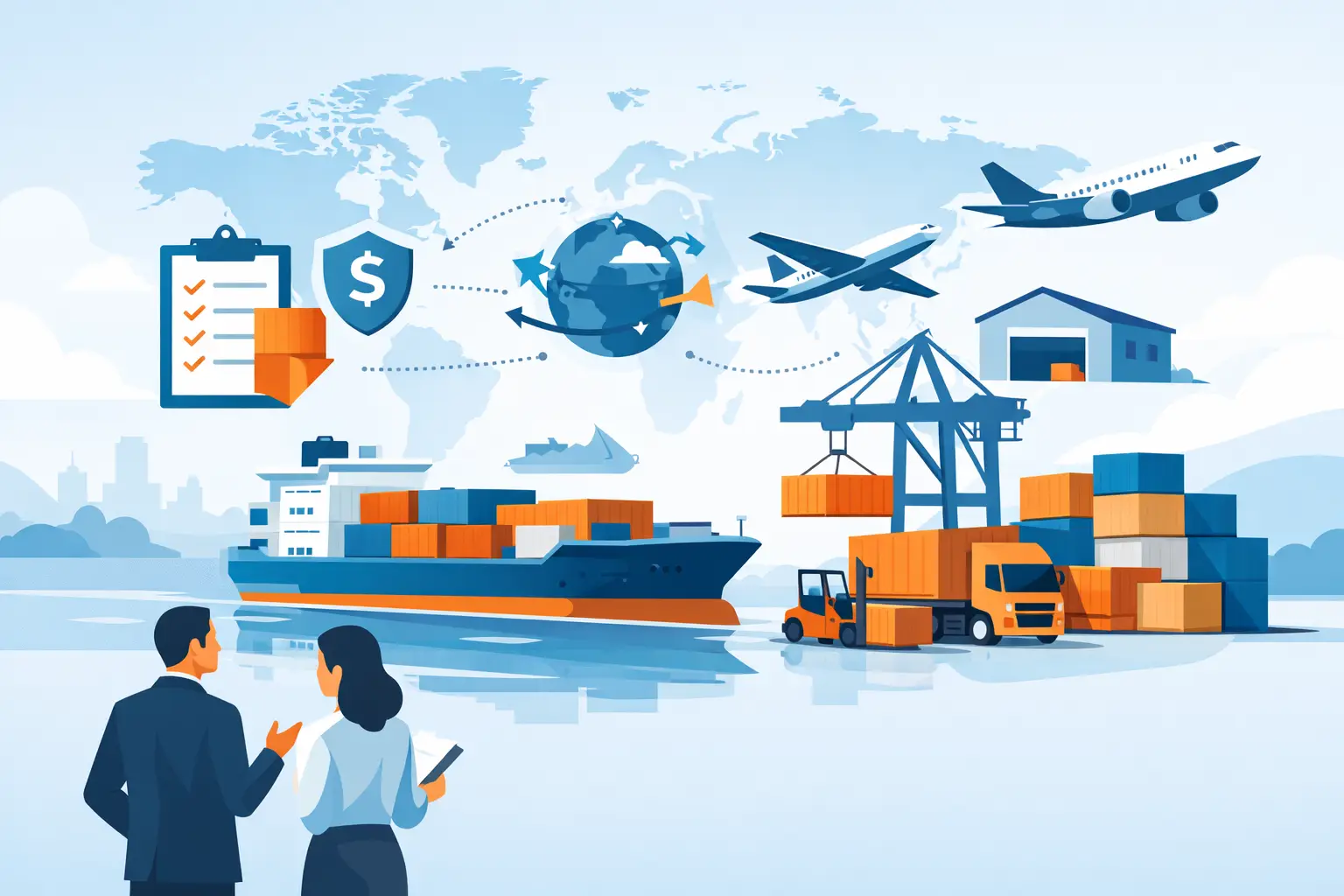
A promising export order can become an expensive lesson when buyer and seller hold different assumptions about who pays the freight, arranges insurance or carries the risk when goods are damaged. That is the practical answer to incoterms: why they matter. They are not decorative abbreviations added to an invoice. They establish the working division of responsibility at the point where a domestic sale becomes an international transaction.
After many years of dealing with overseas markets, I have seen how readily firms concentrate on winning the order and calculating a price, only to leave delivery arrangements until later. That is backwards. The delivery term affects the price, the margin, the paperwork, the insurance position and, often, the relationship with the customer. A clear agreement at the outset may prevent weeks of argument after a consignment has gone wrong.
What Incoterms Actually Do
Incoterms are standard trade rules published by the International Chamber of Commerce. The current set is Incoterms 2020. Each rule allocates certain obligations between seller and buyer: transport arrangements, export and import formalities, costs at defined stages of the journey, and most importantly, the point at which risk transfers from one party to the other.
They provide a common commercial language. If a British supplier agrees to sell machinery FCA Birmingham, Incoterms 2020, a competent buyer, freight forwarder and insurer should understand where the seller’s responsibility ends. Without that precision, phrases such as “delivered to port” or “shipping included” can mean rather different things to different people.
The rule must be stated properly. It should name the chosen Incoterm, the specific place or port, and the version of the rules. “CIP Rotterdam, Incoterms 2020” is meaningful. “CIP Europe” is not. Europe is a continent, not a named place where risk and cost can sensibly be allocated.
Risk is not the same as cost
This distinction is where many disputes begin. A seller may pay for carriage to a destination but cease to carry the risk well before the goods arrive. Under CPT or CIP, for example, the seller contracts and pays for carriage to the agreed destination, but risk normally passes when the goods are handed to the first carrier.
That can surprise an inexperienced buyer. A lorry may be lost or damaged several countries from its final destination, while the seller believes – correctly, under the agreed rule – that the risk has already passed. The buyer may then look to its own insurance, or to the carrier, rather than simply refusing to pay the seller.
Conversely, a seller agreeing to DAP may remain responsible for risk almost to the buyer’s premises. The freight quotation may appear manageable, but delays, damage and local delivery complications can still be the seller’s problem. The cost of the transport and the burden of risk do not always travel together.
Incoterms Matter Because Pricing Depends on Them
An export price is not one figure until the delivery basis is known. The factory price for a consignment may be attractive, but the final cost can include packing, collection, export clearance, terminal handling, sea or air freight, insurance, destination charges, import duties, VAT and final delivery. Someone must carry each of those costs.
For a new exporter, EXW can appear appealing because it places minimal formal responsibility on the seller. Yet it is often a poor choice where the buyer expects the seller to load the vehicle, or where export customs formalities need to be completed in the seller’s country. In such cases FCA is usually more practical. It gives the seller a defined handover point and recognises its role in export clearance.
At the other extreme, DDP can look like excellent customer service. The seller delivers cleared for import, with duties and taxes paid. But it demands real knowledge of the destination country’s customs rules, tax registration requirements and local charges. In some markets, a foreign seller may not be able to act as importer of record at all. Offering DDP casually can turn a sensible order into an administrative and financial trap.
The right rule is therefore not the one that sounds most generous. It is the one that reflects what each party can actually control and price. A business with an experienced logistics operation may be well placed to quote delivered terms in familiar markets. A first-time exporter selling specialist equipment to a capable overseas customer may be wiser to use FCA or CPT and keep the transaction within known limits.
Why the Right Incoterm Protects the Relationship
International trade involves distance, different legal systems, unfamiliar carriers and sometimes a language gap. Even reliable customers can interpret an informal promise differently. Incoterms reduce ambiguity before it has a chance to become personal.
Consider a shipment of components arriving at a port with unexpected terminal charges. If the sales contract says only that the price includes “delivery”, the parties may each feel they have been treated unfairly. If it states CFR Hamburg, Incoterms 2020, the division of carriage costs is clearer, though the parties should still check the exact scope of local charges and their freight arrangements.
The rules do not remove the need for a well-written contract. They do not decide when ownership passes, how payment is to be made, what happens if goods are defective, or the consequences of a breach of contract. Those matters need separate clauses. Nor do Incoterms replace cargo insurance, although terms such as CIF and CIP require the seller to obtain a specified level of cover.
That insurance point deserves attention. CIF is restricted to sea and inland waterway transport, and the seller’s minimum insurance obligation is relatively limited. CIP can be used for any mode of transport and requires a higher level of insurance cover unless the parties agree otherwise. Neither rule should be chosen solely because it contains the word “insurance”. The policy, exclusions, insured value and claims procedure still need scrutiny.
Incoterms: Why They Matter for Containers and Sea Freight
The old shipping terms remain widely used, and sometimes wrongly used. FOB, CFR and CIF were designed for goods delivered on board a vessel. They can be suitable for bulk cargo or other conventional maritime shipments where the seller genuinely places goods on the ship.
For containerised cargo, however, the goods are commonly handed to a carrier at a container terminal or depot before they are loaded on the vessel. In that situation, FCA is usually the better rule because it identifies the actual handover point. Using FOB for a container shipment can leave a gap between the physical transfer to the carrier and the contractual transfer of risk.
This may sound technical, but it has practical consequences when a container is damaged at the terminal, held because of a documentation error, or misses its sailing. The commercial world still uses familiar shorthand, but exporters should resist copying an old term from a previous invoice without asking whether it fits the journey now being undertaken.
Agree the Term Before Quoting
The delivery term should be part of the first serious discussion about an order, not an afterthought for the shipping department. Before quoting, establish the mode of transport, named handover or destination point, customs responsibilities, insurance expectations and whether the buyer has a nominated forwarder.
It is also sensible to ensure that the quotation, order acknowledgement, commercial invoice, packing list and transport instructions all use the same wording. Small inconsistencies create room for disagreement. If the sales team promises DAP but the paperwork suggests FCA, the exporter has created uncertainty precisely where certainty was available.
Staff should understand the few terms the business uses regularly rather than pretend to know all eleven rules by memory. A company exporting parcels by courier, palletised goods by road and occasional containers by sea may need different approaches for each. There is no virtue in complexity. There is considerable value in using terms consistently, accurately and with a named place.
A sound export transaction rests on more than a good product and an enthusiastic customer. It rests on knowing who does what when the goods leave home. Get that agreement right before the price is accepted, and Incoterms become what they were intended to be: a practical discipline that lets both parties trade with clearer expectations.
7 thoughts on “Incoterms: Why They Matter in Export Trade”
Comments are closed.