
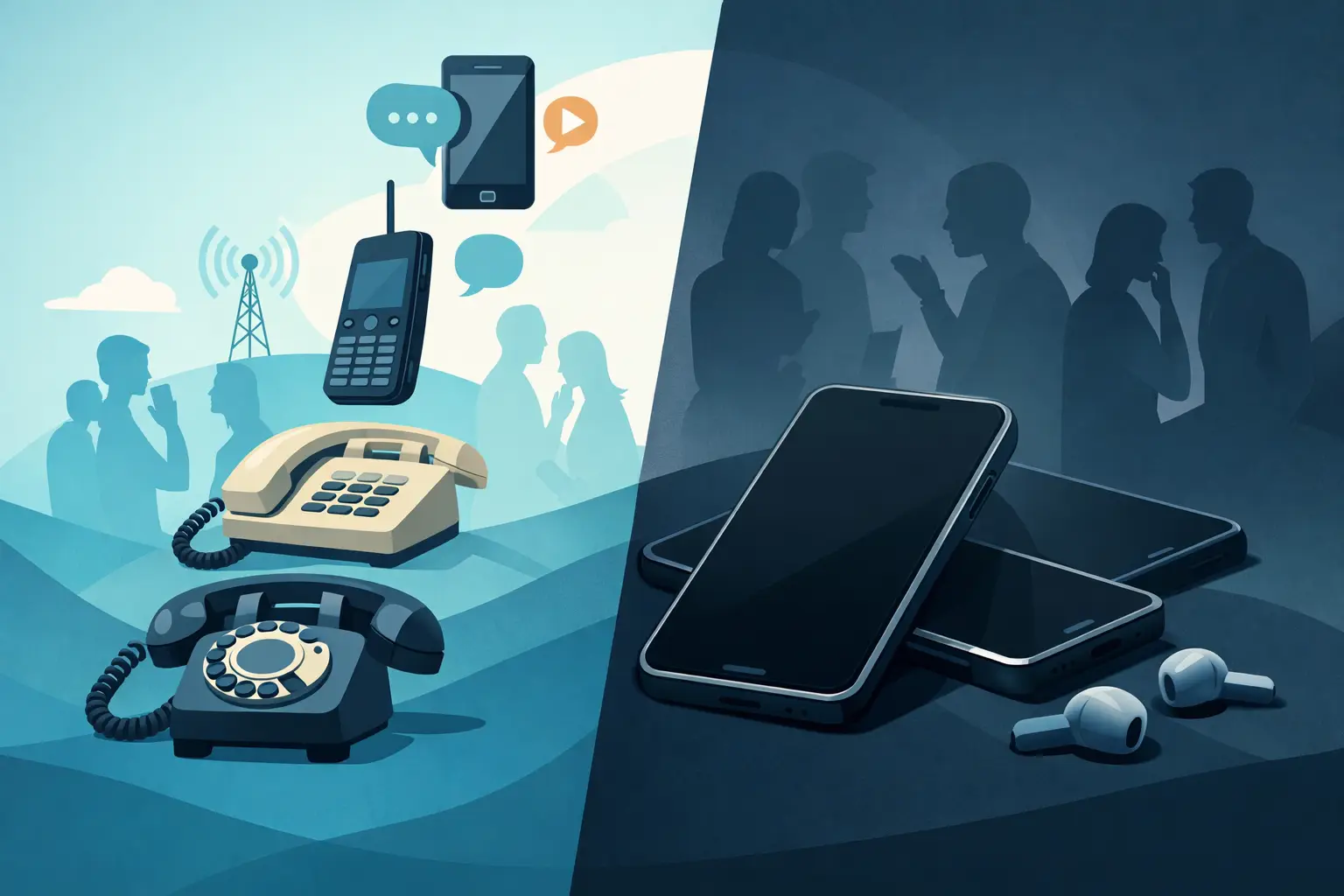
There is an odd contradiction at the heart of modern life. We spent 60 years improving communication, then we turned the phones off. Not literally, of course. The devices are everywhere: on restaurant tables, beside beds, in meetings and in the hands of people crossing roads. Yet the ordinary expectation that one person may telephone another, speak directly and settle a matter has quietly been withdrawn.
For those of us who began working when international contact meant a trunk call, a telex, an air letter or an expensive cable, this is more than nostalgia. It is a question of what communication is for. We have gained speed, volume and reach. We have also, in many organisations, lost the direct human exchange that creates trust, resolves ambiguity and makes responsibility difficult to evade.
Sixty years improving communication, then phones went off
In the late 1960s, overseas business required patience. A call to a customer or agent in another country had to be planned. The connection might be poor, the timing inconvenient and the cost substantial. When travelling, one could be away from home for weeks, sometimes months, with only occasional contact. A cable home was brief because every word cost money.
That limitation was real, and nobody sensible would wish to restore it. Families separated by work had too little contact. Exporters could lose time and orders while documents travelled by post. A misunderstanding might sit unresolved until the next meeting, or until a letter arrived. The technical advances that followed were genuinely liberating.
First came more reliable international telephony and fax. Then mobile telephones, email, video calls and instant messaging. A small manufacturer in Britain could communicate with a distributor in Asia or a customer in North America in minutes. A traveller could alter an itinerary, check a specification or speak to family from almost anywhere. For international trade, this reduced distance in a way that would once have seemed remarkable.
Yet the telephone, the most direct of these tools, has increasingly become the one organisations discourage people from using. Try calling a bank, utility, retailer, local authority or large delivery company. The invitation is often to consult a website, use a chatbot, enter a queue, authenticate yourself several times and explain the same problem to several different people. Many businesses publish a number but make it extremely difficult to find. Others have removed it altogether.
The stated reasons are familiar: cost control, efficiency, security and the ability to handle high volumes. Each has some merit. A routine enquiry may indeed be answered more cheaply online. Records of written exchanges can be useful. Fraud is a serious matter and identity must be checked properly. But these arguments are too often used to justify a system designed around the convenience of the institution rather than the needs of the person trying to deal with it.
A message is not necessarily communication
The modern preference for digital channels confuses the transmission of information with communication itself. A customer can submit a form, receive an automated acknowledgement and still be no nearer to a solution. An employee can send a dozen emails without anyone making a decision. A public body can publish pages of guidance while leaving the central question unanswered.
A conversation does something different. It permits a person to say, “No, that is not what I mean,” before the matter disappears into the wrong category. It allows judgement. It reveals uncertainty, urgency and good faith. It may expose a weak policy or an error in the computer record. Crucially, it creates a human connection in which someone has heard the problem and may feel responsible for helping to resolve it.
This mattered greatly in export work. A contract is not won merely by sending the correct literature or replying to a questionnaire. Overseas customers want to know who they are dealing with. They must assess whether a supplier understands the requirement, can deliver when promised and will remain available when trouble arises. Technical competence is essential, but trust is often built in conversation, in meetings and in the willingness to address difficulty plainly.
Email has a proper place. It is excellent for confirming details, circulating drawings, keeping a record and communicating across time zones. It is much less effective when a relationship is new, a dispute is developing or the subject is complex. The sensible course is often to speak first and write afterwards. Too many modern systems reverse that order, forcing people to write lengthy explanations before they are permitted to reach somebody able to understand them.
The hidden cost of avoiding people
Removing telephone access may reduce a visible cost on a spreadsheet, but it can create larger costs elsewhere. Customers give up. Mistakes remain uncorrected. Vulnerable people are excluded. Staff are left to manage frustration through rigid scripts and fragmented software. Senior management receives tidy reports showing digital uptake, but not the full number of people who abandoned the process because it was too difficult.
There is also a loss of institutional knowledge. The experienced clerk, engineer, account manager or service adviser who could recognise a familiar problem has been replaced in many settings by a workflow. Workflows are useful for standard cases. They fail precisely where experience matters most: exceptions, unusual circumstances and cases where the facts do not fit the prescribed boxes.
The public sector has a particular duty here. Citizens cannot always choose another provider when an official system fails. Nor should access to a service depend upon confidence with apps, passwords and online forms. Digital services can be efficient, but they must not become a barrier erected between public bodies and the public they exist to serve.
Technology should widen access, not narrow it
The argument is not for abandoning digital technology or insisting that every minor enquiry be handled by a call centre. That would be impractical and, in many cases, wasteful. The issue is choice and proportion.
A well-run organisation gives people a clear route to self-service for simple matters and a prompt route to a competent person when self-service fails. It does not hide its telephone number as if a customer calling were evidence of bad behaviour. It does not send people in circles between a website and an automated menu. And it does not treat an elderly customer, a busy small business owner or someone facing an urgent problem as an inconvenience because their case cannot be reduced to a standard form.
For exporters, the lesson is even clearer. Technology can maintain contact, manage documentation and support far-flung operations. It cannot replace the discipline of answering a call, returning one promptly or making the effort to understand another party’s circumstances. In unfamiliar markets, where culture, language and commercial practice may differ, personal contact remains an advantage rather than an outdated habit.
There is a further irony. The same businesses that make themselves difficult to contact often claim to be customer-centred. Customer focus is not a slogan, a survey or a carefully designed application. It is demonstrated when something goes wrong. Does a person answer? Can they understand the facts? Can they take ownership? The answers tell us more than any promotional campaign.
The advance of communications technology ought to have made organisations more reachable than ever. Instead, it has sometimes enabled them to become more remote while appearing more connected. The remedy is not complicated. Keep digital systems for what they do well, but retain a human door that opens when the situation requires it. A telephone call is not a failure of technology. Very often, it is the moment when communication finally begins.