
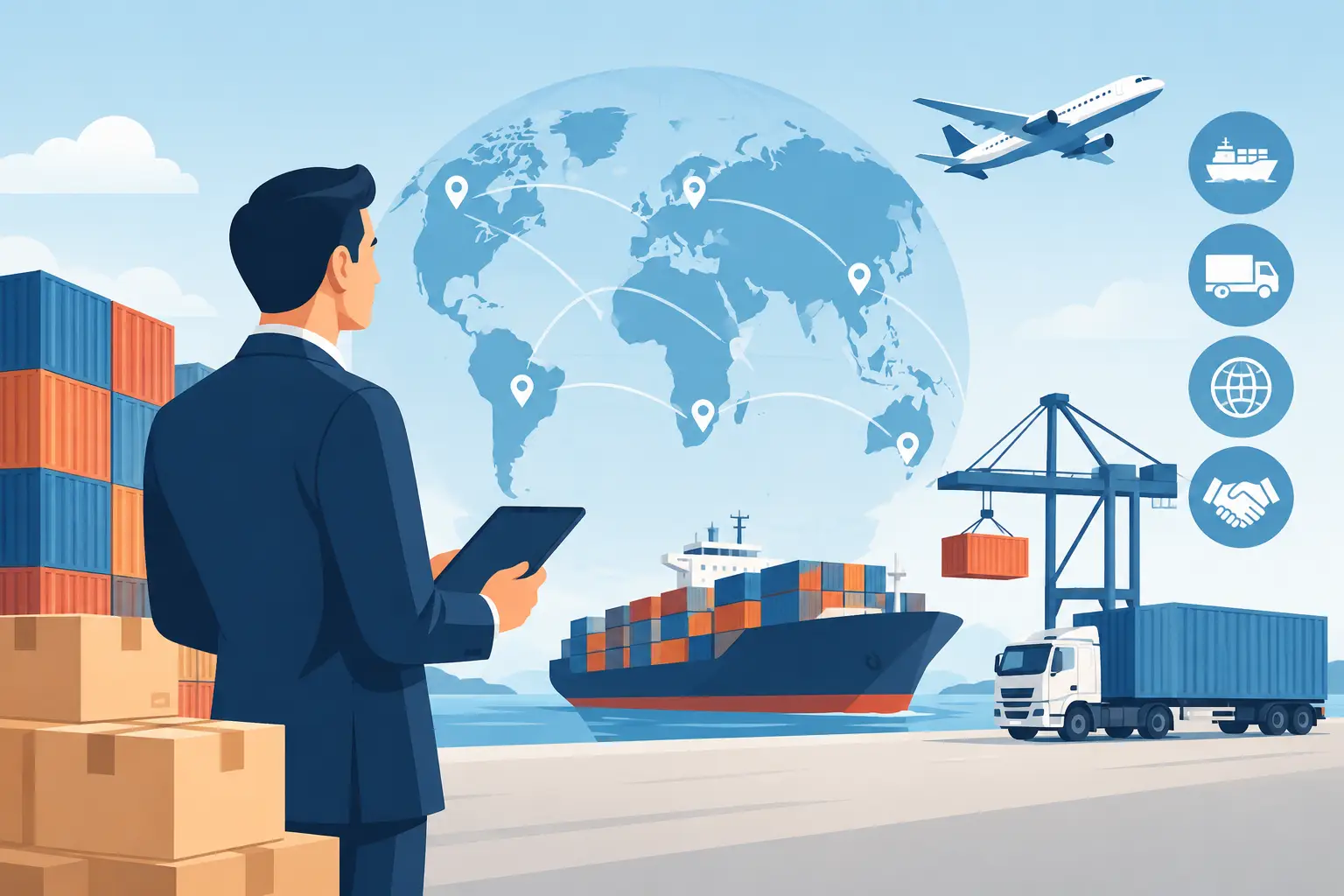
A promising enquiry, an attractive product and a buyer abroad are not, by themselves, an export business. What makes a good exporter is the ability to carry a transaction from first contact to final payment without losing control of the many practical details in between. That ability is learned over time, often through costly mistakes, and it is very different from simply being a successful salesman at home.
Exporting is sometimes described as selling overseas. This is true, but inadequate. A domestic sale may involve a familiar legal system, short delivery distances and established habits of payment. An export sale can involve another language, another commercial culture, an unfamiliar distribution chain, a long sea passage, currency movement, customs requirements and a buyer whose creditworthiness is not easily judged from a distance. Each introduces risk. The good exporter does not pretend these risks do not exist. He or she identifies them early and decides which can be accepted, insured against, priced into the contract or avoided.
What Makes a Good Exporter in Practice?
The short answer is sound judgement supported by discipline. The longer answer is that an exporter must combine commercial curiosity with caution. There is no single qualification that supplies all of it.
International trade has always depended on specialists. The banker understands payment mechanisms and credit. The freight forwarder knows routes, carriers and shipping documentation. The insurer assesses particular exposures. The lawyer advises on contracts and jurisdiction. A manufacturer knows whether a product can be made consistently to the promised specification. None of these people, however, carries the whole transaction in his or her head. The exporter must do so.
That calls for a working knowledge of several disciplines, rather than superficial acquaintance with one. It also calls for the modesty to consult those who know more. A bad exporter assumes that a signed order is the end of the selling task. A good exporter recognises that it is the beginning of an obligation.
Market choice comes before market enthusiasm
There is a persistent temptation to pursue whichever overseas enquiry arrives first. It may be from a country with rapid growth, an apparently energetic agent or a customer who promises substantial volumes. Yet a good enquiry is not necessarily a good market.
The sensible question is whether the product has a genuine place there and whether the exporter can serve it properly. This means looking beyond population figures and broad claims about opportunity. Who already supplies the market? What technical standards, labels or approvals apply? Is the price realistic after freight, duty, local margins and the cost of support? Does the buyer have access to the customers claimed?
Some markets are commercially attractive but administratively demanding. Others are easy to enter but difficult to make profitable. The right choice depends on the product, the resources of the firm and the degree of commitment available. A small manufacturer may be better served by building a dependable business in two neighbouring markets than scattering modest effort across ten countries.
The product must travel as well as sell
Many export difficulties begin in the factory, not at the port. A product that performs well in Britain may require alteration overseas. The voltage may differ. Instructions may need translation. Components may be unavailable locally. Climate, dust, humidity or rougher handling may expose weaknesses that were never apparent in domestic use.
Packaging deserves the same seriousness. Goods may be lifted several times, stored in poor conditions and subjected to a journey far longer than any domestic delivery. The cheapest carton can become very expensive when goods arrive damaged and the customer refuses them. Packing is not an afterthought performed by the dispatch department. It is part of the product and part of the promise made to the buyer.
The same applies to spare parts, installation and service. Capital equipment sold without a credible arrangement for maintenance may create an initial order but ruin the prospect of repeat business. In many overseas markets, reputation has travelled ahead of the salesman long before he arrives.
Good Exporters Treat Terms as Commercial Decisions
Price is often discussed as though it were a single number. In export it is a calculation built from several assumptions: manufacturing cost, packing, inland transport, freight, insurance, finance, commission, duty where relevant, exchange-rate exposure and the likely cost of after-sales support. Leave out one item and the sale may look profitable only until the accounts are examined.
Payment terms are equally fundamental. A buyer may be entirely genuine and still be unable or unwilling to pay on the agreed date. Political events, foreign-exchange controls and banking delays can affect a sound customer. The method of payment should match the country, the buyer, the order value and the relationship. Advance payment may be reasonable for a new customer and specially made goods; an established distributor may expect credit. Neither position is automatically right.
The exporter must also understand the obligation created by each term. A letter of credit, for example, can offer valuable protection, but only if the documents comply precisely with its requirements. Documentary errors that seem minor to the uninitiated can delay payment or give the buyer room to dispute it. Details matter because the bank deals with documents, not with assurances that the goods were shipped in good faith.
Documentation is evidence, not paperwork
Those who dismiss export documentation as bureaucracy usually have not had a consignment held at a border, a claim rejected or payment delayed. An invoice, packing list, certificate, transport document and origin declaration may each have a specific purpose. Together, they record what was sold, how it was packed, where it came from and on what terms it moved.
Modern systems have changed the speed of communication, but they have not removed the need for accuracy. An electronic error can travel faster than a typed one once did. Good exporters establish clear internal responsibility, check documents against the order and do not leave essential information to the last possible moment.
This is particularly relevant when using agents, distributors and forwarders. Delegation is necessary, but responsibility cannot be delegated away. The exporter who has not read the agreement, checked the shipping instructions or confirmed the insurance cover is relying on luck rather than management.
Relationships Need Patience and Clear Boundaries
Personal contact remains one of the great strengths of international trade. Visits reveal matters that reports do not: the standing of a prospective partner, the nature of their premises, the quality of their staff and the way they are regarded locally. They also expose the gap between polite assurances and operational reality.
But friendship is not a substitute for a clear agreement. The scope of a distributor’s territory, sales targets, stockholding, marketing responsibilities, use of trademarks, payment arrangements and termination provisions should be understood before problems arise. A vague arrangement may feel flexible in the early stages; it can become a serious source of disagreement when sales grow or fail to grow.
Cultural awareness matters here, though it is often reduced to clichés. The point is not to memorise a list of national characteristics. It is to listen carefully, avoid assumptions and recognise that commercial trust may be built at a different pace in different places. A direct British refusal, a hurried attempt to close a deal or an over-reliance on email can all be misread. Adaptation is sensible. Abandoning basic commercial standards is not.
Experience Teaches Proportion
No exporter can eliminate every risk or foresee every disruption. Ships are delayed, regulations change, currencies move and trusted people leave. The aim is not perfect certainty. It is to develop the habit of asking the right questions before a small uncertainty becomes an expensive problem.
This is why expertise in international trade is a long-term acquisition. It is formed through repeated contact with buyers, bankers, carriers, officials, factories and markets, and through seeing how one decision affects the next. Courses and guidance can provide a valuable foundation, but they cannot replace the judgement acquired when real goods, real money and a company’s reputation are at stake.
The good exporter is therefore neither reckless nor timid. He or she is prepared, observant and realistic about limitations. That combination is less glamorous than the image of the globe-trotting dealmaker, but it is what enables trade to continue when conditions become difficult. The next overseas order should be welcomed, certainly, but only after the exporter has worked out how to deliver it properly and be paid for it.