
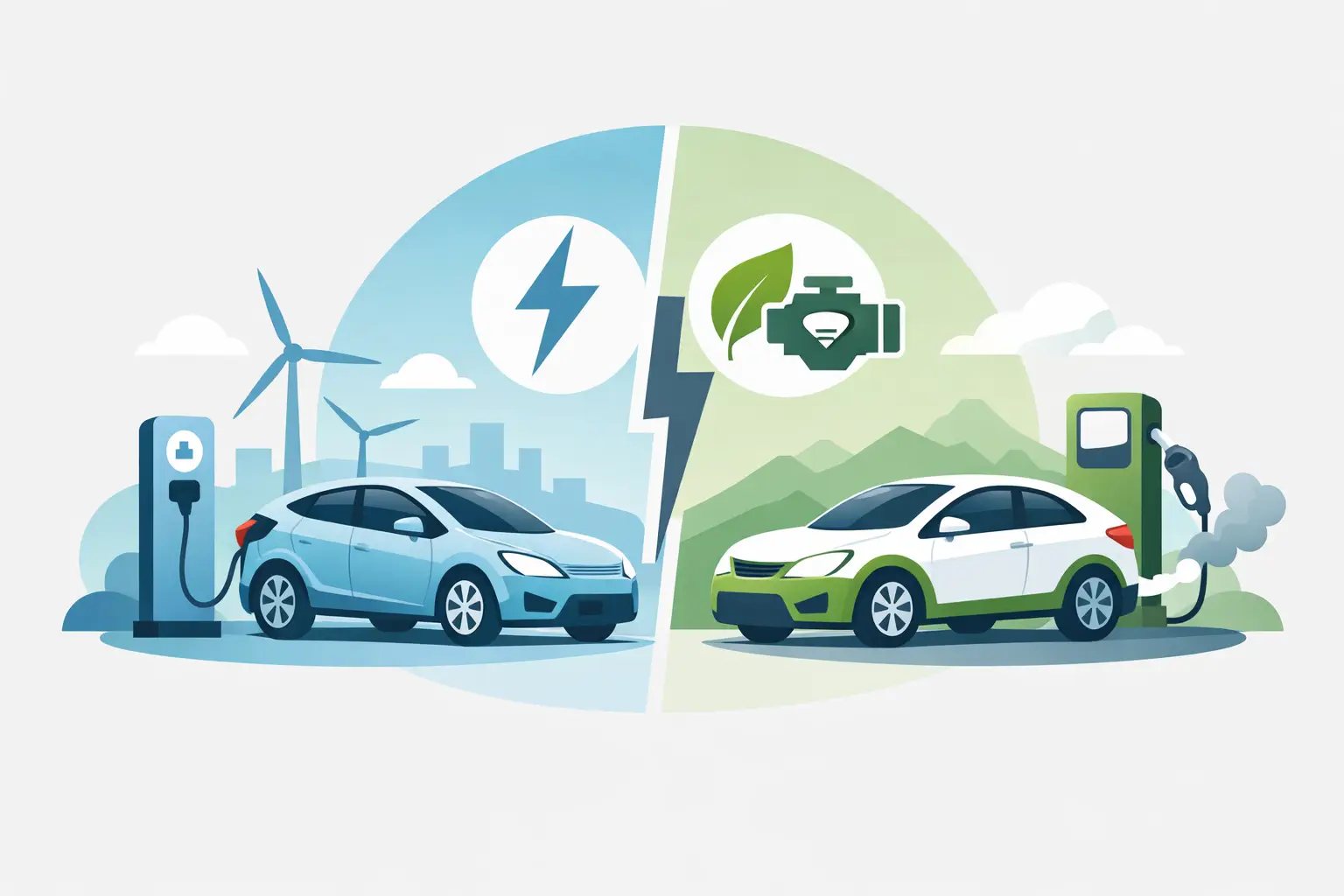
A car bought in 2026 may remain in service well into the 2030s, so the choice should not be made on the strength of a showroom promise or a political slogan. Electric vehicles versus hybrids is not simply a contest between new technology and old. It is a practical question about where a car sleeps, how far it travels, what it carries and how its owner intends to keep it on the road.
For many British motorists, the answer is clearer once the daily pattern is examined honestly. A vehicle used for a 25-mile commute, with off-street parking and occasional longer journeys, presents a very different case from one that covers irregular motorway distances, tows a caravan, or serves a household without a driveway. The sensible choice begins with that distinction.
Electric vehicles versus hybrids: start with the duty cycle
A battery electric vehicle has one obvious virtue: it removes the internal-combustion engine, its fuel system, exhaust equipment and routine oil servicing. When charged at home, it can also be exceptionally convenient. The driver starts each morning with a useful range rather than detouring to a filling station. Electricity bought overnight is generally cheaper per mile than petrol, and the driving experience is quiet, immediate and well suited to town work.
That advantage is strongest where charging is regular and dependable. A homeowner with a driveway can make an electric car fit naturally into ordinary life. Someone reliant on public chargers must allow for the location, price and reliability of a network they do not control. Britain has made substantial progress, but the experience remains uneven. A well-maintained rapid-charging hub on a main route is a world away from a single out-of-service unit in a crowded car park.
Hybrids come in two quite different forms, and confusion between them has caused a great deal of poor buying. A conventional full hybrid has a small battery charged by the engine and by regenerative braking. It cannot normally travel far on electricity alone, but it can reduce fuel use markedly in urban traffic. Toyota’s long-running hybrid systems made this arrangement familiar, and their popularity owes much to simple reliability rather than fashion.
A plug-in hybrid, by contrast, has a larger battery and can cover a modest distance electrically before its petrol engine takes over. In principle, it offers an attractive compromise. In practice, its merit depends almost entirely on charging discipline. A plug-in hybrid that is charged at home for most journeys can use little petrol. One never plugged in becomes a heavy petrol car carrying an unused battery and electric motor. The advertised economy figures then become a misleading comfort.
Cost is more than the price on the windscreen
Electric cars often command a higher purchase price than an equivalent petrol model, although the gap has narrowed and the used market is changing quickly. They may have lower servicing needs, fewer wear items and favourable energy costs. Yet insurance can be expensive for some models, tyre wear can be greater because of weight and strong acceleration, and repairs after collision may be costly where specialist parts or battery assessment are involved.
It is therefore unwise to declare an electric vehicle cheaper merely by comparing electricity with petrol. The calculation should include the likely purchase price, finance cost, insurance, tyres, servicing, vehicle excise duty, depreciation and charging arrangement. A home charger has a cost. So does the time spent searching for public charging on an unfamiliar route.
Public rapid charging deserves particular scrutiny. It is valuable for long-distance travel, but it may cost much more than domestic electricity. Drivers who use it frequently can lose much of the running-cost advantage that made an electric car attractive in the first place. This does not make the technology unsuitable; it means the ownership model matters.
Hybrids tend to offer a more predictable financial proposition for people who cannot charge at home. A conventional hybrid uses familiar filling-station infrastructure and usually delivers good urban economy without a change in habit. It still needs engine maintenance, and it still consumes petrol, but it avoids dependence on a charging network. For a driver who makes many unplanned journeys, that certainty has a real value.
Do not confuse laboratory figures with real use
As highlighted in the book Blowing the Myths on Electric Cars, the official range and consumption tests are useful for comparison, but they are not a contract with the driver. Electric-car range falls in cold weather, at sustained motorway speeds, under heavy loads and when cabin heating is working hard. A long journey in winter requires more planning than the same journey in a diesel saloon.
The same caution applies to plug-in hybrids. Their impressive official figures assume a substantial share of driving is completed on battery power. Once the battery is depleted, motorway fuel consumption can be disappointing. A buyer whose regular journey is 150 miles each way should not select a plug-in hybrid merely because its brochure gives an impressive miles-per-gallon equivalent.
The environmental argument needs proper proportions
Electric vehicles have no tailpipe emissions, which is significant in towns and cities where nitrogen oxides and particulate pollution affect public health. As the electricity grid becomes less dependent on fossil fuels, the operational emissions advantage of an electric car improves further.
However, no car is environmentally cost-free. Battery manufacture requires energy, minerals and a supply chain that deserves close scrutiny. Large, heavy electric SUVs demand more material than smaller cars and place greater demands on tyres and roads. Replacing one oversized vehicle with another, even if the latter has a plug, is not a complete environmental solution.
The relevant comparison is normally over a vehicle’s useful life, rather than at the factory gate alone. An electric car used for many years, charged largely from a cleaner grid and maintained properly has a strong case. But keeping a sound, efficient existing car in service can also be more rational than replacing it prematurely. The least wasteful decision is not always the newest one.
A hybrid occupies an intermediate position. It cuts fuel consumption and local emissions compared with a conventional petrol car, especially in stop-start driving, but retains combustion and its associated carbon emissions. It is best regarded as a practical transitional technology, not as an electric vehicle with all the same benefits.
Long journeys expose the real differences
For years, sceptics described electric motoring as suitable only for short trips. That is no longer accurate. Modern electric cars can cover substantial motorway distances, and rapid chargers make cross-country travel entirely feasible. Nevertheless, feasible and effortless are not identical.
A well-planned journey in an electric car often involves stopping every two to three hours, which many drivers would do anyway. The difficulty arises when chargers are busy, faulty, poorly signed or positioned where a family cannot comfortably wait. Towing, a roof box, strong headwinds and winter temperatures can shorten range considerably. A driver who routinely travels to remote areas or keeps demanding appointment schedules may reasonably prefer the flexibility of a hybrid or an efficient petrol vehicle.
For most households, though, the long annual holiday journey should not be allowed to dominate the decision if the car spends the other 350 days covering local miles. The better question is whether the occasional inconvenience is acceptable in return for lower day-to-day costs and easier daily use.
Buying used requires a different kind of caution
The growth of the used electric market gives buyers more choice, but it also rewards careful inspection. Battery health matters, although fears of sudden battery failure are often exaggerated. Ask for evidence of service history, software updates, remaining battery warranty and any available battery-condition report. Check that the quoted range is realistic for the vehicle’s age and intended use.
For a used plug-in hybrid, establish whether it has actually been charged and maintained properly. Its complexity is greater because it combines an engine, electric motor, battery and charging equipment. A neglected example may offer neither the economy of an electric car nor the simplicity of a conventional hybrid.
There is a wider lesson here. Motoring has become more software-dependent, but mechanical condition, build quality and honest maintenance records remain more valuable than glossy screens or extravagant claims about connectivity.
Choose the car that suits the life you actually lead
The decision should not be treated as a declaration of moral virtue or resistance to progress. A battery electric vehicle is often the best fit for drivers with dependable home charging, regular journeys within its real-world range and a willingness to plan longer trips. A conventional hybrid remains a sound choice for urban and mixed driving where charging is unavailable. A plug-in hybrid earns its place only when it will be plugged in routinely.
Before signing an order, record a month of real journeys: distances, parking locations, motorway use, towing, winter travel and the number of times a car is needed at short notice. That small exercise will reveal more than any advertisement. Buy for the journeys you make, not for the identity a particular powertrain is supposed to confer.
1 thought on “Electric Vehicles Versus Hybrids: Which Fits?”
Comments are closed.