
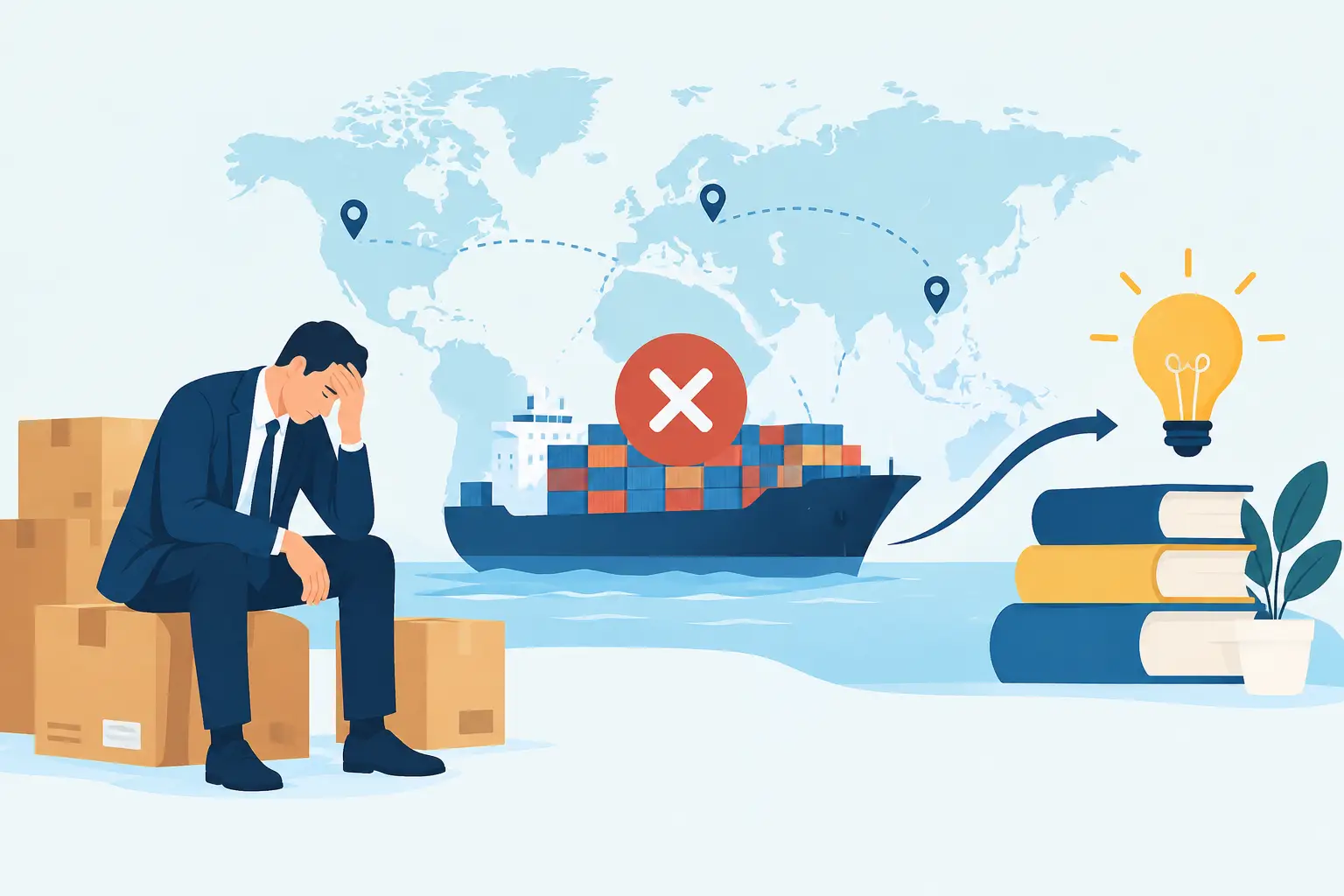
A firm can spend years developing a respectable product, appoint an agent overseas and secure what appears to be a promising first order, only to find that the profit has disappeared before the goods reach the customer. Export failure examples are rarely stories of one spectacular mistake. More often, they show a chain of ordinary decisions made without enough knowledge of the market, the contract or the practical mechanics of getting paid.
That is why exporting deserves more respect than it sometimes receives. It is not simply domestic selling with longer delivery distances. Every transaction brings together marketing, credit, law, transport, packing, customs procedure, insurance and human judgement. A weakness in any one of them can turn a sale into a loss.
Export failure examples: where good intentions go wrong
Consider a British engineering company that receives an enquiry from a new distributor in a fast-growing market. The distributor is enthusiastic, the order is sizeable and the prospect of repeat business is attractive. The manufacturer agrees to give open-account terms because the buyer says this is normal locally and because a competitor is said to be offering the same.
The goods are delivered, accepted and sold onwards. Payment, however, becomes slow. A query is raised about a minor technical point, then about quantities, then about a document. Months pass. The exporter has already paid for materials, labour, freight and commission. By the time the debt is recovered, if it is recovered at all, the margin has been consumed by finance costs and management time.
The failure was not merely a bad debt. It began when enthusiasm for an order displaced proper credit assessment and a sensible payment structure. In a first transaction, a confirmed letter of credit, advance payment, credit insurance or carefully controlled documentary collection may be more suitable. Each method has a cost and none removes every risk, but a supplier should understand what risk he is retaining and why.
A second common example concerns market selection. A company sees demand for its product in one country and assumes that demand alone is enough. It sends a sales manager for a short visit, finds several interested contacts and appoints the most energetic of them as sole agent for a large territory.
The agent may know many people but have little technical ability, inadequate capital and a portfolio of competing products. Alternatively, he may be perfectly capable but expect exclusivity, generous credit and extensive promotional support that the manufacturer cannot afford. Two years later there are few orders, no meaningful market intelligence and an awkward agreement that is difficult to end.
A distributor is not a substitute for a market plan. Before granting exclusivity, the exporter needs to know who buys, who influences the purchase, how the goods are specified, what local service is expected and whether the prospective representative can genuinely reach the relevant customers. A limited trial period with agreed targets often tells more than persuasive assurances over lunch.
The product that arrived but could not be used
Some of the most expensive failures occur after the sale has been made. A machine may be technically excellent in Britain yet unsuitable for its destination. Its electrical specification may be wrong, its instructions may not meet local requirements, its safety guards may fail a regulatory inspection or its spare parts may be impossible to obtain promptly.
There is also the less glamorous matter of packing. An exporter accustomed to sending goods by lorry across Europe may underestimate what happens when a consignment is lifted repeatedly, left on a quay, exposed to tropical humidity or held in a customs warehouse. A wooden case that is adequate for a short road journey is not necessarily adequate for a sea voyage and rough inland handling.
One familiar pattern is a dispute over damaged goods in which everyone blames someone else. The buyer says the equipment arrived damaged. The freight forwarder says the cases appeared sound when collected. The insurer asks whether packing was fit for the voyage and whether the damage was reported within the required period. The exporter discovers that photographs were not taken, the packing specification was vague and responsibility under the agreed Incoterm was poorly understood.
Good packing is not an optional extra added at the end of production. It is part of the product delivered to the customer. The exporter should consider weight, lifting points, moisture protection, corrosion prevention, theft, labelling, local climate and the likely number of handling stages. The cheaper case can prove very costly if it arrives with an expensive item of equipment unusable inside it.
Paperwork is commercial, not clerical
In earlier decades, export documentation involved a formidable amount of paper, stamps, signatures and courier services. Digital systems have reduced some of that burden, but they have not changed the underlying truth: documents determine whether goods clear, whether banks release money and whether a buyer can take delivery.
A small discrepancy can cause disproportionate trouble. The invoice description may not match the wording on the letter of credit. The bill of lading may show a date outside the permitted shipping period. The certificate of origin may be missing, incorrect or issued too late. A customs commodity code may be wrong, leading to delay, extra duty or an enquiry from the authorities.
It is tempting to regard this as administration that can be handed to a junior employee or entirely to a freight agent. Specialists are valuable, but the exporter remains responsible for understanding the transaction. A banker may understand payment instruments without knowing the packing requirements. A shipping expert may organise transport without knowing the commercial significance of a technical specification. International trade works only when these disciplines connect.
The practical answer is not to make every sales person an expert in every detail. It is to establish clear ownership, use reliable advisers, check documents against the contract before shipment and ensure that someone experienced reviews unusual or high-value transactions. The cost is modest compared with a delayed shipment, rejected documents or an unpaid invoice.
When price wins the order and loses the business
Another of the more revealing export failure examples is the quotation that secures business at a price that was never viable. The error often begins with an incomplete calculation. The exporter includes factory cost and a modest profit but overlooks export packing, inland haulage, freight fluctuations, insurance, bank charges, agents’ commission, local certification, warranty support and the cost of holding spare parts.
Currency adds another uncertainty. A contract priced in sterling may be unattractive to an overseas buyer; one priced in the buyer’s currency may expose the British supplier to exchange losses. There is no universal answer. The right approach depends on the currency, duration, competitiveness of the market and ability to hedge. What matters is that the decision is deliberate rather than an afterthought.
Underpricing can be especially destructive in project work. A company wins a prestigious overseas contract and discovers that installation takes longer than expected, local labour rules increase costs, travel is more frequent than budgeted and the customer interprets the specification more broadly than the supplier intended. The firm may complete the work to protect its reputation but quietly lose money throughout.
A detailed scope of supply, written exclusions, realistic contingency and agreed procedures for variations are not signs of mistrust. They are the foundation of a workable relationship. The best overseas customers usually understand this. They have learned, as exporters have, that ambiguity produces disputes.
What these failures have in common
The thread running through such cases is not incompetence. Many are made by capable firms with good products and hardworking people. The trouble is that success at home can create false confidence abroad. A domestic customer may be known personally, speak the same commercial language and operate under familiar law. Overseas, distance magnifies misunderstanding and makes correction slower and dearer.
There is also a tendency to look for a single expert who will solve everything. International trade does not work that way. A lawyer, banker, freight forwarder, insurer and market consultant may each be excellent in their own field, yet none can make the overall commercial judgement for the exporter. That judgement requires the business to bring the separate strands together.
Preventing the next avoidable loss
The sensible exporter begins before the quotation is issued. Is there a real market rather than one promising enquiry? Is the buyer creditworthy? Can the product be used, maintained and legally sold in the destination? What payment terms are acceptable? Who bears the cost and risk at each stage? Can the company support the customer after delivery?
For a new market, it is usually wise to start in manageable fashion. A smaller order, cautious credit terms and a non-exclusive arrangement may feel less ambitious, but they provide evidence. If the relationship works, it can be expanded with confidence. If it does not, the cost of withdrawal is contained.
Experience does not remove risk from exporting. It teaches where risk tends to hide: in an assumption about an agent, a line in a contract, a damp container, a missing document or a promise of payment that has not been tested. The useful lesson from export failure is not to avoid overseas business, but to treat every part of it as seriously as the product itself.