
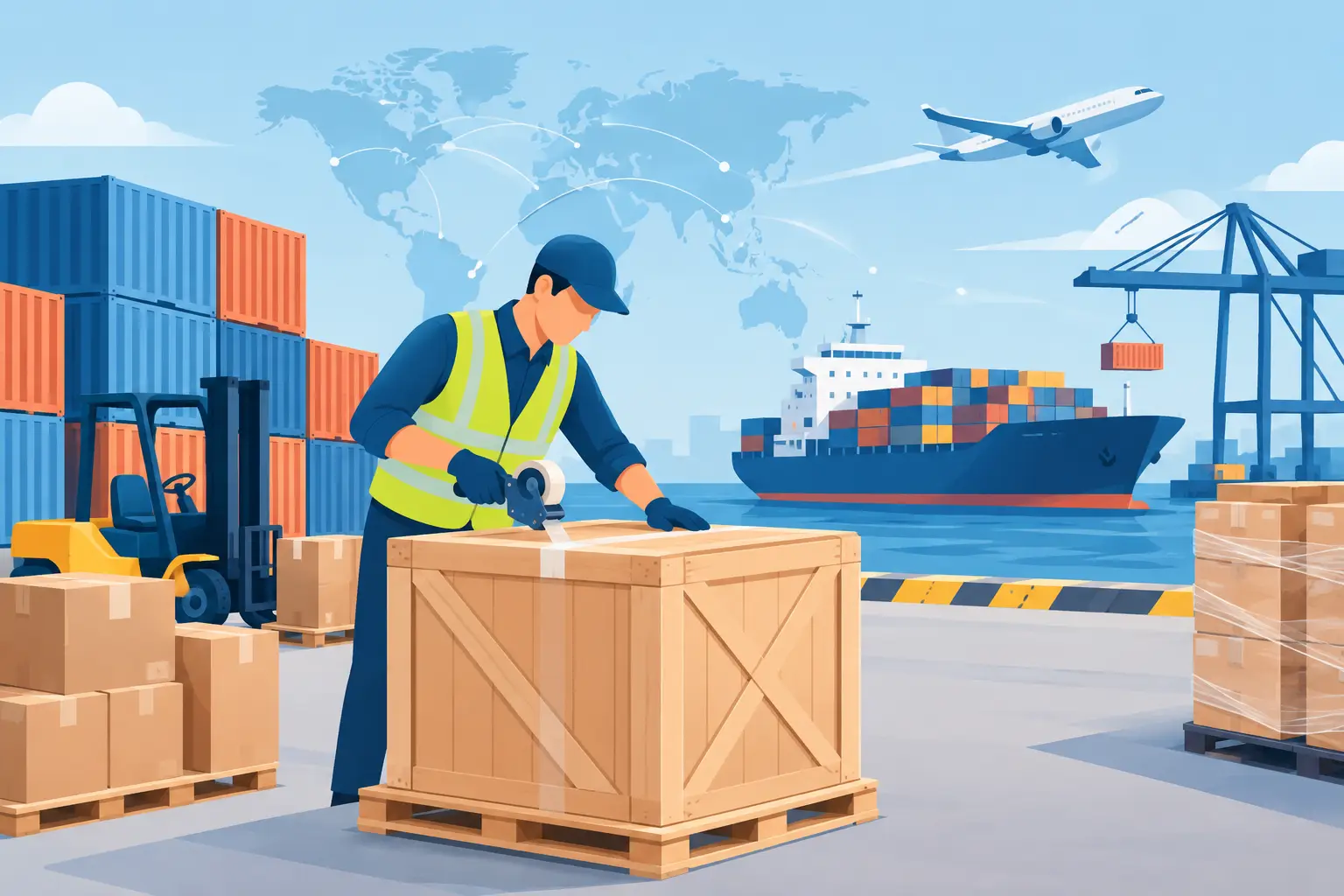
A consignment can be well made, competitively priced and urgently wanted by the customer, yet still fail because of export packing. The damage may not become visible until a crate is opened at the far end of a long sea journey. By then, the exporter has an unhappy buyer, an argument with insurers, a claim against a carrier and, often, little practical remedy. Packing is not the minor operation that follows the important work. It is part of the sale.
Those who have worked in export know that a product’s journey rarely resembles its journey from factory to local customer. It may be lifted several times, held in a humid port, travelled by road on poor surfaces, spent weeks in a container and encountered a climate very different from that of its place of manufacture. The package must withstand all this without relying on goodwill or careful handling.
Export Packing Is an Exercise in Foresight
Domestic packing is usually designed for a known journey and a familiar distribution system. Export packing has to allow for uncertainties. The exporter may know the nominated port and the intended method of transport, but not every warehouse, transfer point or delay along the way. A case that is entirely adequate for a palletised lorry delivery in Britain may be wholly unsuitable for a mixed sea and road movement to a distant inland destination.
The right packing begins with questions that are sometimes asked too late: what exactly is being sent; how fragile is it; what is its value; how will it be handled; and what climate will it meet? A precision instrument, a steel fabrication, a cabinet of electrical controls and a consignment of spare parts each require different protection. There is no useful universal answer beyond the rather obvious one that the packing must fit both the goods and the route.
Sea freight creates particular difficulties. Moisture is the persistent enemy, whether through rain during loading, condensation inside a container or prolonged exposure to humid air. Metal surfaces can corrode, paper and timber components can deteriorate, and electrical equipment can suffer damage that is not apparent at first inspection. Desiccants, vapour barriers and properly sealed inner wrapping may matter as much as the outer case.
Air freight offers a different calculation. Weight becomes expensive, so a heavy timber case may be commercially foolish even when it offers excellent protection. Here, well-designed lightweight materials and careful internal restraint can be preferable. The saving, however, must be genuine. Reducing the weight of packing is not a success if the result is damaged goods, rejected by the buyer or rendered unsaleable.
The Case Is Only One Part of Export Packing
People often use the word packing to mean a wooden crate. That is too narrow. Good export packing is a system: the preparation of the item, its internal support, protection against moisture and abrasion, the outer package, labelling, marks and the information needed for safe movement.
An item must not merely fit inside its case. It must be held so that it cannot move under shock, vibration or changes of orientation. Empty space is not harmless space. A heavy component that shifts inside a crate can damage itself, break through the case or make the load unsafe to lift. Fragile parts need separation from hard surfaces, and projecting sections may need purpose-made supports rather than a few pieces of loose cushioning.
For machinery and engineering equipment, preservation is often overlooked. Bare metal needs suitable protective treatment before it is wrapped. Openings may need sealing. Loose components should be identified and packed so that the consignee can recognise what belongs where. A buyer should not have to search through sawdust and timber offcuts for a small but essential fitting.
Outer cases must also be made for the equipment available at the receiving end. A large, heavy case without clear lifting points can become a costly problem in a depot with only basic handling facilities. Centre-of-gravity marks, lifting instructions and durable identification are practical necessities, not decoration. If the goods must remain upright, that instruction should be prominent, but the exporter should still assume that someone, somewhere, may ignore it.
Timber, Regulations and the Cost of Assumptions
Timber remains useful because it is strong, repairable and familiar to freight handlers. Yet it carries obligations. Many countries require solid wood packaging material to meet recognised phytosanitary standards, commonly evidenced by the ISPM 15 mark. The purpose is to prevent the movement of pests in untreated wood.
This is not an administrative nicety. A non-compliant case can be delayed, refused entry, treated or destroyed at the destination, with costs that soon exceed the modest saving made by using the wrong material or an unqualified supplier. Plywood and other processed wood products may be treated differently, but exporters should not make assumptions. The destination country’s rules and the precise packing material both matter.
Marks on the case should support, rather than confuse, the transport and customs process. They normally need to identify the consignee, destination, package number and relevant handling requirements. Where several cases form one consignment, numbering such as “case 1 of 4” helps the receiver spot a missing piece before an installation team is left waiting.
There is a balance to be struck over markings. They should be sufficiently clear for legitimate handling and delivery, while not needlessly advertising a valuable or attractive cargo. This is one of many areas where sensible judgement, based on the nature of the goods and the country concerned, is worth more than a standard instruction sheet.
Responsibility Cannot Be Packed Away
A common source of dispute is the belief that once goods have been handed to a freight forwarder, responsibility for their condition has passed elsewhere. The legal position depends on the sale contract, the agreed Incoterm, insurance arrangements and the point at which risk transfers. The commercial reality is simpler: the buyer will remember who supplied the damaged goods.
A forwarder can arrange transport and advise on shipping practice. A specialist packing firm can build cases and prepare cargo for dispatch. Both have valuable roles. Neither automatically understands the product as the manufacturer or exporter does. The exporter must provide accurate dimensions, weights, lifting requirements, fragility information and any special preservation needs. Leaving a packing contractor to guess is a poor substitute for specification.
This is why written packing instructions are valuable, particularly for repeated shipments. They establish the required materials, case design, internal blocking, moisture protection, labels and photographs. Photographs taken before dispatch can be useful evidence if damage occurs, but their greater value is preventative: they encourage everyone involved to look critically at the finished job.
Insurance should be considered alongside, not after, packing. Policies can contain conditions relating to suitability of packing, and a claim may become difficult if the insurer considers the goods inadequately protected for their declared journey. Cheap insurance is not an answer to negligent preparation. Nor does a policy repair the loss of confidence when a vital order arrives unusable.
The Cheapest Method Is Often the Dearest
Exporters are rightly concerned about cost. Timber, labour, container space and air-freight weight all affect the quotation. But packing should be judged against the total exposure, not merely the cost per case. The true comparison is between an adequate package and the cost of replacement production, expedited freight, lost time, claims administration and a damaged trading relationship.
There are occasions when elaborate packing is unnecessary. Durable low-value goods moving by a short, controlled road route do not need to be treated as precision equipment bound for a tropical port. Equally, an occasional exporter should not attempt to economise by applying domestic methods to a complex overseas movement. Proportion is the principle.
The most reliable exporters make packing part of product and contract planning. They know the packed dimensions before quoting freight, specify who is responsible for loading and securing the goods, and allow time for proper preparation. This is less dramatic than winning the order, but it is often what determines whether that order leads to the next one.
Export trade is built on promises made across distance. Sound export packing is one of the quiet disciplines that makes those promises credible when the goods finally reach the buyer’s hands.