
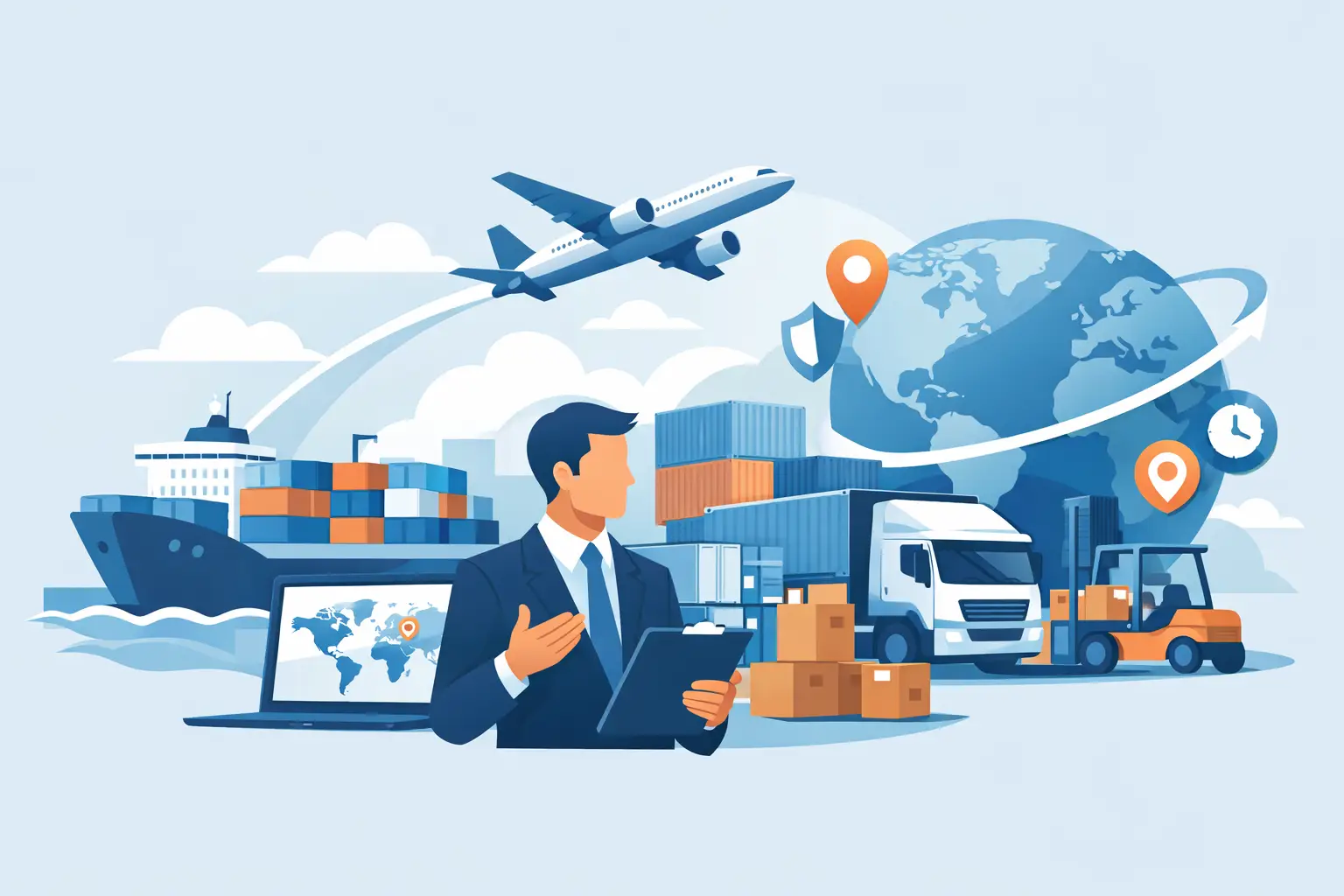
A shipment can look straightforward on a sales order: collect the goods, book the transport, send the documents and await payment. Anyone who has spent time in export knows better. Never underestimate a freight forwarder, because the apparent simplicity of moving goods between countries conceals a chain of decisions in which one overlooked detail can stop a consignment, absorb a profit margin or sour a customer relationship built over years.
Freight forwarders are sometimes treated as mere booking agents, called upon after the commercial work has been done. That is a costly misunderstanding. A good forwarder is often the person who sees the whole physical transaction at once: the nature of the goods, the packing, the route, the carrier, the port, the customs requirements, the insurance exposure and the deadline that matters at the other end.
Why Never Underestimate a Freight Forwarder
In the days before electronic tracking, exporters relied heavily on forwarders for information as well as movement. A telephone call to the dock, an experienced clerk who knew which vessel had actually sailed, or a contact at an overseas agent could make the difference between a manageable delay and a serious dispute. Technology has altered the speed at which information travels, but it has not removed the need for judgement. A screen may report that a container is at a terminal. It does not necessarily tell an inexperienced exporter why it is there, what must happen next, or who has the practical influence to resolve the problem.
The freight forwarder works at the junction between commercial ambition and operational reality. Sales staff understandably want to promise an attractive delivery date. Purchasing departments want the lowest apparent transport price. Finance teams want documents that satisfy the bank or support a payment claim. The forwarder must translate all that into a shipment which can actually travel.
This is not simply a matter of knowing airline schedules or container rates. It means recognising when a consignment is badly packed for its journey, when a road movement needs special equipment, when a commodity is likely to attract customs attention, or when the chosen Incoterm leaves a dangerous gap in responsibility. It may mean advising that the cheapest route is not the least expensive once handling, storage, delay and risk have been considered.
A forwarder also understands that international transport has personalities as well as procedures. Ports, carriers, warehouses, customs authorities and overseas agents all operate within rules, but they do not operate identically. Local practice matters. So does knowing which question to ask before the lorry arrives at the factory gate.
An Example from the past – The Sixty-Foot Problem
In the late 1960s, the company for which the author worked received an unusual order: a consignment of copper-alloy tubes, each approximately sixty feet long, required for the construction of a power station in Tehran.
Manufacturing the tubes was demanding enough. Delivering them presented an entirely different problem.
Modern heavy transport equipment, extendable trailers and specialist project-cargo services were still comparatively limited. British roads were narrower, many junctions were tighter, and the lorries of the period were generally shorter and less manoeuvrable than those used today. A sixty-foot tube could not simply be placed on a conventional vehicle and driven from the factory to the docks.
Even if the tubes could be brought to the port, there remained the much greater difficulty of moving them through Iran.
The established route through Khorramshahr involved roads and inland transport that were wholly unsuitable for cargo of such extraordinary length.
There were not enough tubes, nor was the order sufficiently valuable, to justify employing one of the specialist heavy-haulage companies of the day, such as Pickford’s. The consignment was too large for ordinary transport, yet too small to justify the cost of mounting a major specialist operation. It was a logistics nightmare.
The company’s shipping manager sat down with the freight forwarder, and together they began examining every possible route. Each solution appeared to create another difficulty. Fortunately, the factory still shared a private railway siding with the tar-distilling works next door. Although railway closures were already reshaping Britain’s transport network following the Beeching programme, this particular industrial siding remained operational.
The freight forwarder contacted British Rail. After considering the dimensions and weight of the consignment, British Rail confirmed that it could provide a long flat-bed railway wagon capable of carrying the sixty-foot load from the factory siding to the docks.
That solved only the first stage.
The next question was how to carry the tubes by sea.
Most international cargo at the time travelled aboard conventional break-bulk vessels. Goods were lifted individually by crane and lowered into holds below deck. Roll-on, roll-off shipping was beginning to develop, while freight containers were still a relatively new innovation and had not yet become the standardised global transport system familiar today.
The tubes were too long to fit conveniently into a conventional ship’s cargo hold. They could not be placed inside a container, and there was no suitable road vehicle waiting at the destination to carry them inland. The only realistic possibility was to lash them securely on deck.
For several days, the shipping manager and freight forwarder worked through the problem. Routes were investigated, shipping lines contacted and handling methods examined. One possibility after another was considered and rejected. Every apparent solution failed somewhere between the factory in Yorkshire and the power station in Tehran.
Eventually, they devised a route of remarkable complexity.
The tubes would first be enclosed in specially constructed wooden cases. Each case was approximately twenty-four inches, or 600 millimetres, square and sixty feet, or eighteen metres, long. The cases had to be strong enough to protect the tubes through repeated lifting, exposure to weather and several changes of transport.
They would then be loaded directly onto a British Rail long flat-bed wagon in the private siding beside the company’s premises.
From there, the wagon would travel by rail to King George Dock in Hull. At the dockside, cranes would lift the enormous wooden cases from the railway wagon and place them on the open deck of a Soviet timber-carrying vessel bound for Leningrad, now St Petersburg.
That was only the beginning of their journey.
On arrival in Leningrad, a barge was arranged to come alongside the freighter. The sixty-foot cases were carefully lifted from the ship and lowered onto the deck of the already heavily laden barge.
The barge then entered the Soviet inland waterway system, navigating through a complex network of rivers, lakes and canals before joining the Volga and continuing southwards into the Caspian Sea.
Its destination was an Iranian port on the Caspian coast. Tehran lies considerably closer to the Caspian Sea than to Iran’s ports on the Persian Gulf, making this highly unconventional northern route a practical solution to an otherwise formidable transport problem.
The contract was CIF Iranian port, so the exporter’s responsibility ended when the consignment reached the nominated Caspian destination. The purchaser was responsible for arranging the final overland movement from the port to the power station in Tehran.
The route was indirect, complicated and dependent upon precise coordination between British Rail, dock workers, shipping agents, Soviet vessel operators, barge owners and port authorities. A failure at any one transfer point could have delayed the consignment indefinitely.
Yet the plan worked.
The tubes left the factory siding on a railway wagon, travelled to Hull, crossed the North Sea to Leningrad, passed through the Soviet Union by river and canal, and finally entered the Caspian Sea before being delivered to the Iranian port named in the contract.
It was an extraordinary solution to an almost impossible transport problem—and a striking example of the ingenuity required in international trade before computerised logistics, satellite tracking and modern project-cargo networks.
Never underestimate the resourcefulness of an experienced freight forwarder see The Export Adventurer.
The Cost of Treating Freight as an Afterthought
Many export problems begin with a quotation prepared without sufficient thought about transport. An exporter may quote carriage paid to a distant destination without checking the true inland costs, the availability of equipment, or whether the buyer expects delivery to a place that cannot readily accept the chosen vehicle. The order is won, only for the exporter to discover that freight has consumed the anticipated profit.
This is particularly common when goods are awkward rather than simply heavy. Machinery may require specialist lifting.
Fragile equipment may need purpose-built cases. Hazardous materials may require declarations, approved packaging and carefully selected carriers. Food, pharmaceuticals and temperature-sensitive products bring their own controls. In each case, the forwarder’s early advice is far cheaper than a late correction.
Documentation remains another area where false confidence causes trouble. Exporters can now obtain information online and generate documents from software, which is useful up to a point. But a document is not sound merely because it has been printed neatly. Its description of goods must align with the commercial invoice, packing list, customs declaration and, where relevant, certificate of origin or letter of credit. Dates, consignee details, marks and quantities all matter.
The experienced forwarder will often spot an inconsistency that the exporter has not seen. That may feel irritating at the time, especially when a shipment is pressing. It is preferable to discovering the error after departure, when documents have gone to a bank, a customs office or a buyer who is already dissatisfied.
Cheap freight is not always economical freight
There is nothing wrong with seeking competitive rates. Freight is a genuine cost of trade, and it deserves scrutiny. However, buying purely on price is much like choosing industrial equipment solely because it was cheapest in the catalogue. The purchase price is only one part of the calculation.
A low rate may involve an inconvenient transhipment, a long period before sailing, poor communication, limited liability or charges that emerge later at destination. It may be appropriate for non-urgent, low-value goods going to an established customer. It may be wholly unsuitable for a first order, a time-critical spare part or equipment required for a project with contractual penalties.
A competent forwarder should explain these choices plainly. If they cannot explain the difference between a cheap option and a reliable one, the exporter is not being properly advised. Equally, exporters must be honest about what matters most: speed, certainty, cost, security or a balance between them. No forwarder can make an impossible combination of requirements possible.
A Forwarder Protects the Commercial Relationship
The consignee abroad rarely distinguishes between a delay caused by a carrier, a port, an incorrect export instruction or poor packing. In the buyer’s mind, the exporter has failed to deliver. That is why freight forwarding is not a back-office activity. It is part of customer service and, in many markets, part of the exporter’s reputation.
A forwarder with sound overseas representation can be especially valuable when difficulties arise. A container held for examination, goods arriving without the expected release instruction, or a damaged case on discharge requires someone who can act locally and report accurately. The exporter needs facts, not hopeful assurances. The customer needs to know that somebody is dealing with the matter.
This human element remains important despite the growth of large integrated logistics businesses. Scale can bring buying power, systems and broad coverage. Yet a smaller specialist forwarder may offer closer attention, deeper knowledge of a particular trade lane or commodity, and direct access to the person responsible. It depends on the exporter’s business. There is no universal answer, and loyalty should be earned through performance rather than habit.
For a new exporter, the forwarder can also provide a useful discipline. Before accepting an order, ask how the goods will be packed, where collection will take place, who is responsible at each stage, what documents are required and whether insurance is adequate. These are not administrative details to be left until dispatch day. They are questions that should influence the original quotation and contract.
How to Work Properly With a Freight Forwarder
The best relationship is one in which the exporter supplies clear, complete information and the forwarder challenges assumptions when necessary. Vague instructions such as “send it urgently” are an invitation to confusion. The forwarder needs dimensions, weights, number of packages, goods description, value, collection readiness, destination, delivery requirements and the agreed Incoterm. If the cargo has special characteristics, say so at the outset.
It is equally wise to involve the forwarder before making promises to an overseas buyer. A proposed shipment may be possible, but not on the stated date or at the assumed cost. Early discussion gives room to choose a better route, amend the packing, consolidate freight or alter the delivery term. Once a promise is in writing, flexibility rapidly disappears.
Export training quite properly separates subjects such as customs procedures, commodity codes, rules of origin, payment methods and freight forwarding. In practical trade, however, they meet in the same shipment. The exporter who understands this overall picture is less likely to regard a forwarder as an expense to be squeezed and more likely to see them as a professional partner whose work supports the sale.
The strongest freight forwarders do not merely move boxes. They prevent foreseeable mistakes, interpret changing circumstances and keep goods, documents and people aligned when the journey becomes less tidy than the original plan. That quiet competence seldom appears on a sales invoice, but it is often what allows an exporter to trade with confidence far beyond home shores.
2 thoughts on “Why Never Underestimate a Freight Forwarder”
Comments are closed.