
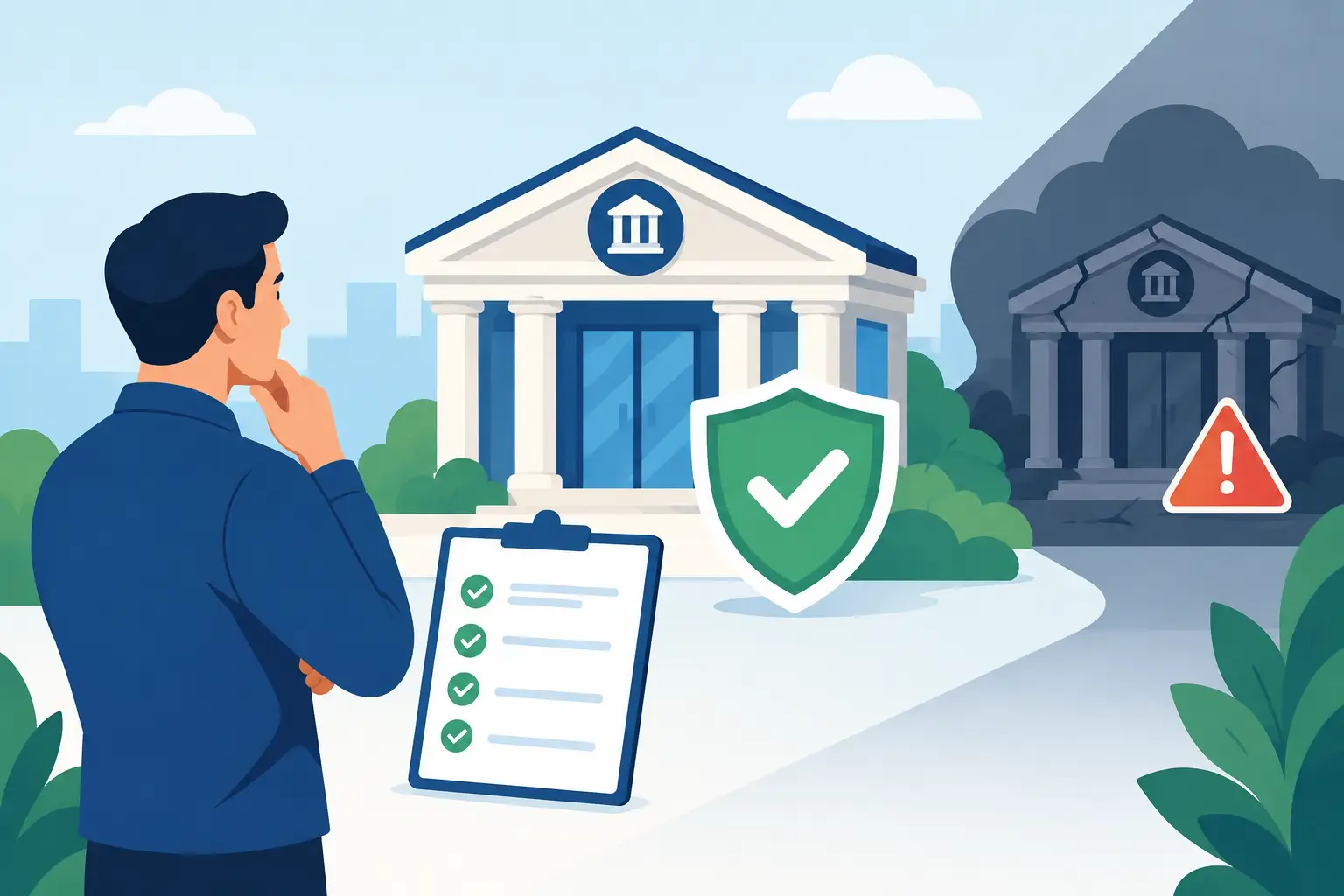
Bank risk, documentary compliance and the limits of cash against documents
A Letter of Credit is often described as one of the safest methods of payment in international trade. It can be – but only if the bank undertaking to pay is itself sound, able to transfer the currency and legally permitted to honour its obligation.
Exporters quite properly devote enormous attention to the wording of a credit. We check the latest shipment date, expiry date, description of the goods, invoice requirements, packing lists, certificates of origin, bills of lading and every other document demanded. Yet there is a more basic question which can easily be overlooked: who has actually promised to pay?
A familiar name, an impressive overseas head office or a branch in London can create an impression of permanence. Banking history tells us that the impression is not always deserved. Barings collapsed in 1995. The Bank of Credit and Commerce International was closed in 1991. Lehman Brothers failed during the 2008 financial crisis, while other banks in Britain, America and Europe required rescue, nationalisation, merger or takeover. Midland, Halifax and the Co-operative Bank survived in changed ownership, but their histories still demonstrate that even established banking names do not necessarily remain independent or unchanged.
For an exporter, this is not the same question as the safety of money in a personal deposit account. A commercial payment of hundreds of thousands of pounds is not made safe merely because a country has a deposit-protection scheme. The exporter must assess the payment undertaking, the institution behind it and the political and transfer risks surrounding it.
The Payment Method Changes the Risk
The expression bank payment can conceal several quite different arrangements. They should never be treated as though they offer the same protection.
Under an unconfirmed Letter of Credit, the issuing bank gives its undertaking to pay when complying documents are presented. The buyer’s commercial promise is therefore replaced, to a considerable extent, by the undertaking of the issuing bank. But the exporter has also accepted the credit risk of that bank and the country in which it operates. A confirmation added by another bank can provide a second, separate undertaking to pay, provided the documents comply. This may transfer much of the issuing-bank and country risk to the confirming bank. The quality of that protection depends upon who the confirming bank is and precisely what it has agreed to do. An advising bank which merely authenticates and forwards the credit has not necessarily confirmed it.
A crucial distinction also exists between confirmation by an independent bank and apparent confirmation through another office of the issuing bank itself. A London branch may look reassuring, but a branch is normally part of the same legal bank rather than a separate institution with independent resources. If the parent bank fails, loses access to foreign currency, becomes subject to sanctions or is ordered to close, both offices may be affected.
A documentary collection offers much less protection. Under documents against payment, often described as cash against documents, the exporter’s bank sends the commercial and shipping documents through banking channels with instructions that they should be released only against payment. The banks handle the documents, but they do not normally promise that the buyer will pay. If the buyer refuses, the exporter may still own goods sitting at a distant port while storage, demurrage, insurance, deterioration or return-freight costs accumulate.
Documents against acceptance carries still greater buyer risk. The documents are released when the buyer accepts a bill of exchange payable at a future date. The exporter has exchanged control of the documents for the buyer’s promise to pay later. Unless a bank has added its own aval or guarantee, that is not the same security as a confirmed Letter of Credit. The practical hierarchy is therefore important. Advance payment protects the exporter most strongly but may be unacceptable to the buyer. A confirmed Letter of Credit can provide strong bank-backed security. An unconfirmed credit leaves the exporter exposed to the issuing bank and its country. Documentary collection protects control of the documents, not payment itself. Open account relies principally on the buyer’s willingness and ability to pay.
The Risk I Did Not Know I Was Taking
I once accepted a Letter of Credit issued by the Rafidain Bank of Iraq and, as I understood it at the time, confirmed through the bank’s own London office. Saddam Hussein was still in power and the Iran-Iraq War was raging. Yet I never questioned whether Iraq might lose the war, whether the bank might run short of foreign currency, whether exchange controls might prevent payment, or whether its doors in Baghdad or London might simply close. At the time, the existence of a London office felt like reassurance.
I regarded the Letter of Credit as security. I examined the terms and prepared the documents, but I did not assess the financial strength, political exposure or transfer capacity of the institution standing behind it. Nor did I stop to ask whether the London office represented a genuinely independent second source of payment.
I was fortunate. The Letter of Credit was paid.
Looking back, however, I had accepted a risk I did not even know I was taking. Risk knowingly accepted is one thing; risk which has never been identified cannot be managed at all.
Banks Deal in Documents Not Goods
Even when the bank remains sound, payment under a Letter of Credit depends upon the presentation of complying documents. The bank does not inspect the goods or decide whether a discrepancy makes commercial sense. It examines the documents against the terms of the credit.
I learned this through a Letter of Credit issued by the Bank of Credit and Commerce International. The credit required the usual documents, including invoices, packing lists, a certificate of origin and bills of lading. Both tare and gross weights had to be shown.
The manufacturer weighed the consignment and recorded a gross weight of 3,400 kilograms on the packing list. The bill of lading, prepared using another measurement, showed 3,407 kilograms. The consignment consisted of several tonnes of cast-iron manhole covers packed in wooden cases. It had been weighed at the factory when the timber was dry, then transported to the docks in wet weather. Timber absorbs moisture, and no two industrial weighing machines can be assumed to produce precisely the same result.
Commercially, seven kilograms on a consignment of that size was insignificant and entirely explicable. Documentarily, the figures did not agree. BCCI treated the difference as a discrepancy and refused payment unless the customer accepted it. The documents had to be sent forward for collection and approval, changing what should have been a bank undertaking into dependence upon the buyer’s willingness to waive the discrepancy.
The customer accepted the documents and we were paid about four weeks late. We suffered delay rather than loss, but the episode illustrates two separate risks. First, a genuine shipment can become non-compliant because independently prepared documents differ in a minor detail. Secondly, once documents are discrepant, the exporter may lose the very protection for which the Letter of Credit was obtained.
There was an extraordinary postscript. BCCI was closed on 5 July 1991 after investigations uncovered serious irregularities, and compulsory winding-up proceedings began in Britain the following year. I cannot prove that the bank’s financial position had anything to do with the scrutiny applied to our documents, and it would be wrong to suggest that it acted improperly by identifying a discrepancy. The irony remains: the bank which would not overlook seven kilograms between two legitimate measurements was itself soon closed after irregularities on an altogether different scale.
The lesson is not that banks should ignore discrepancies. It is that an exporter must manage both documentary risk and bank risk. Perfect documents presented to an unsafe bank may still go unpaid; a first-class bank presented with non-complying documents may also refuse to pay.
What Can Prevent a Bank from Paying
Bank failure is the most obvious danger, but it is not the only one. A bank may remain open yet be unable to obtain the required foreign currency. Its central bank may impose exchange controls. Correspondent banks may withdraw facilities. Sanctions may freeze assets or prohibit payment. War, civil disorder, regulatory intervention, cyberattack or the closure of a local clearing system may interrupt an otherwise valid transaction.
Country risk and bank risk therefore overlap. A profitable and competently managed bank can still be prevented from remitting currency outside its country. Conversely, a bank in a stable country can fail through fraud, poor lending, inadequate liquidity or a sudden loss of confidence.
The 2008 crisis demonstrated how quickly confidence and liquidity can disappear. Lehman Brothers collapsed; Washington Mutual failed; Fortis was broken up; Dexia required repeated state support; and several British banks survived only after emergency intervention or acquisition. These were not obscure names operating at the edge of finance. The lesson for exporters is that size, reputation and longevity are relevant, but none is an absolute guarantee.
Questions to Ask Before Accepting the Arrangement
Before accepting a Letter of Credit or collection, the exporter should be able to answer some straightforward questions:
- Which legal bank has issued the credit?
- Has my bank merely advised the credit, or has a bank added its own confirmation?
- If it is confirmed, is the confirming bank independent of the issuing bank and acceptable to me?
- Is the confirmation available for the full amount and for the whole period during which documents may be presented?
- Is the issuing bank in a country exposed to war, sanctions, exchange controls or shortages of convertible currency?
- Can the credit be made available with and confirmed by a sound bank in my own country?
- Are the documentary requirements clear, achievable and under my control?
- Do independently produced documents – particularly weights, descriptions, dates, quantities and shipping details – have to agree exactly?
- If a discrepancy occurs, who must waive it and what happens to the goods while a decision is awaited?
- Under a documentary collection, what will I do if the buyer refuses to pay or accept the bill?
- Are credit insurance, a bank guarantee, a standby Letter of Credit or another risk-control measure appropriate?
- Has the bank’s current standing been checked by my own bank or another reliable source rather than assumed from its name?
Security Begins Before Shipment
The safest time to resolve these questions is before the sales contract is signed and certainly before the goods are manufactured or shipped. Once a shipment is at sea, the exporter’s bargaining position may already have weakened. The sales contract should state the agreed payment method, currency, bank charges, governing rules, time limits and responsibility for obtaining the credit. A draft Letter of Credit should be requested where possible and checked before issue. Unnecessary documentary conditions should be removed, ambiguous descriptions corrected and sufficient time allowed for production, shipment and presentation.
If the issuing bank or country is unacceptable, the exporter can request confirmation by a suitable independent bank. If confirmation is unavailable or prohibitively expensive, that is itself useful information: the banking market may be signalling a risk which should be reflected in the price, insured, secured differently or declined.
For a documentary collection, the exporter should investigate the buyer as carefully as if granting credit, because the banks are not substituting their promise for the buyer’s. Control of the bill of lading may provide leverage, but it does not remove the commercial problem of unwanted goods stranded overseas.
A Financial Instrument Is Not a Substitute for Judgement
Letters of Credit remain extremely valuable. They separate payment from many of the disputes which can arise under an international sales contract and replace reliance upon the buyer with a conditional bank undertaking. Documentary collections also have a proper place where the parties know one another, the country risk is acceptable and the exporter can tolerate refusal or delay.
Neither method should be accepted merely because a bank is involved. The words confirmed Letter of Credit can sound conclusive, while cash against documents can sound as though cash is already waiting. In reality, the protection depends upon the exact undertaking, the parties giving it and strict compliance with its conditions. My Rafidain transaction was paid, although I had not properly recognised the bank and country risks. My BCCI transaction was also paid, but only after a seven-kilogram discrepancy delayed matters and returned the decision to the buyer. Both experiences ended without loss. They could easily have ended differently.
A Letter of Credit may be strong, but it is never stronger than the bank whose promise the exporter is relying upon. A documentary collection may control the documents, but it does not guarantee that the buyer will take them up. In international trade, the name on the instrument matters just as much as the words printed beneath it.