
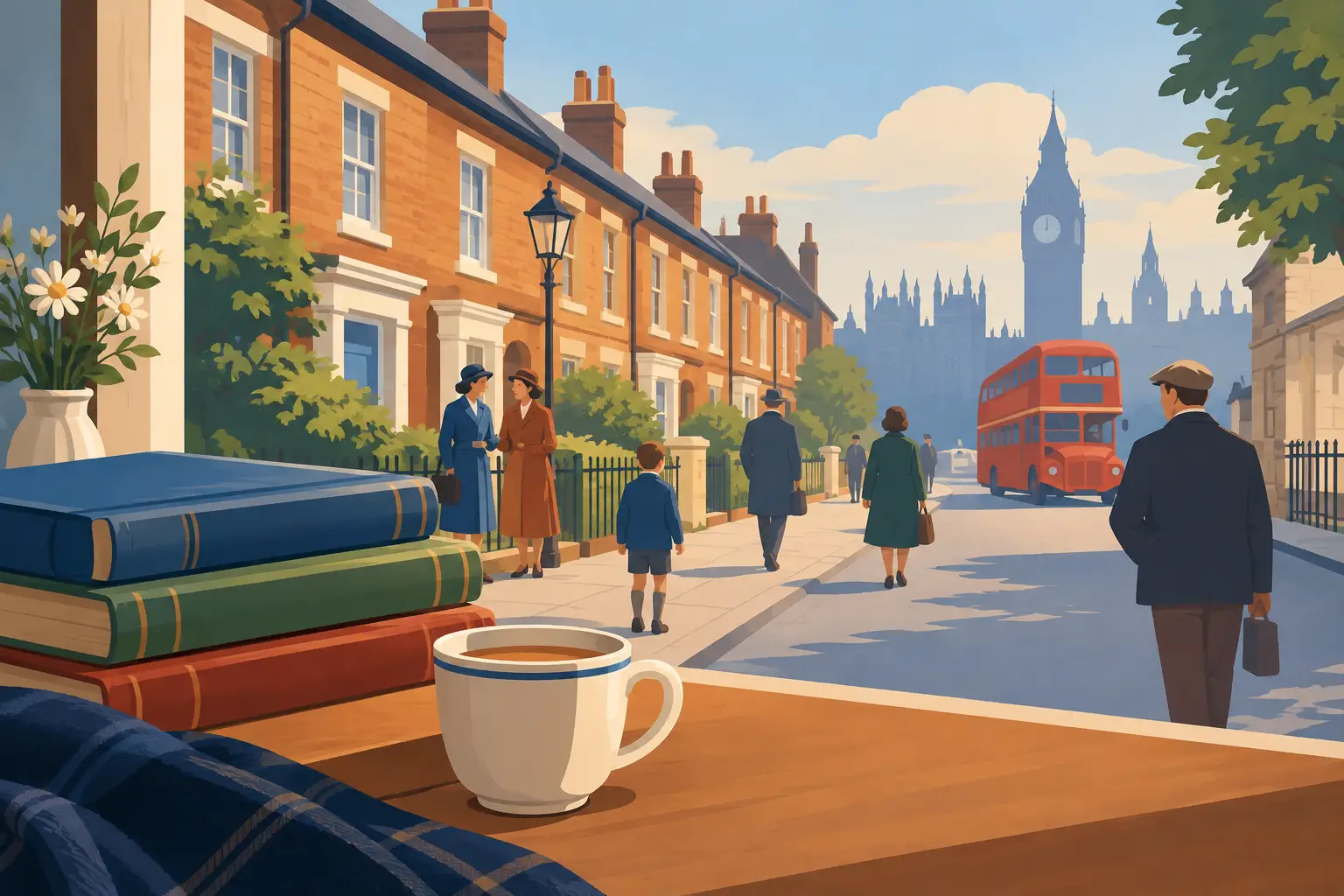
A great deal of British social history fiction begins where the official record thins out. Parliamentary debates, factory returns and newspaper leaders can tell us what was decided. They rarely tell us what it felt like to wait for wages, to keep a household respectable on little money, or to recognise that a change made in Whitehall had reached the street outside.
That is the particular value of British social history fiction. At its best, it does not simply dress a modern story in period costume. It restores pressure to the past: the pressure of class, work, family duty, religion, housing, war, education and authority. For readers interested in how Britain became what it is, such fiction can provide something that statistics and grand political narratives often miss – an understanding of consequence at human scale. See Netheroyd Manor.
British Social History Fiction Is About Systems in Daily Life
Social history concerns the ways people lived rather than merely the decisions of those who governed them. It asks who had security, who had choices, who carried risk and who was expected to accept their position. Fiction has a special capacity to show these matters operating together.
Consider a household in an industrial town at the turn of the twentieth century. The father’s occupation may determine the rent they can afford, the food on the table and whether a child remains at school or enters work. A mother’s unpaid labour may make the difference between order and collapse. The local employer, landlord, chapel, union, school board and public house all exert influence. None needs to be explained at length if the novelist has properly understood the setting. Their presence can be felt in the choices characters make and, more tellingly, in the choices they cannot make.
This is why the best historical fiction is not an escape from serious history. It is an argument about how a society worked. A novel may make that argument quietly, through a lodger who is turned away, a young woman denied advancement, or a family moved from one room to another. Yet these small incidents can reveal more about power than a lengthy lecture on social policy.
The Ordinary Person Is Not a Decorative Figure
Older accounts of Britain often gave prominence to monarchs, ministers, generals and industrialists. Their decisions matter, of course, but they are not the whole country. Britain was also built by dockers, clerks, miners, engineers, domestic servants, shopkeepers, nurses, teachers and countless others whose names did not enter the record.
Fiction can give such people the central place they occupied in real life. That does not mean presenting them as uncomplicated heroes. Ordinary people could be generous, narrow-minded, ambitious, loyal, prejudiced and deeply practical, sometimes within the same afternoon. A convincing novel avoids the temptation to make everyone in the past either a victim or a villain according to present-day preferences.
The point is not to excuse the social arrangements of another era. It is to understand the practical constraints under which people acted. A skilled man might oppose reform because he feared losing the small security he had earned. A family might defend convention because convention was all that stood between them and public shame. A servant might know more about a household than its owners while possessing no safe means of saying so. These are not minor details. They are the mechanics of social order.
Class Must Be More Than Accent and Furniture
British fiction has long been alert to class, but the subject is easily reduced to signals: a regional voice, a school tie, a particular piece of furniture or an awkward dinner party. Such details can be useful, but they are not class itself.
Class is also access to time, credit, education, contacts and forgiveness. It shapes whether a mistake becomes a temporary embarrassment or a life-changing disaster. It affects who can move for work, who can borrow money, who is heard by an official and who is presumed to be at fault. The difference between a clerk dismissed from a respectable post and a labourer unable to find a day’s work may be expressed differently, but both can expose the insecurity beneath the appearance of order.
For this reason, the most persuasive novels pay close attention to work. Employment was not merely background activity. It governed identity and standing. In Britain’s industrial and commercial past, a job often meant entry into a community, a pattern of deference, an expectation of conduct and a source of pride. Losing it could mean far more than reduced income.
Institutions Shape the Story, Often Unseen
One strength of social history fiction is its ability to show institutions without treating them as abstractions. The Poor Law, the factory system, military service, local government, the civil service, the railways and the National Health Service all altered private lives. Yet few people encountered them as ideas. They encountered them through forms, queues, inspectors, foremen, rules and decisions made by someone behind a desk.
This remains familiar. Anyone who has worked in a large company, traded across borders or dealt with public administration knows that institutions have personalities as well as procedures. Their written purpose and their lived effect may differ considerably. A rule that appears reasonable at headquarters can produce absurdity or hardship where it is applied.
Historical fiction can catch this discrepancy. A character may be grateful for a new benefit while humiliated by the means of obtaining it. Another may respect the law yet see plainly that it operates differently for those with money or influence. Such tensions are central to Britain’s social development. The country’s institutions have often been capable of both genuine improvement and stubborn exclusion.
Accuracy Requires Judgement, Not a Catalogue
A novel needs sound research, but research alone does not create truth. There is a difference between authentic detail and the accumulation of detail for its own sake. Readers do not need every room described as though it were an auction catalogue, nor every historical event inserted because it happened that year.
The more difficult task is to understand what mattered to people at the time. Did they have reliable news? How far could they travel? What did illness mean when treatment was limited? How much privacy was possible in a crowded house? What did a widow, an apprentice or an ex-serviceman reasonably expect from the state, the family and the neighbourhood?
Language requires similar restraint. Dialogue should not sound like a museum performance, but neither should twentieth-century or contemporary attitudes be placed carelessly in the mouths of earlier characters. People in the past were neither fools nor simply us in unfamiliar clothes. They possessed intelligence and moral feeling, but they interpreted the world through different assumptions.
Why These Stories Matter Now
Britain still argues about housing, unequal opportunity, regional decline, inherited advantage, migration, public services and the dignity of work. These questions are not new, even when the vocabulary changes. Social history fiction gives them depth by reminding us that present arrangements have histories.
That does not mean the past supplies easy answers. A nostalgic view of earlier Britain can ignore poverty, constrained lives and the considerable power exercised by class and custom. Equally, a wholly contemptuous view of the past can fail to recognise courage, mutual aid, craftsmanship and the resourcefulness on which communities depended.
Good fiction resists both temptations. It shows that people may have found meaning in institutions that also limited them. It recognises that reform can improve lives while creating fresh complications. It accepts that progress is neither automatic nor evenly shared.
For readers of serious nonfiction, historical novels can therefore be a useful companion rather than a diversion. A study of labour relations, education or political reform establishes the framework. Fiction can put people inside that framework and test it against the messy reality of loyalty, fear, vanity, affection and necessity. The two forms do different work, but each can sharpen the other.
Reading Beyond the Costume Drama
The term historical fiction sometimes brings to mind country houses, courtship and inherited estates. There is nothing wrong with those subjects, provided they are honestly handled. But British social history is wider and more interesting than the drawing room. It includes the shop floor, the shipyard, the suburban semi, the council estate, the colonial posting, the railway carriage and the cramped rented room.
Readers should look for novels in which material conditions are not merely scenery. Notice who pays, who waits, who is protected and who must improvise. Notice whether work changes a character’s prospects, whether education opens a door, and whether official authority is treated as remote, useful or threatening. These questions reveal whether a book has understood its society or merely borrowed its wallpaper.
The lasting achievement of British social history fiction is that it makes large forces legible without making them impersonal. It returns history to the point at which it was actually lived: in workplaces, kitchens, streets, schools and family conversations. That is where the inherited habits of Britain were made, challenged and, sometimes, changed.