
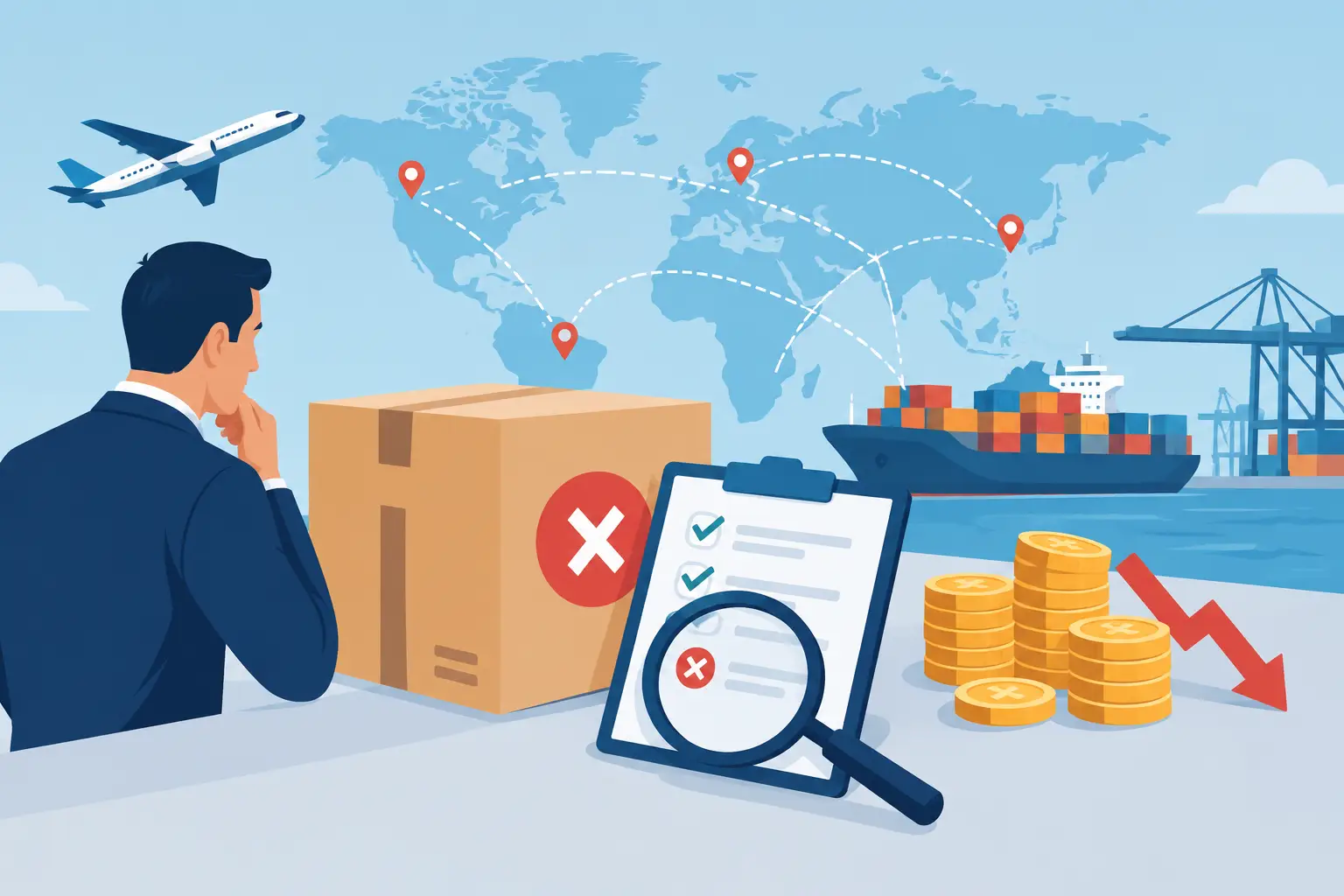
A consignment can be manufactured perfectly, packed carefully and dispatched on time, yet still fail before it reaches the customer. One incorrect tariff classification, a missing certificate, a poorly chosen payment term or a discrepancy in a document can stop goods at a port, prevent a bank from paying, or leave an exporter facing a claim they cannot recover. The cost of errors in international trade is therefore rarely confined to the immediate invoice.
Those who have worked in overseas markets know that trade is a chain of dependent activities. Marketing may identify an opportunity and a salesman may secure an order, but the order still depends on accurate specifications, suitable packing, transport arrangements, insurance, export and import formalities, banking, payment and local representation. A weakness at any point can undermine all that went before.
The cost of errors in international trade is cumulative
The obvious cost is a delayed or rejected shipment. Demurrage, storage, additional freight, inspection charges and the cost of returning or destroying goods can soon turn a profitable order into a loss. These charges are particularly painful because they often arise when the exporter has already committed labour, materials and working capital.
The less obvious cost is the loss of cash flow. An exporter may have paid suppliers, completed production and handed goods to the carrier, yet remain unpaid because the documents do not comply with the agreed terms. Under a documentary credit, for example, a bank deals with documents rather than goods. If the credit calls for a particular description, date, signature or certificate, an apparently minor discrepancy can give the buyer an opportunity to delay or refuse payment.
There is also a commercial cost which does not sit neatly in the accounts. Overseas customers tend to judge a supplier by their ability to deliver reliably. They may be sympathetic to a first mistake, especially where a local authority has changed a requirement without warning. They are less forgiving when confusion over paperwork, labels or delivery dates becomes a pattern. In many markets, confidence is built slowly and damaged quickly.
A small mistake can conceal a larger failure
It is tempting to treat errors as administrative mishaps. Often they are evidence of a more fundamental problem: no one has taken responsibility for the whole transaction.
Consider packing. An engineer may know exactly how to manufacture a machine, while a freight forwarder knows how to arrange a voyage. Neither fact guarantees that the machine has been protected against humidity, rough handling, long storage or theft in transit. Timber packaging may need to meet phytosanitary rules. Marks on cases may need to match the invoice and packing list. A crate that is perfectly adequate for a lorry journey in Britain may be unsuitable for a sea voyage, tropical conditions or repeated handling at an inland depot.
The same applies to product descriptions. Commercial staff sometimes use language designed to sell, while customs authorities require a precise and defensible description of what is actually being imported. An inaccurate classification can mean the wrong duty, an unexpected licence requirement or an allegation that the importer has made a false declaration. The exporter may regard this as the importer’s difficulty, but a serious distributor will expect its supplier to provide dependable information.
Trade errors are not always the exporter’s fault. Requirements vary widely between countries and can change with little notice. Nevertheless, a business that enters a market without checking its obligations is taking a commercial risk, not suffering bad luck.
Payment terms deserve more thought than they receive
A substantial number of avoidable losses begin with an agreement to payment terms that were never properly understood. The desire to win an order can make a supplier accept open account trading with an unfamiliar customer in a difficult market. At the other extreme, insisting on the most secure method available may make an exporter uncompetitive where established suppliers offer credit.
There is no universal answer. The sensible choice depends on the value of the order, the buyer’s reputation, the country risk, the availability of credit insurance, the strength of the contract and the exporter’s ability to withstand late payment. What matters is that the payment method is considered before goods are made, not after they are on the water.
Letters of credit have long offered useful protection in suitable circumstances, but they require discipline. Their value lies in clear, workable terms and documents prepared exactly as required. A credit burdened with impractical conditions is not a safeguard. It is an invitation to discrepancies.
Equally, export credit insurance should not be regarded as a cure for casual credit control. Policies have conditions, limits, exclusions and notification requirements. If an exporter continues supplying a buyer whose payments have become overdue without consulting the insurer, cover may be prejudiced. Insurance is a valuable part of risk management, but it cannot substitute for judgement.
Expertise is specialised, but responsibility cannot be fragmented
International trade encourages a dangerous assumption: that someone else will know. The bank will know about payment, the forwarder about shipping, the insurer about risk, the lawyer about contract terms and the customs agent about declarations. Each may indeed be highly competent in their own field. None can be expected to understand every part of the exporter’s product, market, commercial promise and internal procedure.
This is why experienced exporters appoint a person who can see the transaction as a whole. That individual need not be an expert in every discipline. They do, however, need enough understanding to ask the right questions before a commitment is made. Is the Incoterm appropriate for the route and customer? Who is responsible for import clearance? Does the insurance cover the agreed journey? Are the documents consistent? Can the promised delivery date actually be achieved?
The answer may require advice from several specialists. Good trade practice is not pretending that one person knows everything. It is recognising where specialist knowledge is required, and ensuring that advice is obtained early enough to alter the transaction.
The human cost of getting it wrong
Behind a customs hold or a disputed invoice are people under pressure. The export clerk who has to explain why payment has not arrived may have followed instructions that were incomplete from the beginning. The production department may be asked to remake goods at short notice. The overseas buyer may have customers waiting and a reputation of their own to protect.
Blame is an easy response, particularly when the immediate error is visible. It is more useful to examine the process. Was there a written order review? Were responsibilities clear? Had anyone checked the country requirements? Was the final document compared with the contract, packing list and credit? Did the business rely on knowledge held by one long-serving employee without recording it?
These questions matter because repeat errors usually arise from weak systems, not isolated carelessness. A short pre-shipment review can reveal inconsistencies before the goods leave the factory. It costs little compared with correcting them after arrival abroad.
Prevention is cheaper, but not always simple
The strongest protection is preparation at the quotation stage. Before offering a price, an exporter should understand the destination, the likely route, the delivery obligation, documentation, duty exposure, payment risk and any special standards or licences. This need not make every small order bureaucratic. It means matching the level of checking to the value and complexity of the risk.
A repeat shipment to a trusted customer in a familiar market may be straightforward, although even routine trade can be disrupted by regulatory change. A first order involving controlled goods, a remote destination or a new distributor deserves more time. The apparent cost of checking can feel unwelcome when margins are tight. The cost of discovering a problem after shipment is usually far greater.
Records are equally important. A business should retain the reasoning behind classifications, origin statements, insurance decisions and agreed delivery terms. Staff change, memories fade and disputes may emerge long after the goods have been delivered. Clear records turn experience into an asset rather than something that leaves with the next retirement.
International trade has never been merely a matter of selling abroad. It is a practical discipline in which commercial ambition must be supported by patient attention to detail. The exporter who treats that detail as part of the sale, rather than an inconvenience after it, is far more likely to keep both the order and the customer.