
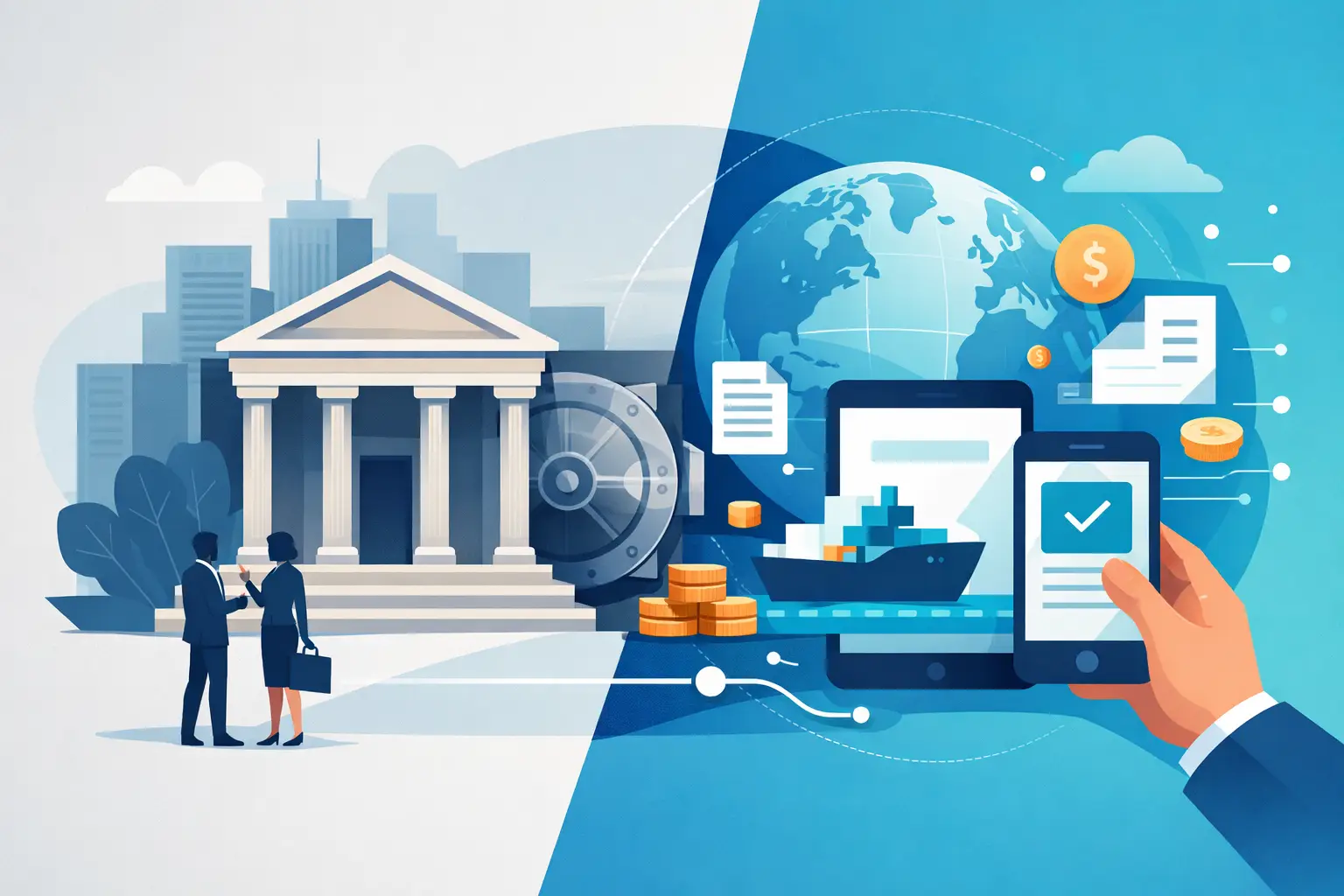
A set of export documents once travelled the world by courier, often at considerable cost and with uncomfortable delays. An invoice, packing list, certificate of origin, inspection certificate and bill of lading might be perfectly prepared, yet still sit in a bank pouch or airport warehouse while a ship arrived at its destination. The obvious question is: are banks needed if documentary payments become all digital?
The short answer is yes, but not always in the same capacity, and not for every transaction. Digitisation can remove much of the physical handling that made documentary trade slow and expensive. It cannot, by itself, remove the commercial risks that led exporters and importers to use banks in the first place.
The distinction matters. Too much discussion of digital trade assumes that moving a document from paper to screen also removes the need for trusted intermediaries. It does not. A document is not merely information. In international trade it can be evidence, an instruction, a claim on goods, and the trigger for payment or finance.
What digital documentary payments can genuinely change
The case for digitisation is compelling. Once a trusted electronic system is in place, documents can be created, checked, transmitted and presented in minutes rather than days. A buyer, seller, freight forwarder, insurer, inspection body and bank may each see the relevant version without waiting for a courier or chasing a missing original.
This is particularly valuable when there is a discrepancy. Under a traditional letter of credit, a bank examines the documents, not the goods. A misspelt name, a late date, an inconsistent weight or an omitted phrase can create a delay while parties exchange messages across several countries. Digital preparation can catch some such errors earlier, before documents are formally presented.
The savings are not trivial. Courier charges, paper handling, duplicate data entry and repeated checking all add cost. For smaller exporters, those costs can be disproportionate to the value of the consignment. Faster presentation may also mean faster payment, improving cash flow at precisely the point when an exporter has already paid for production, packing and freight.
Electronic bills of lading are especially significant. In paper form, the bill of lading has historically carried immense practical importance because possession or control of it can determine who may claim the cargo. If an electronic equivalent can securely establish exclusive control, transfer it from seller to buyer and be recognised in the relevant legal jurisdictions, a major source of delay can disappear.
But the words ‘securely’ and ‘recognised’ carry more weight than technology enthusiasts sometimes admit.
If documentary payments become all digital, what remains for banks?
Banks have never simply been expensive post offices. Couriers were visible, and their charges were easy to resent, but the bank’s more important functions sit behind the envelope.
A confirmed letter of credit, for example, is not just a process for sending documents. It is an undertaking to pay, subject to compliant presentation. The issuing bank substitutes part of its credit standing for that of the overseas buyer. A confirming bank may add its own undertaking where the exporter has concerns about the issuing bank or the country in which it operates.
That service remains valuable where the parties do not know each other well, where the order is substantial, or where political and currency risks are real. A digital document may reach the buyer instantaneously. It does not ensure that the buyer has the money, is willing to pay, or is permitted to pay under the rules applying in their country.
Banks also provide trade finance. An exporter may need pre-shipment finance to buy materials or pay wages. After shipment, it may need to discount a receivable rather than wait 30, 60 or 90 days for payment. Importers, too, may need credit to release goods and sell them on. Digitisation can make finance quicker to arrange and easier to monitor, but it does not create the credit itself.
Then there is compliance. International payments require checks relating to sanctions, money laundering, fraud and prohibited goods. These controls can be frustrating, particularly to firms with a clean trading record, but they are not optional. A digital platform may automate parts of the process, yet somebody must bear responsibility for decisions where the transaction is unusual, sensitive or potentially unlawful.
The bank’s role may therefore become less clerical and more judgement-based. Fewer people will be sorting paper in a back office. More attention will be placed on validating data, assessing risk, supplying finance and accepting legal liability.
Not every trade needs a bank at the centre
It would be equally wrong to argue that banks will retain their traditional role in every deal. Many do not do so now.
Established trading partners frequently work on open-account terms. The exporter ships the goods and invoices the customer, relying on the relationship, credit insurance, credit limits and ordinary commercial discipline. Payment may be made electronically without documentary collection or a letter of credit. For routine trade between sound businesses in stable markets, this can be sensible and economical.
Documentary collections occupy a middle ground. Banks pass documents against payment or acceptance, but they do not normally give the same payment undertaking as under a letter of credit. If all documents are electronic, collections could become far simpler. In some cases, specialist platforms, insurers or logistics providers may take over practical elements that banks once performed.
There is also scope for new entrants. Fintech businesses can offer document workflows, identity checks, foreign exchange, credit assessment and payment services with speed that large banks have not always matched. Their arrival should be welcomed where it brings genuine competition and lower costs.
Yet new technology firms do not abolish risk. They redistribute it. A supplier choosing a platform must ask who owns the data, who controls access, what happens if the firm fails, where disputes are heard, and whether the platform’s electronic records will be accepted by courts, customs authorities, carriers and insurers. A polished interface is not a guarantee of legal certainty.
The difficult question is trust, not paper
The strongest argument for digital documentary trade is that data can be shared quickly and checked automatically. The weakness is that the same data can be manipulated quickly if governance is poor. A private key, secure identity system and carefully designed permissions can be powerful safeguards, but they require disciplined management. Lost credentials, compromised systems and fraudulent instructions have replaced some of the old risks of lost or forged paper.
Nor is a distributed ledger a magic answer. It may provide an auditable record of transactions, but it cannot establish whether a container holds the goods described, whether an inspection was honest, or whether an overseas customer will remain solvent. Commercial reality still sits outside the database.
Legal acceptance is another uneven area. The United Kingdom has made important progress in recognising certain electronic trade documents. Elsewhere, the law may be different, incomplete or untested. International trade works only when the documents, payment arrangements and contractual rights are recognised along the entire route – not merely at the exporter’s desk in Britain.
Experienced exporters have always known that the apparent simplicity of a transaction can be deceptive. A buyer may be reputable but located in a country with exchange controls. A shipment may be straightforward but involve a carrier whose electronic process is not accepted by an insurer. A digital bill of lading may be technically excellent but unusable if one party in the chain insists on paper. These are transitional problems, but they are real problems.
Banks will need to earn their place
The pressure on banks is justified. If they continue to charge nineteenth-century prices for moving twenty-first-century data, clients will rightly look elsewhere. Documentary credits and collections should become faster, clearer and less dependent on repetitive manual work. Banks must also be more transparent about fees and more willing to support smaller exporters, not only large corporates with dedicated treasury teams.
Their future lies in doing what a document platform cannot easily do alone: underwriting payment obligations, extending credit, managing currency risk, carrying out serious compliance checks and standing behind a transaction when something goes wrong. Those services have a cost, but they also have a purpose.
Digital documentary payments should not be judged by whether they remove banks from the process. They should be judged by whether they remove avoidable delay while preserving confidence between parties who may be separated by thousands of miles, different legal systems and very different commercial circumstances. The exporter who understands that distinction will be better placed to use the new tools without surrendering the safeguards that still matter.
5 thoughts on “Are Banks Needed If Documentary Payments Go Digital?”
Comments are closed.