
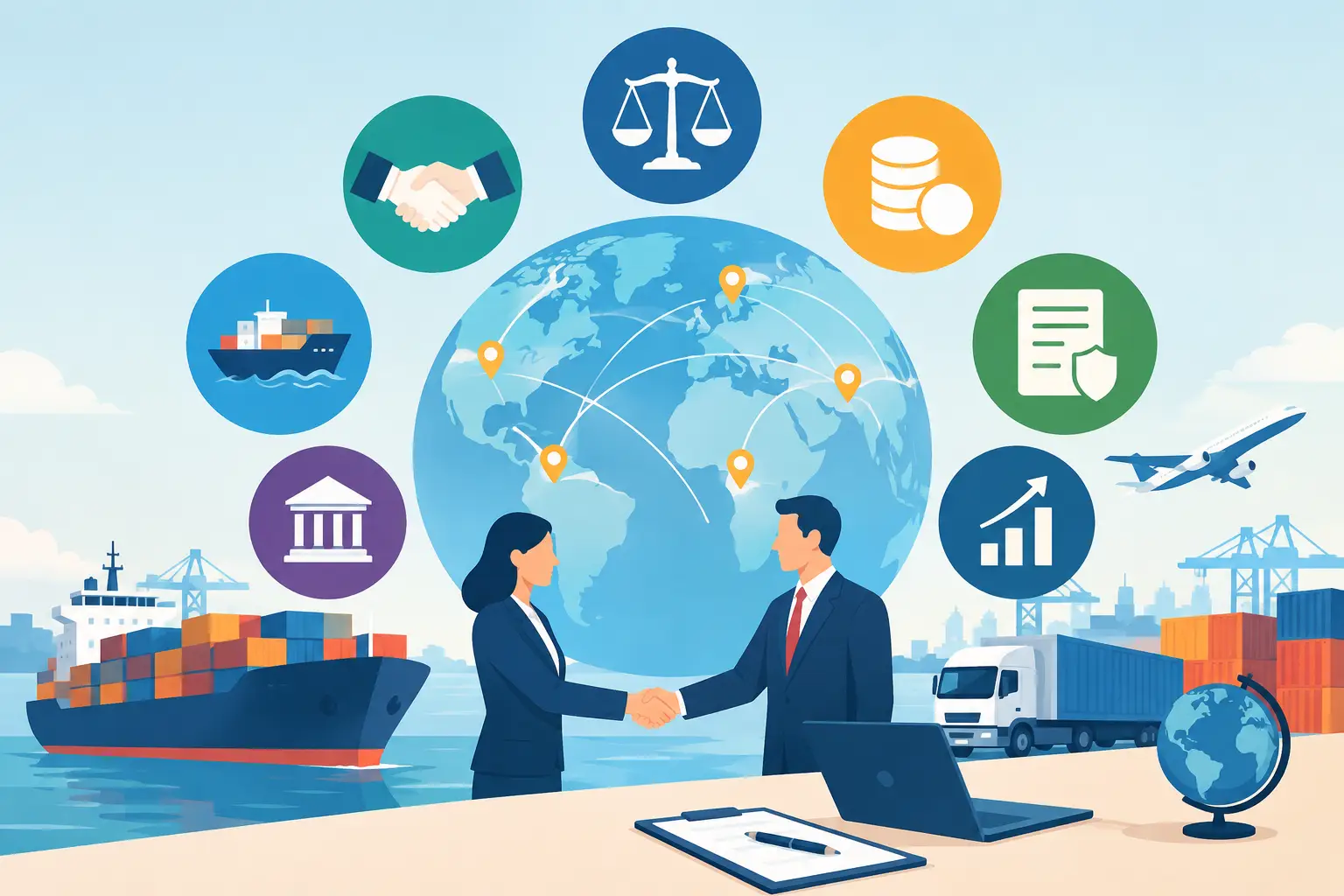
A container may leave a British port carrying perfectly good machinery, food or components, yet the exporter can still lose money long before it reaches its destination. The disciplines involved in international trade extend far beyond finding a customer and arranging transport. They determine whether the seller is paid, whether the goods clear customs, whether the contract means what both parties think it means, and whether a promising overseas relationship survives its first difficulty.
That is why international trade has never been a single profession. It is a meeting place for commercial judgement, law, banking, transport, technical knowledge and human understanding. Digital systems have altered the speed of communication, but they have not removed the underlying risks. Indeed, a quicker transaction can expose poor preparation more rapidly.
The disciplines involved in international trade
The best exporters understand enough of several disciplines to ask sensible questions and recognise danger early. They do not need to be lawyers, freight forwarders, bankers and engineers at once. But they do need to know where one responsibility ends and another begins.
Market knowledge and commercial judgement
Everything begins with a market, but a market is not simply a country marked in a government report. It is a particular group of customers with purchasing habits, established suppliers, local standards, price expectations and channels of distribution. A product that succeeds in Britain may be too expensive, wrongly specified or poorly supported elsewhere.
Commercial judgement also means selecting the right representative, distributor or agent. This is an area where enthusiasm can outrun caution. A well-connected individual may open doors, but that does not necessarily make them financially sound, technically capable or committed to the supplier’s interests. Before appointing an overseas partner, an exporter should establish who owns the business, whom it represents already, how it will service customers and how disputes will be handled.
Experience teaches that the first order is rarely the true test. The test comes when delivery is late, a customer asks for a concession, or the distributor has stocked the wrong item. International trade depends on relationships, but relationships need clear commercial boundaries.
Contract law and documentary precision
A purchase order is not always a complete contract. In cross-border business, loose language carries a higher price because the parties may work under different legal assumptions and have limited recourse if matters go wrong. The specification, price, currency, delivery terms, warranty, governing law and dispute process should be settled before goods are made or dispatched.
The apparently modest detail matters. Does the price include packing? Who insures the goods at each stage? When does risk pass from seller to buyer? What constitutes acceptance of the goods? Modern Incoterms provide a useful common vocabulary, but they do not replace a properly drafted sales contract. Nor do they decide every issue concerning payment, quality or ownership.
Documentation is part of this discipline, not clerical afterthought. A discrepancy between an invoice, packing list, certificate of origin and transport document can delay customs clearance or prevent payment under a Letter of Credit. The commercial department, shipping department and bank must work from the same facts.
Trade finance and credit assessment
An overseas sale is also a credit decision. The exporter has supplied value and must decide how much confidence to place in a buyer, a bank and a foreign legal system. Payment in advance is attractive to the seller but may be unacceptable to a new customer. Open-account credit is convenient for an established relationship but can leave the supplier exposed when a buyer’s finances deteriorate.
Letters of Credit remain valuable where the transaction justifies their cost and discipline. Yet they are not a guarantee in the casual sense in which the term is often used. A Letter of Credit is an undertaking by a named bank, subject to its terms and to the presentation of complying documents. Its value rests partly on the financial standing of the issuing bank and, where relevant, the confirming bank.
Banking history is a corrective to complacency. Barings collapsed, BCCI was closed, and the financial crisis of 2008 showed that large institutions can fail or require rescue. Deposit protection for ordinary savers is one matter; an exporter relying on a substantial bank undertaking is another. Credit insurance, confirmation, staged payments and realistic credit limits may all be appropriate, depending on the country, customer and value of the contract.
Logistics, customs and supply-chain control
Goods do not move merely because a carrier has been booked. They must be packed to survive handling and climate, classified correctly for customs purposes, described accurately and delivered to the agreed point. For engineered products, the logistics function must understand dimensions, weight, lifting points, hazardous content and any special storage requirements. A crate that is inadequate for a short road journey may be disastrous after weeks at sea.
Customs has become more visible to British businesses since the UK’s departure from the European Union, but it was always central to trade beyond national borders. Commodity codes, customs valuation, origin rules, licences, temporary admission procedures and import restrictions affect cost and timing. A wrong tariff classification can lead to duty demands, penalties and a damaged customer relationship.
Logistics is also a strategic matter. A low freight quotation may conceal a transhipment risk, weak local handling or uncertain arrival dates. Equally, the fastest route may not be worth its premium for goods that are neither urgent nor perishable. The right choice depends on the product and the promise made to the customer.
Technical competence and regulatory standards
Many exports fail not because the product is badly made, but because it is unsuitable for the intended environment or lacks evidence of compliance. Electrical equipment may need different plugs, voltage arrangements, safety approvals or labelling. Machinery may require guards, manuals in the local language, training and access to spare parts. Food, chemicals, medical products and defence-related goods face still more demanding controls.
This is where engineering and technical service become commercial disciplines. The sales person who promises a performance figure without consulting the designer can create an obligation the factory cannot meet. In my own experience of industrial markets, the most credible exporter was usually the one prepared to ask detailed questions before quoting. That approach may slow the first conversation, but it prevents costly improvisation later.
Export controls deserve particular care. Some goods, software and technical information require licences because of their potential military or dual-use application. The destination, end user and intended use can matter as much as the item itself. Treating this as an administrative irritation is a serious mistake.
Language, culture and negotiation
A common business language does not guarantee common meaning. “We will consider it” may be a polite refusal. A request for a discount may be routine negotiation in one market and a sign of distrust in another. Titles, seniority, meeting etiquette and the pace of decision-making vary considerably.
Cultural awareness should not become a collection of national stereotypes. Individuals differ, and experienced businesspeople recognise performance rather than rely on caricature. The practical point is to listen carefully, avoid assumptions and allow time for trust to develop. Frequent travel once made this obvious. Video meetings are useful, but they rarely reveal a warehouse, a service department, a family-owned firm’s real chain of authority or the condition of a local market.
Political risk and public policy
Trade operates within political systems. Exchange controls, sanctions, import licensing, local-content rules, tax changes, civil unrest and currency shortages can change the economics of a contract after it has been signed. The risk is not confined to distant or unfamiliar markets. Governments everywhere can alter the rules quickly when domestic pressures intervene.
Exporters therefore need a working grasp of political risk, not a forecaster’s pretence of certainty. They should consider whether payment can leave the country, whether the buyer depends on a public tender, how stable the currency is, and whether insurance or contractual protection is available. Government trade services can provide useful intelligence, but responsibility for the decision remains with the company.
No discipline works in isolation
The most expensive trade failures often occur in the gaps between departments. Sales agrees a delivery date without consulting production. Finance approves credit without seeing the political exposure. Shipping prepares documents after the bank terms have been accepted. Technical staff discover too late that the product requires an approval not included in the quotation.
Good export management brings these people together before commitment, particularly for unfamiliar markets, high-value orders and long-term projects. It is less glamorous than announcing a new overseas contract, but it is where the profit is protected.
International trade rewards enterprise, curiosity and persistence. It also rewards the modest habit of checking what one does not know. For any firm contemplating its next foreign order, that may be the most useful discipline of all.