
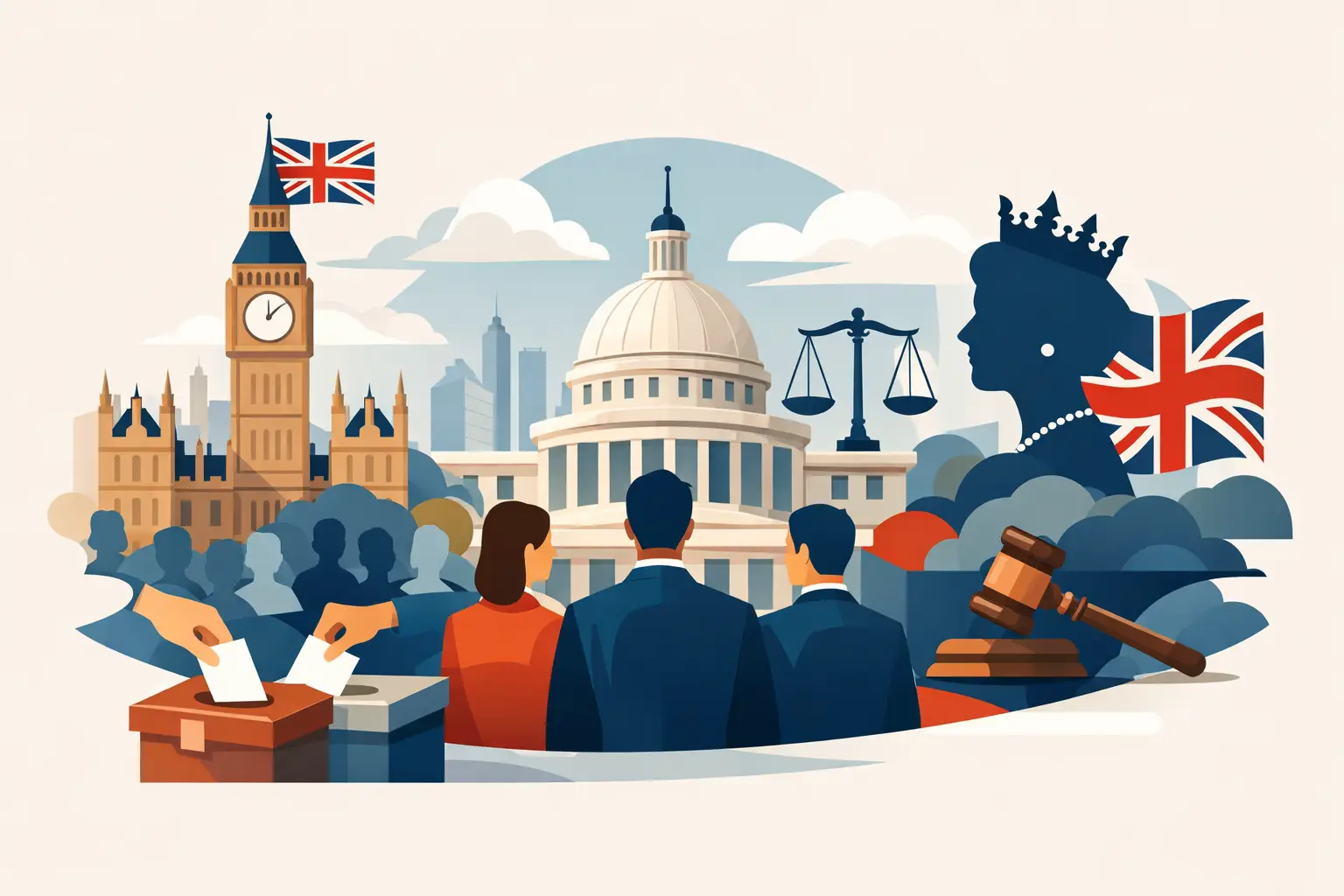
A British general election can remove a government in a single night, yet much of the machinery that shapes public life does not change at all. Civil servants remain at their desks, judges continue to interpret the law, the House of Lords revises Bills, and the Crown performs its constitutional role. To understand how British democracy really functions, one must look beyond the ballot box and examine the relationships between institutions, power and public consent.
Democracy is more than an election result
Britain is a parliamentary democracy and a constitutional monarchy. The public elects Members of Parliament, usually every four or five years, and those MPs determine who can command a majority in the House of Commons. The leader of that majority becomes Prime Minister and forms a government.
That is the basic arrangement, but it can give a misleading impression that voters directly choose a Prime Minister or a government programme in every detail. They do not. Voters elect one MP for each constituency. The national outcome is then assembled from 650 separate contests, under the first-past-the-post system.
This system tends to reward parties whose support is concentrated in particular places and penalise those whose vote is spread thinly across the country. A party may win a large Commons majority with considerably less than half of all votes cast. Another may receive millions of votes but secure few seats. It is a system valued for producing decisive governments, but it does so at a cost to proportional representation.
Parliament is sovereign, but government usually leads it
The phrase ‘Parliamentary sovereignty’ is often repeated as though it settles every constitutional question. In principle, Parliament can make or unmake any law. No court may normally strike down an Act of Parliament simply because it considers the Act unwise or unfair.
In practice, the government of the day usually controls Parliament’s timetable, commands a voting majority in the Commons and has the resources to prepare legislation. This gives the executive – the Prime Minister, ministers and their departments – formidable influence. A government with a reliable majority can normally pass its principal Bills, even when individual MPs have reservations.
That does not mean Parliament is powerless. MPs scrutinise legislation in committee, question ministers, investigate public failures through select committees and represent constituency concerns. A determined backbench revolt can force a government to alter course. The Commons can also refuse confidence to a government, though this is rare when one party has a working majority.
The important distinction is between legal power and political power. Parliament possesses the legal authority. Government often possesses the practical capacity to use it.
The House of Lords: limited, but not irrelevant
The House of Lords is unelected, which makes it an uncomfortable institution in a democracy. Yet its role is more substantial than its critics and defenders sometimes admit. It examines Bills in detail, proposes amendments and can require ministers to think again.
The Lords cannot normally block legislation indefinitely, particularly financial measures or Bills passed again by the Commons. Its strength lies in delay, revision and the force of informed objection. Its members include former judges, civil servants, diplomats, scientists, business figures and campaigners, alongside hereditary peers and bishops. That breadth can improve scrutiny, but the method of appointment leaves a serious question of democratic legitimacy unresolved.
The Crown governs formally, ministers govern politically
The monarch is head of state, but not the political decision-maker. Laws receive Royal Assent, governments are formally appointed by the Crown, and Parliament is opened in the monarch’s name. These are constitutional acts performed according to established convention and ministerial advice.
The value of the monarchy, for those who support it, is continuity and political neutrality. A sovereign does not need to fight an election, build a party machine or defend a manifesto. The danger lies in imagining that ceremonial language is the same as personal political authority. It is not.
Britain’s constitution relies heavily on conventions – accepted practices that are not always set out in one definitive written document. A Prime Minister is expected to resign after losing the confidence of the Commons. Ministers are expected to answer to Parliament. The monarch is expected to act on advice. Such conventions work because political actors accept that breaking them carries a constitutional and public price.
That dependence on restraint is both a strength and a weakness. It permits flexibility in a changing country. It can also be tested by a government willing to press every ambiguity to its advantage.
Courts, law and the limits on ministers
British courts cannot usually overturn primary legislation, but they can and do limit ministers, public bodies and officials. Through judicial review, courts may find that a minister has acted beyond legal powers, failed to follow a fair process or used a power for an improper purpose.
This matters because modern government is conducted through an enormous volume of delegated legislation, regulations, guidance, contracts and administrative decisions. Parliament cannot inspect every decision made by every department, council, regulator or agency. The rule of law therefore depends not merely on Acts of Parliament, but on whether those exercising public power stay within their lawful remit.
The Human Rights Act and the European Convention on Human Rights have added another layer of protection and dispute. Courts may declare that legislation is incompatible with Convention rights, though Parliament retains the final legal word. Critics see this as judicial intrusion into politics. Supporters see it as a necessary restraint on temporary majorities. The practical answer is that both Parliament and the courts have legitimate roles, but neither should pretend the balance is free from tension.
Devolution changed the old picture of Westminster
Westminster remains central, but Britain is not governed from Westminster alone. Scotland, Wales and Northern Ireland have devolved institutions with differing powers over matters such as health, education, transport and aspects of justice.
Devolution has made British democracy more responsive in some respects. Policies can reflect different priorities and circumstances within the nations of the United Kingdom. It has also made accountability harder for voters, because responsibility is often shared, disputed or misunderstood. A citizen dissatisfied with public services may blame Westminster for a decision made in Edinburgh, Cardiff or Belfast, or vice versa.
Local government is another neglected part of the democratic structure. Councils make consequential decisions about planning, housing, roads, adult social care and local services. Yet they operate under severe financial constraints and with powers shaped by central government. Democracy is weakened when local representatives carry responsibility without sufficient control over the money required to meet it.
Parties, the media and the less visible pressures
Formal institutions are only one side of the story. Political parties select candidates, frame arguments, discipline MPs and decide which issues reach the public. Most voters encounter politics through party campaigns, broadcasters, newspapers, online platforms and personal discussion rather than through parliamentary debate.
Money matters too. Election spending is regulated, but political influence is not confined to the election period. Donors, trade unions, business groups, charities, lobbyists and campaigning organisations all seek to shape policy. Such activity is not inherently improper. In a free society, people must be able to argue for their interests. The difficulty arises when access is unequal, funding is opaque or ministers become too dependent on a narrow circle of supporters.
The civil service supplies another essential check, though it is not an elected check. Ministers set policy; officials provide advice, administer programmes and preserve institutional memory. Governments are entitled to expect energetic delivery. Equally, they benefit from candid advice based on evidence, including advice they may not wish to hear. A permanent civil service is not glamorous, but it is one reason a change of government need not mean administrative disorder.
How British democracy really functions between elections
The health of democracy is not measured solely by turnout on polling day. It is measured by whether ministers can be questioned, whether information can be obtained, whether courts remain independent, whether opponents can organise freely and whether voters can remove those in power without upheaval.
Britain performs well in several of these respects, but no system should be treated as self-maintaining. Concentrated executive power, an unrepresentative electoral outcome, weakened local institutions and declining trust can reinforce one another. The constitutional system relies on people in office respecting limits which are sometimes more customary than compulsory.
For citizens, the practical lesson is straightforward. Vote, certainly, but also pay attention between elections: to your MP, your council, the Bills passing through Parliament and the claims made in the name of ‘the people’. Democracy functions best when public consent is informed rather than merely assumed.
1 thought on “How British Democracy Really Functions Today”
Comments are closed.