
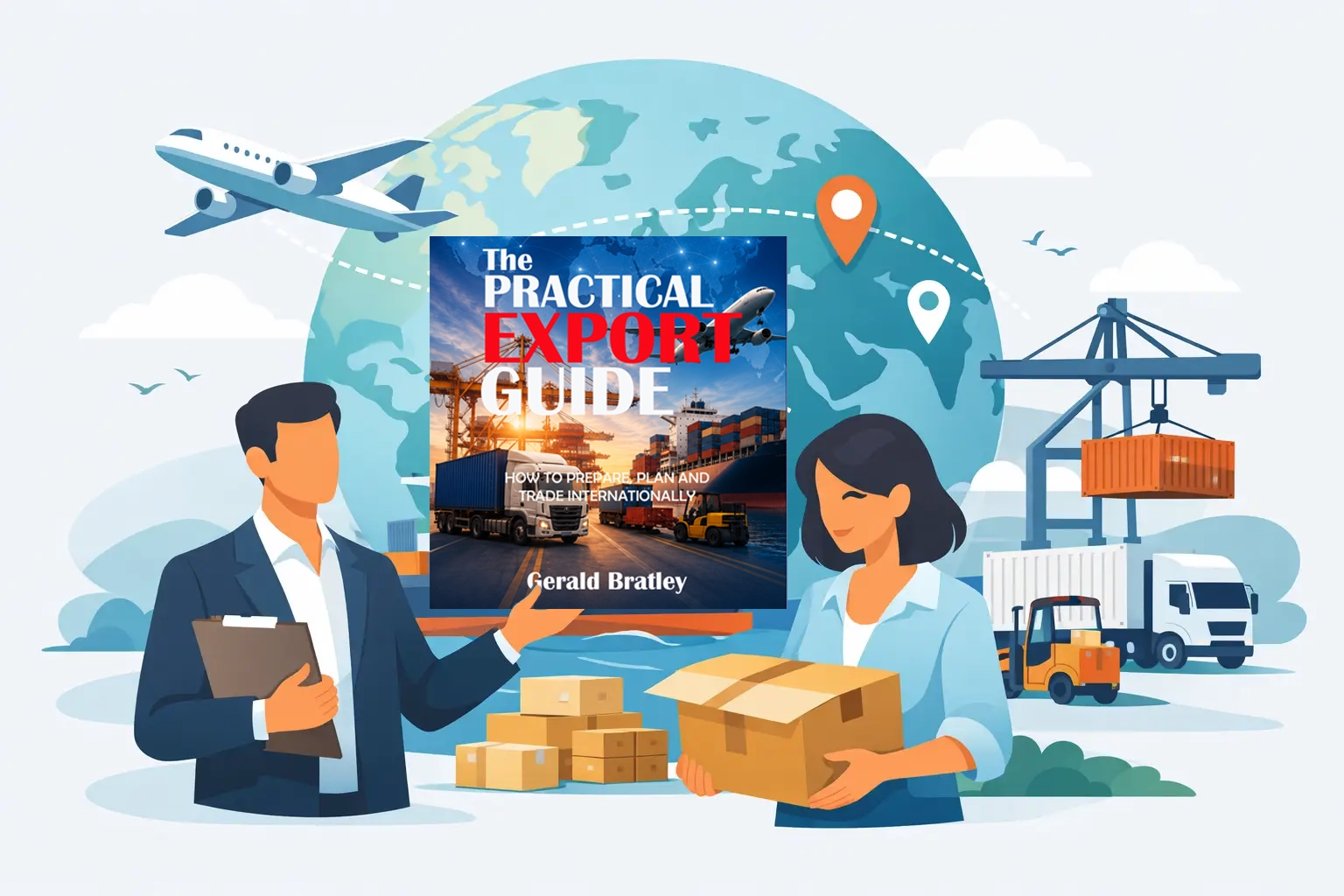
An export order can look reassuringly simple on a desk: a customer, a product, a price and a destination. The Practical Export Guide begins where that simplicity ends. Between accepting an order and receiving payment lies a chain of commercial decisions, documents, people, regulations and physical movement. A weakness in any one of them can turn a promising overseas sale into an expensive lesson.
For many years, international trade was learned by working alongside experienced export clerks, shipping managers, salespeople, freight forwarders and bank staff. Much of that informal apprenticeship has disappeared. Systems may now be electronic, but the underlying responsibilities remain much the same. The exporter still has to establish what has been sold, to whom, on what terms, how it will travel, who carries the risk, and how the business will be paid.
This is not an argument against specialist training. Customs procedures, commodity codes, origin rules, export controls, Incoterms, transport and documentary credits all deserve careful study in their own right. The difficulty is that a newcomer can study each subject separately and still fail to see how an export transaction works as a whole. That is the gap a practical overview is intended to fill.
Why export knowledge must be connected
A sale to an overseas customer is not merely a domestic sale with more kilometres attached. It introduces distance, different legal systems, unfamiliar commercial habits, currency exposure and a greater dependence on intermediaries. The customer may have a genuine requirement and still be unable to import the goods promptly. A lorry may reach a port on time while the documents fail to meet the requirements of a bank or customs authority. Goods can be well made and correctly packed, but arrive damaged because the packaging was suited to a UK carrier rather than a long sea journey.
The export manager therefore needs a working view of the entire transaction. This does not mean personally completing every declaration or booking every consignment. It means knowing the questions to ask before commitments are made, recognising when specialist advice is necessary, and understanding the consequences when one decision affects another.
Consider a quotation. The price is not simply the factory cost plus a margin. It depends on the agreed delivery term, packing, insurance, inland transport, freight, duties where applicable, payment costs, currency risk and the cost of supporting the customer during the transaction. A quotation made casually, perhaps to secure an early order, may impose obligations the supplier has neither priced nor understood.
The Practical Export Guide starts before the order
The best time to deal with an export problem is before the customer has been promised anything. A sound initial enquiry should prompt a quiet examination of the market, the prospective buyer and the product itself. Is there a genuine need? Is the buyer established and creditworthy? Can the product be supplied consistently? Are there technical standards, labelling rules, licences or local registrations to consider? Can the exporter give sensible delivery dates?
No two markets are identical. A product that sells readily in one country may require altered instructions, different voltage, revised packaging or a local agent in another. Even apparently minor matters can matter greatly. Spare parts availability, installation capability and after-sales service may decide whether a distributor will represent a British manufacturer seriously.
It is also prudent to distinguish an enquiry from an order. Overseas customers, like domestic ones, may seek quotations from several suppliers. Their request for a pro forma invoice is not necessarily proof of firm intent. Before allocating scarce production capacity or incurring unusual costs, establish the buyer’s authority, the payment method and the precise specification. An exporter who hears only what he hopes to hear is vulnerable.
Price, delivery and risk belong together
Incoterms are often treated as a technical subject to be memorised. Their practical importance is more straightforward: they help define who does what, who pays for which part of the journey, and when risk passes from seller to buyer. Used accurately, they reduce ambiguity. Used carelessly, they create it.
The named place matters as much as the three-letter term. A delivery obligation to a named port, terminal, warehouse or customer site can have materially different costs and responsibilities. Nor should an exporter assume that a familiar term has the same commercial effect in every conversation. Put the agreed term, named place, transport assumptions and any special arrangements clearly in the quotation and order acknowledgement.
There is no universally best arrangement. A new exporter selling modest consignments to a trusted distributor may sensibly choose a different term from an experienced machinery maker delivering valuable equipment to a difficult destination. The right answer depends on bargaining power, transport knowledge, insurance, customer expectations and appetite for risk.
Documentation is evidence, not bureaucracy
Export paperwork has acquired a reputation for being tiresome, partly because it punishes inaccuracies so effectively. Yet each document exists to provide evidence for someone: the customer, carrier, insurer, bank, customs authority or tax authority. The commercial invoice describes the sale and its value. The packing list helps identify what has been shipped. Transport documents record carriage. Origin evidence may affect duty. Export declarations create a formal record of the movement.
The practical discipline is consistency. Names, addresses, product descriptions, quantities, values, currency, weights and references should agree across the documents. A discrepancy that appears trivial in the office may delay clearance at a border, prevent payment under a credit, or cause suspicion among officials who have no reason to know that an error was innocent.
Product descriptions deserve particular care. “Parts” or “samples” may be convenient shorthand, but they rarely tell a customs officer enough. A clear description, supported by correct classification and origin information where required, is better business practice. It helps the forwarder, reassures the customer and makes the exporter less dependent on hurried corrections after the goods have left the premises.
Digital systems have made document transmission faster, but they have not made incorrect information harmless. Technology reduces repetition when it is set up properly. It does not remove the need for people who understand the transaction they are entering into a screen.
Payment should shape the sale
The most satisfying export order is of little use if payment is uncertain or delayed beyond the point at which the business can carry it. Payment arrangements should be considered at quotation stage, not raised awkwardly once the goods are ready.
Advance payment offers obvious protection to the supplier, but may be unacceptable to an unfamiliar buyer. Open-account trading is convenient and common with established customers, but it places reliance on credit control and the buyer’s financial health. Documentary credits can offer useful security when correctly drafted and handled, yet they are demanding instruments. They require strict compliance with their stated terms, and bank charges and administrative effort must be allowed for.
Between these options are deposits, staged payments, guarantees, export credit insurance and other arrangements. The point is not to use the most elaborate method available. It is to match the method to the value of the order, the country risk, the buyer relationship, the length of the supply cycle and the supplier’s ability to absorb a loss.
Currency deserves the same sober attention. A profitable price in sterling can become less profitable if the exporter agrees to invoice in a foreign currency and exchange rates move before payment. Larger businesses may use hedging arrangements; smaller firms may prefer to price in sterling where the market permits. Neither is automatically right. What is dangerous is accepting a currency exposure without knowing that it exists.
Freight forwarders are partners, not substitutes for judgement
A competent freight forwarder can be invaluable. They understand routes, carriers, bookings, customs processes and the practical realities of moving goods through congested ports and changing border arrangements. They can often identify a problem before it becomes costly.
But the exporter remains responsible for the information supplied and the promises made to the customer. A forwarder cannot decide whether the product is correctly classified, whether an export licence is required, or whether a commercial invoice accurately reflects the contract unless the exporter has done the necessary work. Delegation is sensible; abdication is not.
The same applies to insurance. Cargo insurance should be discussed in relation to the actual journey, the transfer of risk and the nature of the goods. A fragile high-value item travelling through several hands calls for a different approach from a pallet of standard components moving by road to a nearby market. Read the limits, exclusions and claims procedure before a loss occurs.
Build an export process that survives pressure
The real test of an export system is not whether it works on a quiet day. It is whether it still works when production is late, a customer changes an instruction, a document is queried and the carrier’s collection time is approaching. That requires clear responsibilities, usable checklists and records that can be found without a prolonged search.
A small exporter does not need a large department to achieve this. It does need one person to own the process, a reliable method for checking orders against quotations, and a habit of reviewing mistakes without concealing them. Repeated problems with product descriptions, packing, payment or delivery dates usually point to a weakness earlier in the process.
Experience teaches that export success is rarely founded on a dramatic gesture. It is built through ordinary disciplines carried out consistently: knowing the customer, confirming the contract, preparing accurate information, selecting capable partners and retaining enough control to recognise trouble early. That is the useful purpose of a practical export guide: not to replace expert knowledge, but to help the exporter see the whole journey before the goods begin theirs.
Order your copy now or click here for more information visit my website.