
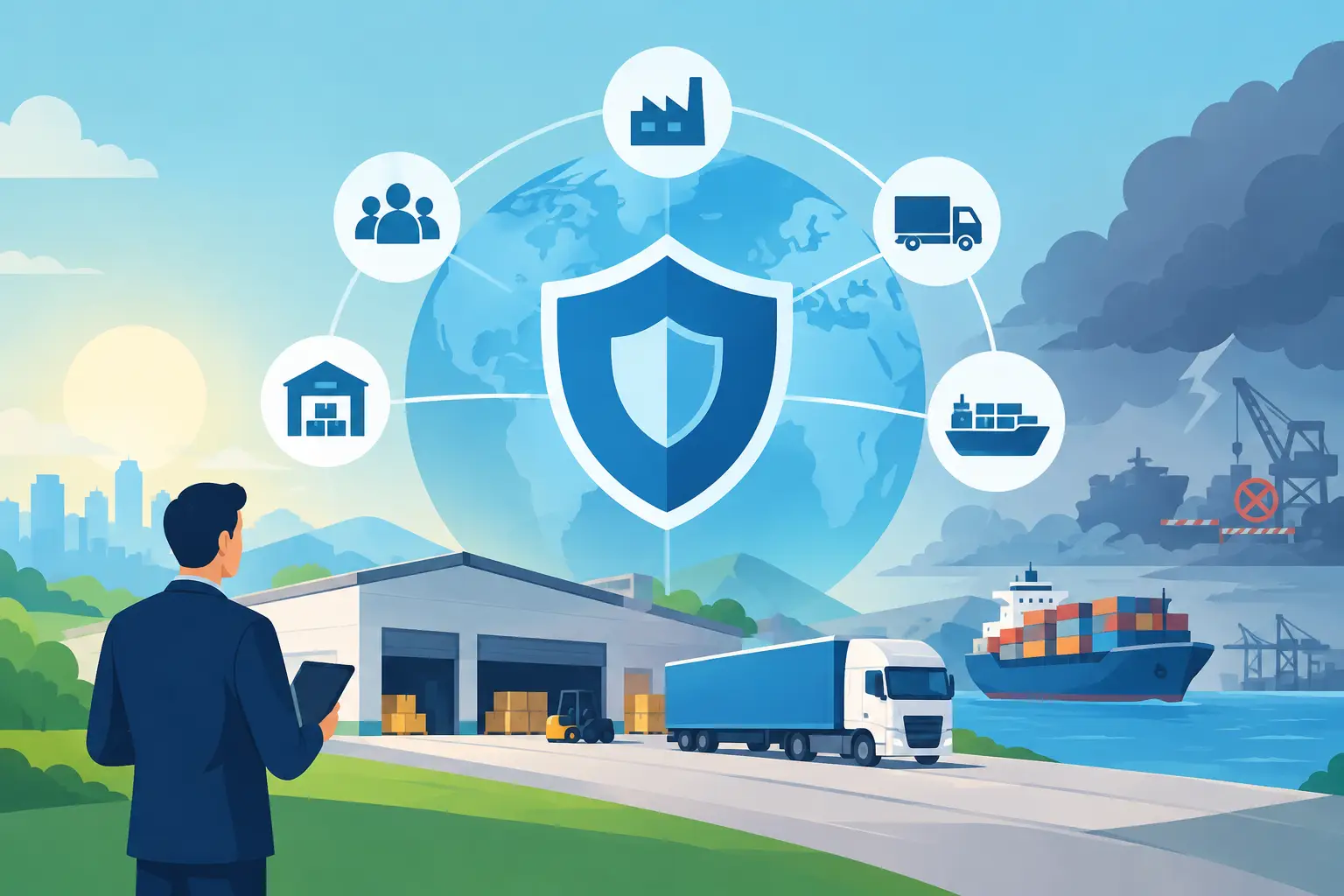
A container delayed in a distant port can stop a British production line within days. A missing electronic component can hold up a finished vehicle worth many thousands of pounds. A change in customs procedure, a strike, a blocked waterway or a political dispute can turn a routine order into an expensive argument. Supply chain resilience is the ability to continue trading through such interruptions without pretending they will never occur.
The phrase is often used loosely. It can suggest warehouses full of spare stock, a fashionable software platform, or a board-level promise that risks are being managed. None is sufficient by itself. Resilience is built through knowledge: knowledge of suppliers, routes, documents, contracts, transport capacity, product dependencies and the people who can make decisions when the original plan fails.
For firms involved in international trade, this is not a new lesson. The tools have changed, and the scale of global interdependence has grown, but the underlying discipline remains familiar. Goods only move reliably when a chain of specialist tasks is understood and properly joined together.
Supply chain resilience begins with seeing the whole chain
A supply chain is not simply a line between factory and customer. It includes the source of raw materials, component makers, packaging suppliers, freight forwarders, carriers, ports, customs agents, insurers, banks and distributors. It also includes the terms on which each party is paid and the information passed between them.
This matters because a business can have an excellent relationship with its immediate supplier while knowing almost nothing about the firms further back. That arrangement works until a second- or third-tier supplier encounters trouble. The immediate supplier may then be unable to obtain a resin, casting, microchip, carton, chemical or specialist fastening. By the time the problem reaches the buyer, the practical options may be limited.
The first requirement is therefore visibility, though not merely the fashionable kind displayed on a dashboard. A purchasing manager should know which components are genuinely critical, where they are made, how long replacement would take and whether an alternative specification can be used. In many businesses, this information is scattered among purchasing records, engineering files, old correspondence and the experience of one long-serving employee. That is a vulnerability in its own right.
Before digitisation, exporters maintained this understanding through files, shipping schedules, letters, telephone calls and personal visits. The paperwork was slower, but it forced people to consider the route, the terms of delivery, the insurance and the documents required at the border. Modern systems can process great quantities of data, yet they do not remove the need for judgement. A computer may report that a shipment is late. It cannot necessarily decide whether a substitute material is acceptable to an engineer, a customer and an insurer.
Efficiency has a price
For several decades, business thinking placed great value on lean inventories and just-in-time delivery. There were sound reasons for this. Stock ties up capital, requires storage and can become obsolete. Shorter supply lines and reliable replenishment can make a firm more competitive.
The weakness appears when efficiency is treated as an absolute rather than a commercial choice. A company that holds only a few days of supply may save money in ordinary conditions, but it is making an assumption about the reliability of transport, suppliers and borders. That assumption may prove reasonable for common items. It is far less reasonable for parts with a long production lead time, a single approved source or difficult regulatory approval.
There is no universal rule that every business should carry more stock or bring all production home. Both measures can be costly, and domestic suppliers are not immune to labour shortages, energy prices, industrial action or their own overseas dependencies. The sensible question is narrower: which failures would stop our ability to serve customers, and what is the least wasteful way to reduce that exposure?
The practical elements of supply chain resilience
Resilience is often strongest where it is unglamorous. It lies in accurate product records, tested contacts and agreements that have been read before something goes wrong. It also depends on a willingness to spend money in advance where the alternative is a much larger loss later.
A serious review should examine at least four areas.
- Supplier concentration: A sole supplier may be justified by quality, intellectual property or volume, but the dependency should be explicit. A second approved source, even one receiving modest orders, can be valuable insurance.
- Transport and route exposure: An alternative carrier is of little use if it uses the same port, the same congested road corridor or the same overseas hub. Route options should be assessed by their actual points of failure.
- Inventory and lead times: Buffer stock should be based on replenishment reality, not an arbitrary target. A low-value component that stops a high-value assembly deserves special attention.
- Documentation and contractual terms: Commodity codes, origin evidence, licences, Incoterms, insurance responsibilities and payment conditions can all delay goods or create disputes when arrangements are under pressure.
These are not separate clerical matters. They affect one another. A decision to source from a lower-cost country may require longer shipping time, greater stockholding, more complex customs work and a different exposure to currency or political risk. The purchase price alone does not tell the full commercial story.
People remain the decisive factor
The most capable supply-chain systems can still fail if no one has authority to act. During disruption, firms need clear escalation routes. Someone must be able to approve expedited freight, release contingency stock, speak directly to customers, authorise an alternative supplier or accept a temporary change to packaging.
This is where experience is difficult to replace. A banker may understand payment risk but not the practical consequences of a missing bill of lading. A lawyer may interpret a contract accurately but not know whether a pallet can be repacked in time to meet an aircraft cut-off. A shipping specialist may know the port but not the technical limits of a substitute component. International trade works because these disciplines meet. It falters when each assumes another department has dealt with the problem.
Companies should therefore test their arrangements in a realistic way. Ask what would happen if a key supplier stopped production for a month, if a principal port became unavailable, or if customs systems failed on a busy day. The purpose is not to create dramatic scenarios for a presentation. It is to expose unanswered questions while there is time to answer them.
Resilience is also a question of trust
When capacity is scarce, suppliers tend to look after customers they know, understand and regard as dependable. A purchaser who has driven every concession to the limit, changed orders without warning and treated suppliers as interchangeable may discover that contractual rights offer little practical comfort in a shortage.
Long-term relationships do not remove commercial discipline, but they create channels of communication. A supplier may warn a trusted customer early, reserve material, suggest a technical alternative or help sequence deliveries. Such co-operation is difficult to obtain from a spreadsheet alone.
The same applies to customers. If an exporter can explain a delay honestly, set out the choices and give credible revised dates, many customers will work with them. If information arrives late or is plainly evasive, confidence disappears quickly. In difficult periods, communication is not public relations. It is part of operational control.
Britain’s particular exposure
The United Kingdom is a trading island with deep experience of importing, exporting and maritime commerce. It is also heavily dependent on international flows of food, fuel, components and finished goods. That makes competent logistics, customs knowledge and port capacity matters of national economic importance, not simply private business concerns.
Recent years have shown how quickly established assumptions can be disturbed. Pandemic closures, container shortages, conflict, sanctions, energy shocks and changing border rules have all had consequences far from their point of origin. The lesson is not that global trade has failed. Global trade remains essential and often beneficial. The lesson is that distance and complexity must be understood rather than wished away.
For smaller exporters, the answer is rarely an expensive corporate risk department. It may be a disciplined review of their ten most important inputs, a proper conversation with freight partners, up-to-date records of customs responsibilities and a modest reserve of the items that would halt production. The scale differs, but the principle does not.
Supply chain resilience is built before the crisis, in ordinary decisions that can seem tedious at the time. Know what you depend upon, keep practical alternatives alive, and ensure that the people responsible have the facts and authority to act. When disruption comes, that preparation is worth far more than a reassuring slogan.