
A letter of credit can make an overseas sale bankable, but only when its terms match the way the goods are actually bought, supplied and shipped. “Transferable and divisible L/Cs explained” is therefore not merely a banking question. It concerns the practical relationship between buyer, exporter, supplier and bank – and the point at which an intermediary may be paid without exposing either party to an unnecessary risk.
The terminology is often used loosely. A transferable credit has a precise meaning under the rules normally governing documentary credits. A divisible credit, by contrast, is not generally a formal category in the same sense. People may mean that the credit can be split between suppliers, that partial shipments are permitted, or that the proceeds may be shared. Those are different arrangements, with different consequences.
Back in the 1970s, I built a business using transferable and divisible letters of credit to assemble package deals for major contractors throughout the Middle East. These included projects such as Doha General Hospital, Salmaniya Medical Centre, the Kuwait Water Towers and the Aqaba Holiday Inn, along with numerous others across the region. The contractor placed a single order with my company, and I brought together products from numerous manufacturers, arranging for them to be shipped as one consignment. Without these two ingenious banking arrangements, I simply would not have had the financial resources to undertake such contracts. They enabled a small export merchant with limited capital to compete for substantial international business that would otherwise have been beyond his reach.
Why the distinction matters
Letters of credit developed because distance, unfamiliarity and differing legal systems made open-account trade hazardous. The bank’s undertaking gave the seller confidence that payment would be made against conforming documents, rather than depending solely on a distant buyer’s willingness or ability to pay.
Yet international trade is rarely a simple transaction between manufacturer and end customer. An exporter may be acting as a merchant, buying from several makers. A trading company may have won an order but need its supplier to manufacture the goods. An agent may be entitled to a commission from the proceeds. Each situation raises the question: can the benefit of the credit be passed on?
The answer depends upon the wording of the credit, the applicable banking rules and the commercial structure behind the contract. Assumptions are expensive in documentary business. Banks deal in documents, not in the fairness of an arrangement or the quality of the goods.
Transferable and divisible L/Cs explained in plain terms
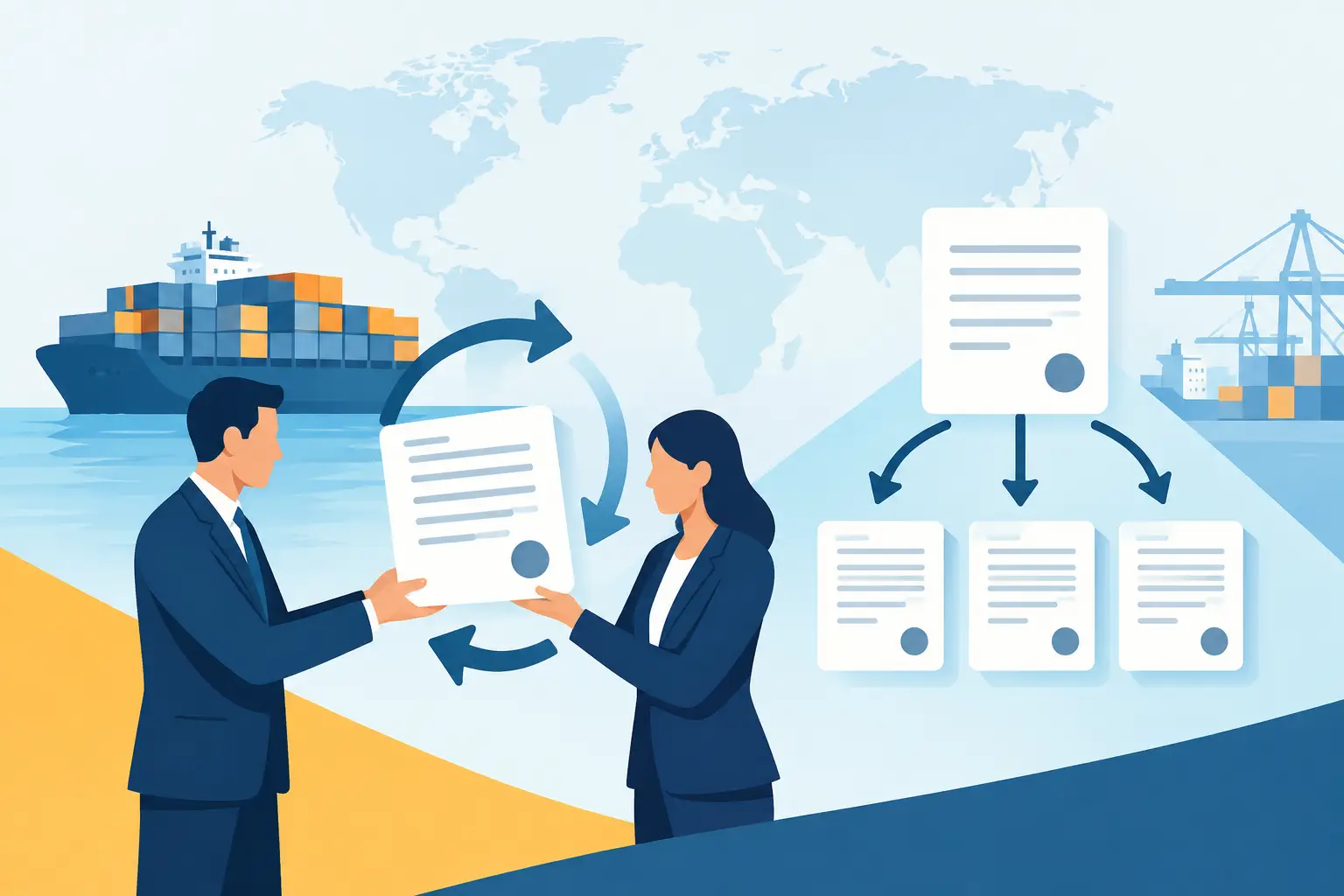
A transferable letter of credit is one which expressly states that it is transferable. It allows the first beneficiary – usually the trader or intermediary named in the credit – to ask the transferring bank to make all or part of the credit available to one or more second beneficiaries.
The first beneficiary does not simply hand the credit to a supplier. The transfer is administered through a bank. The original credit must clearly be marked transferable, and the bank handling the transfer is normally entitled to charge for the service and require clear instructions.
A transferable credit is particularly useful where a trader has sold goods that will be supplied by another business. The trader may arrange for the second beneficiary to receive a transferred credit for the relevant quantity and value. Provided the documentation complies, the supplier can obtain payment without having to rely purely on the trader’s promise.
There is, however, a limit that is sometimes overlooked. A transferred credit may be transferred only once. It cannot ordinarily be passed from the second beneficiary to a third. If several suppliers are involved, the first beneficiary may request transfers to more than one second beneficiary, provided the original credit permits partial shipments or partial drawings where necessary.
The first beneficiary usually retains an important commercial position. They may substitute their own invoice and, in some cases, their draft for that presented by the second beneficiary. This enables the trader to preserve the identity of the final buyer and the margin earned on the transaction. But it also places a premium on accurate timing and document control. A supplier’s compliant documents are of little use if the intermediary fails to replace documents or invoices within the period allowed.
What people usually mean by a divisible credit
The expression “divisible L/C” is commonly used in commercial conversation to describe a credit whose value can be used in portions. That may be possible, but it is the terms of the particular credit that decide the issue.
The most common example is a credit allowing partial shipments. A UK exporter might sell machinery, spare parts and installation equipment that cannot sensibly travel on one vessel or leave one factory at the same time. If partial shipments are allowed, separate compliant presentations may be made for each shipment, up to the total value of the credit.
That is not the same as a transferable credit. Partial shipments allow the named beneficiary to ship and draw in stages. They do not, by themselves, permit the beneficiary to nominate suppliers or transfer rights under the credit to them.
A credit may also be available by instalments. It could specify, for example, a fixed quantity and value to be shipped each month. Such provisions need careful reading. A missed instalment can have severe consequences if the credit states that the remaining instalments are cancelled. Commercially, an instalment schedule may help production planning; legally, it can create a rigid timetable that does not tolerate a late component, a delayed sailing or a documentation error.
The alternatives when transfer is not suitable
Transferable credits are useful, but they are not always acceptable to the buyer or appropriate for the transaction. A buyer may prefer to deal only with the party named as seller and may resist a credit that advertises the involvement of intermediaries. The terms may also be too restrictive for a multi-layer supply chain.
In that case, a trader may consider a back-to-back credit. The trader receives a credit from the overseas buyer and uses it as security for a separate credit issued in favour of the supplier. The two credits are independent. The supplier’s credit is not a transfer of the buyer’s credit.
This can give greater flexibility in the supplier-facing credit, but it brings greater responsibility. The trader must ensure that dates, goods descriptions, transport requirements, insurance provisions and document demands leave sufficient time to receive the supplier’s documents, check them and present conforming documents under the master credit. A small mismatch can leave the trader obliged to pay the supplier while unable to obtain payment from the overseas buyer.
Another possibility is assignment of proceeds. This means that the beneficiary directs that money due under the credit should be paid, wholly or partly, to another party. It does not make that other party a beneficiary and does not give it the right to present documents or perform under the credit. Assignment of proceeds can be useful for financing or commission arrangements, but it is not a substitute for transfer where the supplier needs direct drawing rights.
The document problem is often the real problem
The attraction of a letter of credit is certainty, but certainty is conditional. The bank examines the documents against the credit. It does not investigate whether the shipment was late for good reason, whether the goods were suitable, or whether a minor discrepancy ought to be forgiven.
For transferable arrangements, the original credit should be examined before any supply commitment is made. Particular attention should be given to the latest shipment date, expiry place, presentation period, whether partial shipments and transhipment are allowed, required transport documents, insurance requirements, inspection certificates and the exact description of goods.
The difference between “approximately”, “not exceeding” and a precise quantity may matter. So may a request for documents issued by a named body in a country where the supplier cannot realistically obtain them. The experienced exporter asks not whether the credit looks broadly satisfactory, but whether every document can be produced exactly as required within the available time.
A practical example
Suppose a merchant receives a credit for £200,000 to supply manufactured components to a customer overseas. Two British suppliers will make separate batches. If the credit is expressly transferable and permits partial shipments, the merchant may arrange transferred portions of £120,000 and £80,000 for the respective suppliers.
Each supplier presents documents for its own shipment. The merchant may then substitute its invoice, reflecting the final selling price, before documents proceed under the original credit. This preserves the merchant’s role, but only if the documents are controlled carefully and the credit leaves enough time for substitution.
If the credit merely permits partial shipments but is not transferable, neither supplier acquires the right to draw under it. The merchant must instead fund the suppliers, negotiate other payment terms, or consider a properly structured back-to-back arrangement. Calling the credit “divisible” does not change that position.
Questions worth settling before agreement
Before accepting an L/C, the exporter should establish whether they are the actual supplier or an intermediary, whether more than one supplier must be paid from the transaction, and whether each shipment can be documented independently. They should also decide who bears bank charges, currency risk and the cost of discrepancies.
The buyer’s sales contract and the credit must tell the same story. A carefully negotiated contract is of limited value if the credit requires impossible documents; equally, a workable credit cannot cure a vague contract or unreliable supply chain. Where values are significant, early discussion with an experienced trade banker and a documentary credit specialist is prudent.
The useful discipline is to describe the commercial flow before discussing banking language: who sells, who manufactures, who ships, who needs payment, and when. Once those facts are clear, it becomes much easier to see whether transfer, partial shipment, assignment of proceeds or a separate credit is the honest and workable solution.