
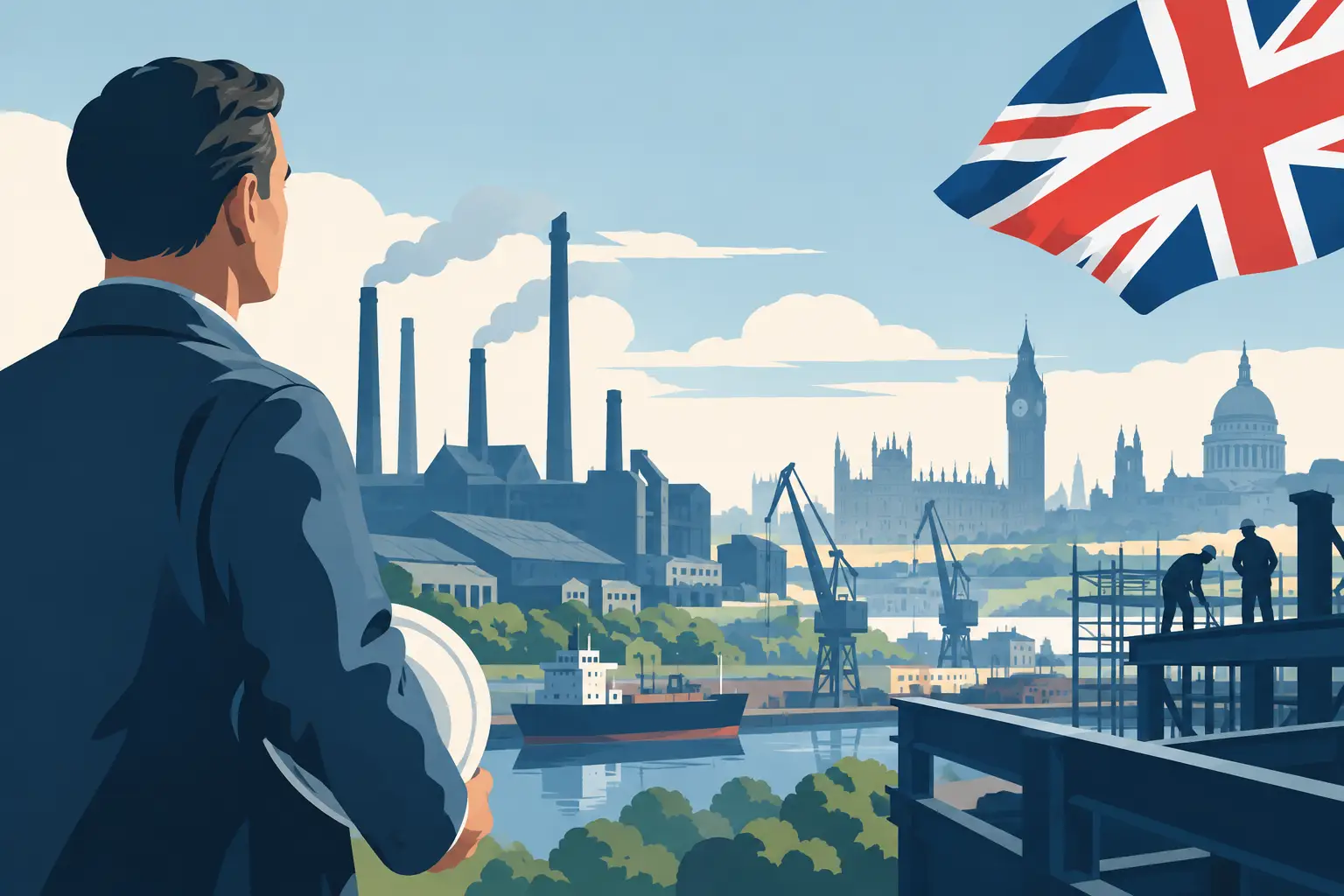
Britain emerged from the Second World War victorious but economically exhausted. Any useful guide to postwar British industry must begin with that uncomfortable fact. The country retained great engineering capacity, skilled labour and established overseas commercial connections, yet it also carried worn-out plant, heavy debts, rationing and an urgent need to earn foreign currency. The subsequent story is not simply one of industrial decline. It is a record of recovery, innovation, missed opportunities and difficult choices made under pressures that are easily forgotten.
The starting point: reconstruction, not prosperity
In 1945, Britain’s factories had been working intensely for war. Aircraft, ships, vehicles, armaments, chemicals and precision engineering had expanded or been redirected to military production. Much of that capacity was impressive, but peacetime conversion was not automatic. Machinery had been run hard, investment had been postponed, housing was scarce and many experienced people had spent years in the Armed Forces.
The immediate national priority was exports. Britain needed dollars to buy food, fuel, raw materials and equipment. That made manufacturing central to economic policy in a way that can seem unfamiliar now. A firm making machine tools, electrical goods, textiles, locomotives or commercial vehicles was not merely serving a domestic market. Its sales abroad affected the country’s ability to pay its way.
There was also a political judgement that certain industries were too significant to be left entirely to fragmented private ownership. Coal, railways, gas, electricity and steel became subjects of nationalisation, although the precise boundaries changed with governments. The case was practical as well as ideological. These were basic industries on which every other business depended, often requiring investment over decades rather than quarters.
A mixed economy with real constraints
Postwar Britain was neither a centrally planned economy nor a free-market one in the modern sense. Private firms remained dominant across much manufacturing, commerce and exporting, while public corporations controlled important infrastructure and raw materials. Exchange controls, import restrictions and planning arrangements reflected a world of scarce foreign currency.
This arrangement had strengths. It gave the state a means of directing investment in industries where failure would damage the whole economy. It also had weaknesses: public ownership could insulate poor management, while private companies could be too small, too family-controlled or too cautious to invest at the necessary scale. Neither ownership model offers a simple explanation for what followed.
A guide to postwar British industry: the sectors that mattered
Manufacturing was broader than the familiar images of coal pits, shipyards and smoky steelworks. Britain remained a serious producer of capital goods, chemicals, pharmaceuticals, electrical equipment, cars, aircraft and specialised engineering products. Much was exported to Commonwealth markets and to countries where British standards, language and commercial networks provided an advantage.
Engineering firms often succeeded because they knew a particular process intimately. A maker of pumps, valves, textile machinery, laboratory equipment or food-processing machinery might sell into dozens of countries through agents and distributors built up over years. This was international trade before email, online catalogues and instant tracking. Orders travelled by post, cables were expensive, and the competence of an overseas representative could determine whether a distant market was retained or lost.
The strength of these businesses lay in technical knowledge and relationships. Their vulnerability lay in scale and adaptation. Overseas competitors, notably from Germany, the United States and later Japan, invested heavily in product development, production methods and market support. British firms could rely too readily on a respected name or a longstanding customer. In export markets, reputation must be renewed with delivery performance, spare parts, service and an understanding of local requirements.
Motor manufacturing illustrates the larger problem. Britain possessed famous marques, capable designers and substantial demand at home and abroad. Yet the industry suffered from divided ownership, inconsistent quality, weak labour relations and insufficient investment in modern production. Japanese manufacturers later demonstrated what integrated design, quality control, supplier discipline and patient export development could achieve. The lesson is not that British workers were uniquely deficient. It is that industrial performance depends on the system around them.
The productivity question
The most persistent postwar criticism of British industry concerned productivity. This is sometimes reduced to a moral tale about poor management or restrictive trade unions. Both could be factors, but the real picture was more complicated.
Productivity is affected by the age and layout of machinery, access to capital, design quality, workforce training, energy costs, management competence, supply chains and the size of a production run. A factory producing short batches of highly varied equipment cannot match the output per employee of a plant making large numbers of standardised products. Nor should it be judged by precisely the same measure.
Britain did have structural difficulties. Too many companies were small for their markets. Investment decisions were often delayed. Management and shop-floor representatives could become trapped in adversarial bargaining, with demarcation disputes making change harder than it needed to be. Some boardrooms remained socially narrow and technically detached. A preference for finance, property or overseas investment could appear safer than committing large sums to new machinery at home.
Yet there were important successes. The chemical and pharmaceutical industries, aerospace, telecommunications research, specialist machinery and parts of electronics showed considerable ingenuity. Rolls-Royce engineering, despite its well-known crises, represented technical accomplishment of the highest order. Britain’s problem was less an absence of talent than an inability to convert talent consistently into commercially durable, scalable businesses.
From the 1970s to a different industrial settlement
By the 1970s, the earlier postwar system was under severe strain. Inflation, oil shocks, strikes, changing world trade and intensifying competition exposed longstanding weaknesses. Governments attempted various remedies: industrial intervention, price and income policies, rescue packages, mergers and state support. Some were necessary in the short term; some prolonged the life of businesses that had no viable long-term future.
The industrial restructuring of the 1980s was therefore not imposed on a healthy, settled economy. It responded to genuine problems. But the manner and speed of change carried costs that were underestimated. Mines, steelworks, shipyards and factories were more than workplaces. They supported local shops, apprenticeships, transport links, clubs and family incomes. Once a concentration of skilled work disappeared, replacing it was rarely a matter of opening a training scheme or offering a tax concession.
Privatisation, deregulation and the weakening of collective bargaining altered the balance of power decisively. Some industries became more efficient and more responsive to customers. Others lost domestic capability, strategic control or the capacity to train future generations. It depends on the sector. A competitive consumer market is not the same as a defence supply chain, a railway network or an electricity system.
The expansion of financial and service industries brought wealth, particularly to London and the South East, but it did not answer every regional or national economic need. An economy that designs, makes, maintains and exports complex goods has a different resilience from one that primarily consumes imported products and sells services where it can. Britain has never ceased manufacturing, but manufacturing’s share of employment and public attention has diminished markedly.
What the postwar record still teaches
The central lesson is that industry cannot be considered separately from trade, education, infrastructure and finance. A manufacturer may have an excellent product, but it will struggle without export credit, reliable shipping, knowledgeable distributors, technical service and people able to negotiate contracts across cultures. International business is a chain of disciplines. Failure at one point can waste expertise at every other point.
A second lesson is that long-term industrial capability is slow to build and quick to disperse. Apprenticeships, toolrooms, supplier networks and engineering judgement cannot simply be purchased when a crisis arrives. Governments should be cautious about trying to preserve every existing job, but equally cautious about treating the closure of productive capacity as a private matter with no public consequence.
Finally, postwar British industry should be judged with precision rather than nostalgia. The era contained poor products, complacent management and damaging disputes. It also contained remarkable technical skill, export determination and enterprises that served demanding customers around the world. Understanding both sides provides a firmer basis for discussing electric vehicles, energy security, advanced manufacturing and Britain’s place in modern trade.
The worthwhile question is not whether Britain can recreate the industrial world of 1950 or 1970. It cannot, and should not try. The more useful question is whether the country is prepared to value practical knowledge, patient investment and the unglamorous work required to make, sell and support things well.