
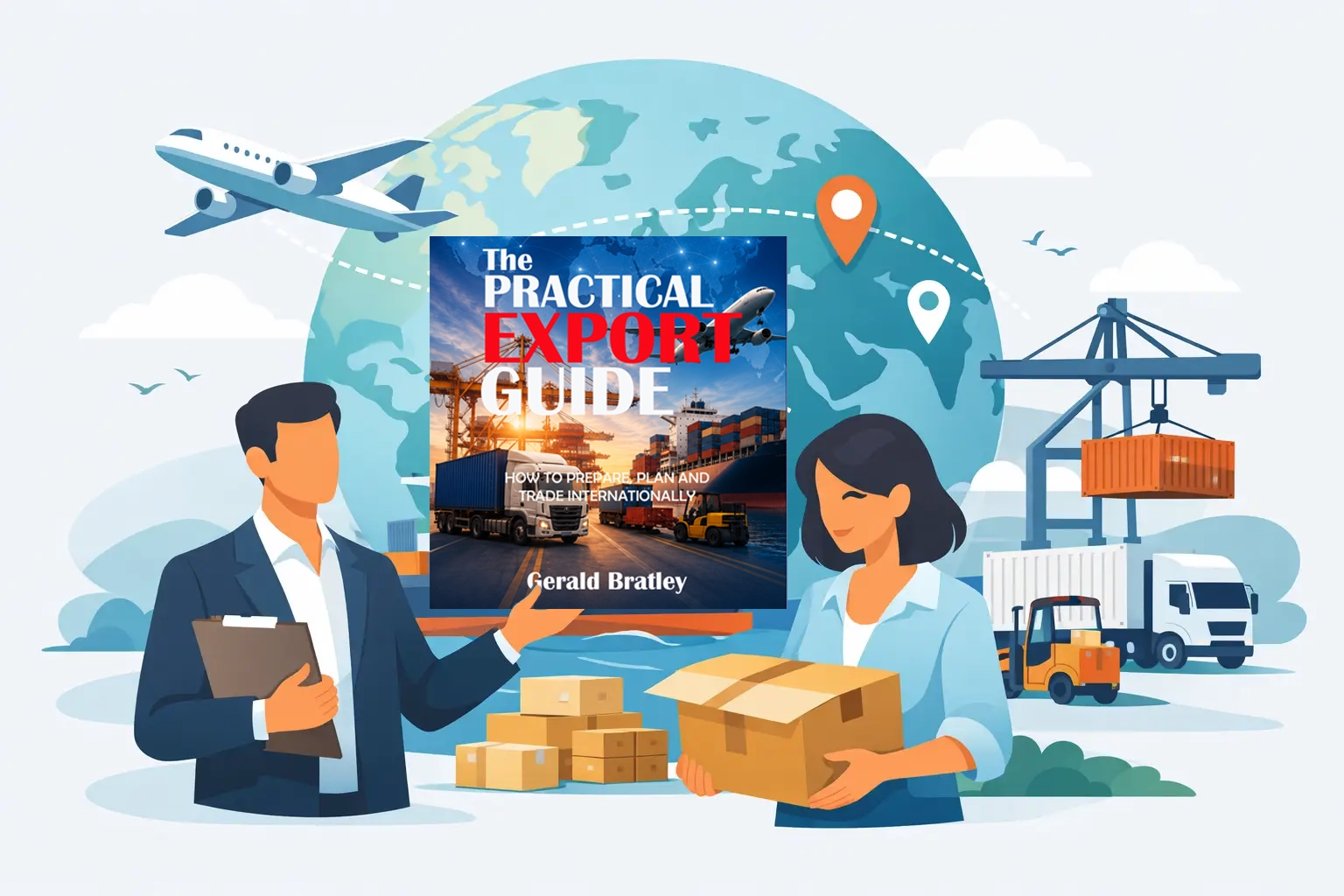
An export order can look deceptively simple: agree a price, make the goods, send them abroad and wait to be paid. The practical export guide begins where that comforting picture ends. A consignment is not merely a product moving from a British factory or warehouse to an overseas customer. It is a chain of obligations involving seller, buyer, carrier, insurer, bank, freight forwarder and customs authority. If one link is wrong, the effects are seldom confined to one sheet of paper.
The most expensive export errors are often not dramatic. A document is issued late, an Incoterm is used without understanding its consequences, a letter of credit is accepted with impossible conditions, or goods arrive at a port without the information needed for clearance. Each may appear administrative. In practice, each can delay delivery, undermine a customer relationship or leave the exporter unpaid.
This is why exporting cannot sensibly be reduced to salesmanship, customs compliance or freight alone. Those disciplines meet at the point where a firm has made a binding promise to deliver goods, on stated terms, to a customer in another jurisdiction. The work is to ensure that the promise can be performed.
What The Practical Export Guide is really about
International trade is governed by commercial contracts, national laws, international conventions, customs rules, banking practice and the physical limitations of transport. Books commonly deal well with one of these subjects in isolation. A customs manual may explain declarations; a banking text may explain documentary credits; a logistics handbook may describe the movement of containers. Yet an exporter works across all of them at once.
The practical question is not simply, “What form is required?” It is, “What must happen first, who needs this information next, and what will the error cost if it is discovered at the wrong stage?” That is the distinction between knowing a rule and managing an export transaction.
Over nearly six decades of work in industry and overseas markets, I have seen that timing is often the hidden discipline. A commercial invoice cannot accurately be prepared until the contract, goods, price, currency and delivery terms are settled. A transport document depends on what is actually shipped and how it travels. A bank will examine documents against the instructions it has received, not against the exporter’s good intentions. Customs authorities need correct classification, value, origin and movement data when they require them, rather than after the lorry has reached the frontier.
Digitisation has changed the speed at which information moves, but it has not removed this underlying sequence. Indeed, rapid electronic systems can make a poorly understood process fail more quickly.
Start with the contract, not the paperwork
The export process is often weakened at its beginning. A salesman is pleased to obtain an order and assumes that operations, finance or a freight forwarder will deal with the detail. But the detail should have shaped the offer before the order was accepted.
A sound contract identifies the goods precisely, quantity, quality standard, price, currency, delivery term, delivery point, delivery date, payment method, insurance responsibility, inspection provisions and the law or dispute procedure that will apply. Not every transaction needs a lengthy bespoke agreement. A regular sale of standard goods to a trusted distributor may be straightforward. But even straightforward trade needs clarity, particularly when a disagreement arises.
Incoterms are not a substitute for thought
Incoterms are useful because they allocate defined responsibilities between buyer and seller. They do not determine ownership of the goods, provide a complete contract, or automatically solve questions of insurance and payment. They must be stated with the named place or port and the appropriate version. “FOB UK” is not a satisfactory instruction. Nor is using a term designed for sea freight when the goods will travel by air or road.
The correct term depends on the transaction. A new exporter may be tempted to quote delivered terms to appear helpful. That can mean accepting unfamiliar costs, local clearance complications and exposure in a country where the buyer is better placed to act. Conversely, selling too early in the journey may reduce control over the transport and the evidence needed to support a payment claim. There is no universally safest Incoterm. There is only the term that matches the goods, route, customer, bargaining position and capability of the parties.
Documents tell the same commercial story
Every document in an export transaction should describe the same reality. The order, invoice, packing list, transport record, certificate of origin, insurance certificate and any customs declaration must not contradict one another on essentials such as description, quantities, marks, dates, consignee and shipment details.
This is not pedantry. Documentary trade has developed because parties separated by distance need reliable evidence. A buyer may need a document to obtain import clearance. A bank may need it before making payment. An insurer may need it if a claim follows. A customs authority may use it to assess duty, VAT or regulatory compliance.
The exporter should therefore establish one reliable source of commercial data and use it consistently. Product descriptions deserve particular care. They should be accurate enough for customs and the buyer, but should not casually introduce variations from the contract. A vague description can cause delay; an embellished one can create a discrepancy.
Classification, valuation and origin require the same discipline. They affect customs treatment and may affect whether a preferential tariff can be claimed. Origin is especially prone to misunderstanding. It is not necessarily the country from which goods are dispatched, nor the nationality of the company selling them. The relevant rules depend on the goods and the agreement being relied upon. Assumptions made to save a few minutes can produce an unwelcome bill or a challenge from an authority months later.
Payment risk must be considered before shipment
A profitable order is of little value if the money does not arrive. Payment terms should reflect the creditworthiness of the buyer, country risk, value of the order, nature of the goods and the exporter’s ability to bear a loss.
Payment in advance gives the seller strong protection but may be unacceptable to a new customer. Open account terms can be commercially necessary for established trade but require proper credit control and a clear view of collection risk. Documentary collections and documentary credits sit between these positions, each with their own cost, procedure and limitations.
A documentary credit is frequently described as secure. It can be, provided its terms are workable and the documents comply. Banks deal in documents, not in goods. If the credit calls for a certificate that cannot be obtained, a shipment date that cannot be met, or wording inconsistent with the contract, the difficulty begins before the goods leave the premises. The time to challenge unsuitable conditions is when the credit arrives, not when documents are rejected after shipment.
Exporters also need to distinguish currency risk from non-payment risk. A reliable buyer who pays in a volatile currency can still turn an apparently sound sale into a disappointing one. Whether to invoice in sterling, the buyer’s currency or a major trading currency is a commercial decision. For larger or longer-term commitments, it may justify specialist financial advice and appropriate hedging.
Freight is part of customer service
Transport is sometimes treated as the final operational task, handed to a forwarder once the order is packed. A capable forwarder is invaluable, but cannot repair decisions that were wrong at quotation stage. The mode of transport, packing specification, route, transit time, insurance, dangerous-goods requirements and delivery point should be considered before the price is agreed.
The cheapest route is not always the economical one. A delayed low-value consignment may be tolerable. A delayed critical spare part that stops a customer’s production line can do more damage than the freight saving was worth. Similarly, inadequate export packing may survive the journey often enough to encourage complacency, until a claim exposes the lack of a proper standard.
Good exporters treat freight information as part of the service offered to the customer. They know when goods were collected, where responsibility passed, what evidence exists of delivery and whom to contact when the normal plan fails. This does not mean attempting to control every event at a port or border. It means knowing who is responsible and retaining sufficient oversight to act early.
Build a process that survives ordinary human error
Export competence should not depend on one experienced individual remembering every exception. Staff change, customers alter instructions and regulations develop. The answer is a documented process that is clear enough to train a new colleague and disciplined enough to expose a gap before goods are dispatched.
A practical procedure will include checks on customer and country, contractual terms, product controls, origin, classification, payment security, shipment instructions, document review and record retention. It should also identify who has authority to release goods when a problem remains unresolved. Four separate checklists may be useful for sales, finance, despatch and management, provided they are connected rather than competing documents.
The purpose is not bureaucracy for its own sake. It is to make sound habits repeatable. A modest exporter with a well-understood routine can often trade more safely than a larger business in which information is scattered among sales, accounts and logistics systems that do not speak to one another.
The lasting value of practical export knowledge lies in recognising that a transaction is a whole. The contract determines the promise; the goods, transport and documents demonstrate performance; the payment arrangements decide whether performance becomes revenue. Treat each part seriously, and overseas trade becomes less a gamble on distance than a disciplined extension of ordinary business.
Who Should Read This Book?
Whether you are exporting for the first time or have spent years specialising in one area of international trade, understanding the complete process leads to better decisions.
The Practical Export Guide is written for:
• Students studying International Business, International Trade, Supply Chain Management and Logistics. • Export Managers seeking a complete understanding of the export process. • Directors and business owners developing international markets. • Professionals working in documentation, customs, shipping, freight forwarding, banking, insurance, production, logistics, sales and finance who wish to understand how their own role fits into the wider picture. • Export consultants, trainers and advisers looking for practical guidance based on real commercial experience. • Universities, colleges, Chambers of Commerce and commercial training organisations. • Anyone wishing to understand the complete process of international trade.
International trade is only as strong as its weakest link.
1 thought on “The Practical Export Guide for Real-World Trade”
Comments are closed.