
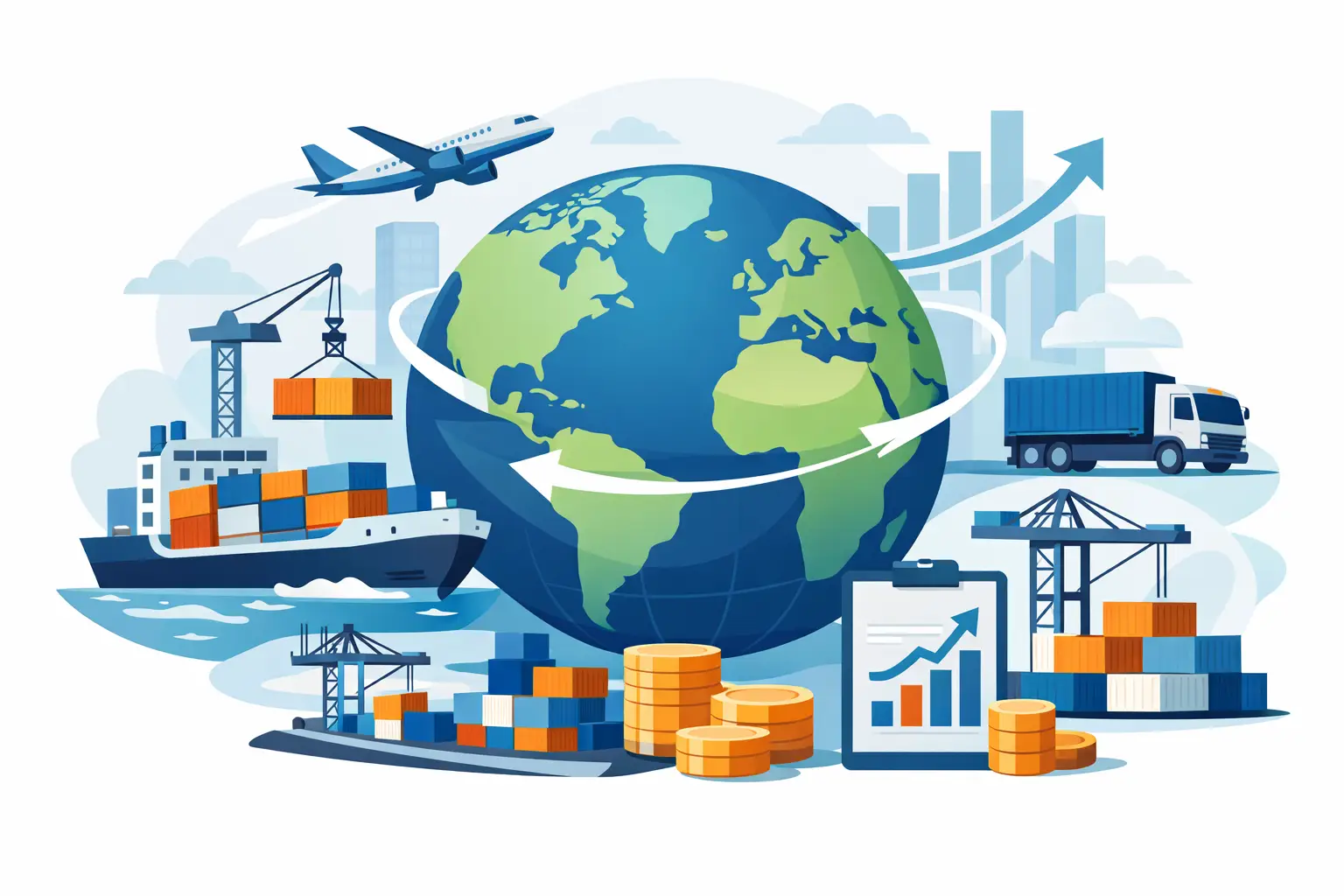
A container arriving late at Felixstowe, a component held up at a border, or a customer asking for prices in a volatile currency can tell us more about trends in global trade than a grand speech about globalisation. Trade remains immense, inventive and indispensable. Yet the assumptions that governed it for much of the late twentieth century – predictable routes, steadily falling barriers and the primacy of lowest cost – have been weakened.
Having begun work in international trade when overseas communication involved telexes, cables and costly telephone calls, I am wary of claims that trade has suddenly become either simple or impossible. The tools have changed beyond recognition. The central disciplines have not: knowing the customer, understanding the market, getting the documentation right, protecting cash flow and maintaining patience when events take an unwelcome turn.
Trends in Global Trade Are Less About Volume Than Risk
World trade has not retreated into isolation. Goods, services, capital, data and expertise still cross borders at a scale that would once have seemed extraordinary. What has changed is the calculation behind each transaction. Companies and governments now give greater weight to security of supply, strategic dependence and political risk.
For many years, a business could reasonably concentrate production where labour, materials or specialist capability were cheapest. Long supply chains were accepted because transport was relatively inexpensive and reliability was assumed. The pandemic, port congestion, conflict, sanctions and disruption in major shipping lanes exposed the weakness in that calculation. A factory may save money on a component, only to lose far more when that component cannot arrive.
This does not mean that every manufacturer will bring production home. Such a move is often impractical and expensive, particularly where skills and supplier networks have grown over decades elsewhere. More commonly, firms are pursuing a mixed approach: holding more stock of critical items, qualifying a second supplier, locating some production closer to final customers and paying more attention to the resilience of shipping and insurance arrangements.
For British exporters, the lesson is plain. Reliability has become part of the product. A buyer may accept a slightly higher price if delivery dates are credible, spare parts are available and a supplier communicates honestly when trouble arises. The cheapest quotation has never always won business, but it is less decisive than it once was.
Regional Blocs Matter, but Markets Remain Individual
One of the more persistent trends is regionalisation. North American, European and Asian supply networks have deepened as businesses seek shorter routes and clearer regulatory frameworks. Trade agreements can make this easier, but an agreement on paper does not create a market by itself.
Rules of origin are a good example. Preferential tariffs may be available, yet the exporter must establish that goods qualify, retain evidence and make the appropriate declarations. These requirements are manageable for a prepared business. They can be a costly surprise for one that has treated export administration as an afterthought.
There is also a tendency in political discussion to describe large regions as though each were a single commercial entity. Europe is not one market in practical terms, however useful common rules may be. Nor are ASEAN, the Gulf or Latin America. Language, purchasing habits, distribution structures, payment culture and local competition can differ sharply between neighbouring countries.
The experienced exporter starts with a country and a customer, not a coloured block on a map. A distributor who knows a technical sector, carries stock and employs competent service engineers may be more valuable than an impressive-looking network spread too thinly across several territories. Trade is built through institutions, but it is completed by people who trust one another.
The return of government to trade
Governments have always influenced trade through tariffs, export credit, standards and diplomacy. The difference now is that trade policy is more openly connected to national security and industrial policy. Semiconductors, energy equipment, communications technology, pharmaceuticals, batteries and critical minerals are treated differently from ordinary consumer goods because states regard access to them as strategically important.
This can create opportunity. Where governments support investment in clean energy, transport infrastructure or domestic manufacturing capacity, demand follows. It can also create uncertainty. Subsidies abroad may distort competition, while export controls and sanctions can change an established market overnight.
Businesses should therefore take politics seriously without allowing newspaper headlines to replace judgement. A country may be politically difficult but commercially worthwhile in selected sectors. Another may appear stable but pose serious problems of delayed payment, weak legal enforcement or an unreliable local partner. Good market research includes the political setting, but it must go beyond it.
Digital Trade Has Speeded Up the Front End, Not Removed the Hard Work
Digital systems have transformed the daily mechanics of exporting. Quotations can be sent immediately, online meetings arranged across time zones, shipping tracked in real time and customs information transmitted electronically. Smaller firms can now identify overseas enquiries and present themselves to customers without maintaining costly offices abroad.
That is genuine progress. It has reduced distance and made international contact more accessible. It has not abolished the need for personal knowledge. A video call cannot tell an exporter whether a prospective agent is financially sound, respected by customers or capable of supporting a complex installation once the sale is made.
The same applies to online marketplaces and data-led marketing. They may be effective for standardised products, replacement parts and consumer goods. They are less likely to replace a long technical discussion where a buyer needs confidence in specification, installation, training and after-sales service. The more expensive or consequential the purchase, the more human confidence still matters.
Digitalisation has also made fraud easier to attempt. False bank details, impersonated suppliers and convincing but fictitious shipping documents demand proper controls. Confirmation of payment instructions through an established contact, clear authority levels and careful scrutiny of unexpected changes are no longer administrative niceties. They are basic safeguards.
Services, Knowledge and Standards Are Taking a Larger Share
Public attention often focuses on containers, ports and tariffs. Modern trade increasingly includes services that are less visible: engineering design, software, education, finance, maintenance, consultancy, licensing and remote technical support. Britain has significant strengths in many of these areas, though success should not be assumed simply because the service is delivered digitally.
A service export still has to meet local regulation, tax requirements and professional expectations. It may involve data rules, licensing restrictions or the need for staff to travel. In some markets, a local presence remains essential. The idea that services move freely because they cannot be loaded on to a ship is attractive but misleading.
Standards are becoming more important alongside tariffs. Environmental reporting, product safety, data protection, traceability and labour conditions increasingly shape purchasing decisions and market access. For some firms this will feel like an added burden, particularly where customers demand evidence that was not previously requested. For others, it is a chance to distinguish themselves through sound engineering, transparent sourcing and dependable quality control.
The important point is to treat compliance as a commercial matter, not merely a legal one. If a buyer cannot use a product because the supporting evidence is missing, the product is not export-ready, however good its design may be.
Price, Currency and Payment Remain Unforgiving
There is a fashionable belief that technology has made trade frictionless. Anyone who has watched a profitable order deteriorate because of currency movement, unexpected freight costs or a customer extending payment terms knows otherwise. International trade still rewards businesses that understand their numbers.
Export prices should account for more than the factory gate figure. Incoterms, insurance, packing, inland transport, customs costs, agent commission, warranty exposure and the cost of finance all deserve attention. The correct arrangement depends on the product, the destination and the strength of the relationship. Offering delivered prices may help a new buyer, but it also places more responsibility on the seller. Selling ex works may appear safer, yet can leave the customer facing a process they do not understand.
Payment terms deserve equal care. An established customer with a long record may reasonably be offered credit. A new customer in a market with uncertain enforcement may require advance payment, documentary security or insurance. There is no universal answer. Prudence is not distrust; it is the habit that allows an exporter to continue trading after an occasional disappointment.
A More Demanding Form of Internationalism
The future of trade is unlikely to be a return either to carefree globalisation or to national self-sufficiency. Most countries need imports, export markets, foreign investment and access to specialist knowledge. At the same time, voters and governments are asking harder questions about dependence, employment, energy and strategic control.
That makes international trade more demanding, but not less worthwhile. The businesses best placed to prosper will be those that combine digital speed with old-fashioned preparation, diversify where it is sensible, and avoid confusing a distant enquiry with a durable market. The exporter who learns the detail, visits when it matters and keeps promises still possesses an advantage that no algorithm can provide.
1 thought on “Trends in Global Trade and What Has Changed”
Comments are closed.