
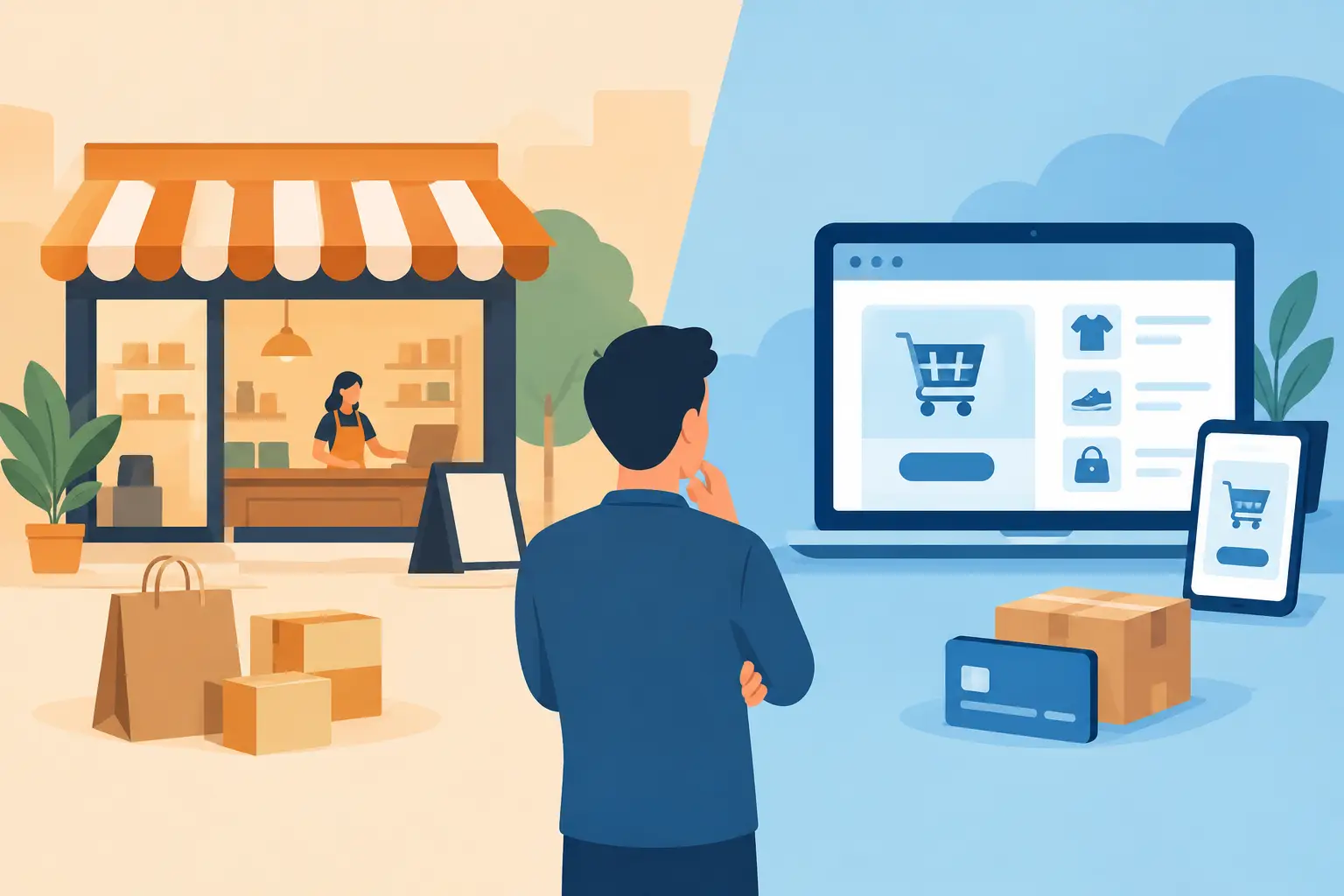
A delayed shipment once produced a recognisable trail: a stamped document, a freight forwarder’s telephone number, a bank officer who knew the customer, and perhaps a telex message that had to be read carefully. In the debate over analogue trade versus digital commerce, that physical trail is often dismissed as slow and obsolete. It was slow. Yet it also made responsibility visible, and that remains one of the central tests of any trading system.
Digital commerce has changed the speed, reach and cost of selling across borders. A small British manufacturer can identify an overseas prospect, quote in another currency, arrange transport and receive payment with tools that would once have been available only to a substantial exporter. That is a considerable achievement. But the movement of goods between countries has not become merely a matter of clicking a button. Goods still need to meet specifications, be packed properly, insured, declared, financed and delivered to someone who is willing and able to take them.
The useful question, therefore, is not whether analogue methods should defeat digital ones. It is where each provides the discipline, evidence and judgement that trade requires.
Analogue Trade Versus Digital Commerce: What Changed?
Traditional trade was built around documents and people with defined roles. The exporter prepared an invoice, packing list and, where required, certificates of origin or inspection. The carrier issued a transport document. A bank might examine documents under a letter of credit. Each party dealt with a limited part of a larger transaction, and errors could be expensive.
This arrangement was cumbersome, but it encouraged care. A discrepancy between a credit and an invoice could stop payment. An inaccurate description of goods could hold up a consignment at the port. An experienced shipping clerk knew that a missing mark, an unsuitable carton or an incautious declaration could undo months of sales effort. International trade has always depended on such unglamorous competence.
Digital systems have compressed many of these stages. Customer relationship software records conversations. Online marketplaces display products globally. Freight platforms offer quotations in minutes, while customs declarations and payment instructions are transmitted electronically. Information can be copied, searched and shared without retyping it several times.
The gain is real, particularly for repeat business with reliable partners. A well-designed digital process reduces routine administration and gives managers a clearer view of orders, stock and transit. It can also preserve an audit trail more effectively than a filing cabinet full of fading carbon copies.
But digitisation does not remove the underlying obligations. It simply changes the form in which they appear. A poor commodity code entered rapidly remains a poor commodity code. A buyer whose creditworthiness has not been checked remains a risk, however polished the online storefront may be.
The Strength of Human Judgement
The greatest weakness of fashionable accounts of digital commerce is their tendency to treat information as knowledge. A platform may show that a company exists, has a website and has made enquiries. It cannot, by itself, establish whether the buyer has authority to place the order, whether local demand is genuine, or whether the promised payment will arrive.
Those judgements are formed through contact, local knowledge and repeated observation. A distributor may have impressive offices but weak coverage outside one city. A prospective agent may speak excellent English yet represent competing products with greater commitment. A customer may insist on an attractive order quantity while quietly expecting extended credit. None of this is reliably answered by a dashboard.
The older methods of trade had a practical virtue: they required people to speak to one another. Travel, meetings, factory visits and conversations with local advisers could reveal matters that a digital exchange conceals. This does not mean every export sale requires a flight abroad. It means that the more distant, unfamiliar or valuable the transaction, the less sensible it is to rely solely on online signals.
For complex engineering products, after-sales service and technical training remain especially resistant to simplification. The sale is often the beginning of the commercial relationship, not its end. A video call may assist diagnosis, but it cannot always substitute for a competent engineer on site, spare parts held locally, or a distributor who understands the equipment.
Paper Was Never the Point
It would be mistaken to romanticise paper. Lost originals, delayed couriers and illegible copies caused their own difficulties. Nor did a physical document guarantee honesty. Fraud existed long before online marketplaces, and respectable-looking paperwork could be constructed around nonexistent goods.
What mattered was not paper itself but the chain of verification behind it. A bill of lading, a bank’s document-checking function or an independent inspection certificate gave parties a defined basis for action. Digital records can do this equally well, and sometimes better, if the system identifies who entered the information, when it was amended and who has accepted it.
The danger begins when electronic speed is confused with proof. A PDF may look authoritative while being no more dependable than the person who created it. An automated approval can create false comfort if no one has examined the commercial sense of the transaction.
Where Digital Commerce Earns Its Place
Digital tools are at their best when they remove repetition rather than judgement. They are particularly valuable for maintaining product data, preparing standard quotations, tracking consignments, managing routine customs information and keeping customers informed. For a firm handling many modest orders, these efficiencies may determine whether exporting is viable at all.
They also widen access. A specialist producer outside the traditional commercial centres can be found by customers overseas without maintaining an expensive network of representatives in every market. Digital marketing, provided it is directed at a sensible market and supported by prompt human response, can open doors that were once firmly closed.
There is a further advantage in continuity. The experienced export manager who kept essential facts in a personal notebook was valuable but also a single point of failure. Properly managed systems allow product specifications, customer history and shipping requirements to remain available when staff change. That is not a minor administrative improvement. It is part of building an export operation that can survive and grow.
Yet small firms should be wary of buying elaborate software before they understand their own process. Technology cannot decide which country is worth pursuing, what incoterm is appropriate, whether a quotation leaves enough margin, or whether insurance covers the actual risk. A simple, disciplined system used by knowledgeable people is superior to an expensive one that nobody trusts.
The Parts That Still Resist Automation
International commerce is an assembly of specialised disciplines. Marketing, technical sales, packing, freight, insurance, documentation, payment terms, contracts and customs each have their own demands. No single software package, consultant or online course makes a person expert in all of them.
This is why the most successful exporters retain access to specialists. A banker may understand payment mechanisms without knowing how machinery should be secured in a container. A freight forwarder may arrange transport expertly without being responsible for the wording of a distribution agreement. A lawyer may draft a contract but have little reason to judge whether a proposed agent can sell the product. The exporter must coordinate these contributions and know enough to ask the right questions.
Digital commerce can make this coordination easier, but it cannot abolish it. Indeed, rapid online selling may expose a business to more markets before it has developed the capacity to serve them. A website offering worldwide delivery is not an international strategy. It may be an invitation to take orders in countries where tax treatment, product standards, returns, sanctions or service arrangements have not been considered.
A Sensible Hybrid for Exporters
The practical model is neither nostalgic nor technological for its own sake. Use digital systems to make routine work accurate, traceable and fast. Use experienced people for the points at which trust, risk and interpretation matter.
For a new overseas customer, that may mean researching the firm online, then speaking directly to decision-makers and seeking independent references. For a high-value order, it may mean electronic documentation combined with payment security appropriate to the relationship. For a repeat customer, it may mean a largely automated ordering process, while keeping someone responsible for noticing a change in buying pattern or payment behaviour.
There is also a cultural issue. Digital channels encourage immediate replies and apparent certainty. Trade often requires a more measured answer: the delivery date depends on a carrier’s schedule; the price depends on the exchange rate and agreed terms; the product may need adaptation for the market. Saying this plainly is not a weakness. It is the beginning of a credible commercial relationship.
The future of trade will involve more data, more automation and more electronic evidence. It will not eliminate the need for patience, competence and personal accountability. The exporter who treats digital tools as servants of sound judgement, rather than substitutes for it, will be in a stronger position when the transaction becomes difficult – which, sooner or later, it will.